Kathmandu— Every dish passed down through generations and shared across society carries a question: where did it originate, and when?
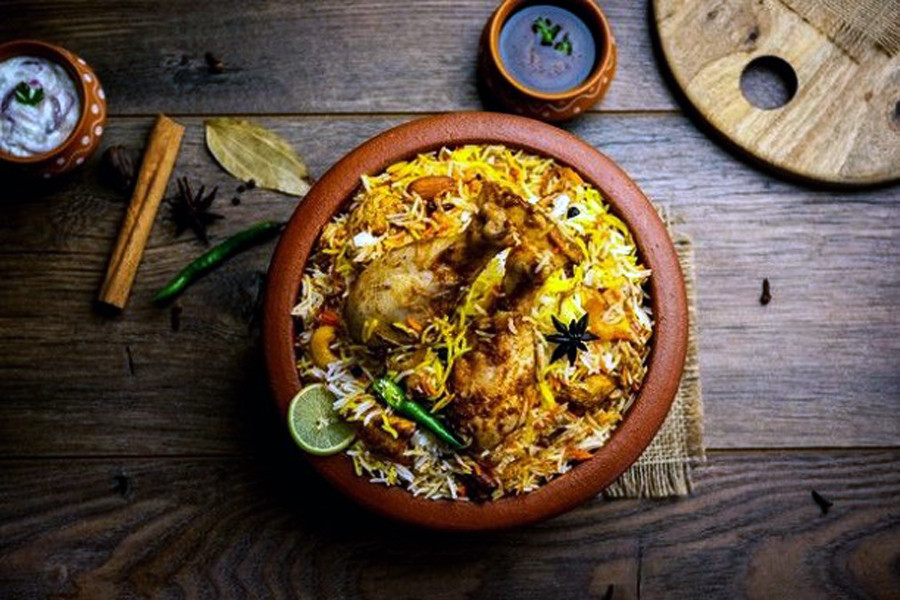
Especially in Nepali Muslim households, questions are often raised about the history of biryani, a dish that has long become a distinct taste of its own.
The answer is usually linked easily to the Indian city of Hyderabad, where it is believed to have originated. But the story is not that simple.
In India itself, biryanis carry diverse identities — Hyderabadi biryani, Kashmiri biryani, Mughlai biryani, Lucknowi biryani, Kolkata biryani, Bombay biryani, Bangalore biryani, Malabar biryani — each with their own history and flavors.
In Pakistan, Sindhi biryani, Punjabi biryani, Bohri biryani, and Afghani biryani are recognized variations. Bangladesh too has its own tales.
In Nepal, particularly across the Madhes and Terai regions, the style of biryani is more or less uniform, but its taste is still considered distinct in its own way.
It is hard to tell how much of biryani’s story is fact and how much is myth. Some trace its roots to Persia, while many see it as a classic Mughlai dish.
During the Safavid dynasty in Persia (1501–1736), a dish known as berian pilau was popular. It is argued that this dish, evolving over time, became what we now know as biryani.
The recipe involved marinating meat overnight with yogurt, herbs, spices, raisins, cashews, and dried pomegranate seeds, then mixing it with partially cooked rice the next morning to create berian pilau. This method closely resembles today’s biryani, a connection also acknowledged by experts of Islamic cuisine in India.
From Babur (Zahir-ud-din Muhammad), who began Mughal rule in India in 1526, to Akbar (1556–1605), and later to Bahadur Shah II, the last Mughal emperor who was dethroned by the British in 1857 and exiled — the Mughal empire left a deep influence on the Indian subcontinent. This influence extended strongly to food culture.
Biryani, believed to have developed between the 15th and 19th centuries, is thus considered an inseparable part of Mughal cuisine. There are also many accounts that Muslim traders introduced biryani from Persia to South Asia during the Mughal period, alongside dishes like pilau and kebabs, spreading its flavors widely.
In 1638, when the Red Fort was being built in Delhi, hundreds of workers were brought in from Persia. It is said that they helped spread the taste of biryani. Preparing food for such a large workforce in one go made biryani — as a single-pot meal — the most practical and efficient choice, lending credibility to these stories.
Dozens of such tales circulate around biryani. The word itself is derived from the Persian biriyan, meaning “to fry before cooking.” Both the word and the dish have traveled across centuries and borders. In Nepal, biryani has largely followed the same rhythm as in India, say the cooks who prepare it.
Of course, flavors change with places and times. How much biryani has adapted to local Nepali culinary traditions remains a question to be explored.
Over its journey of thousands of kilometers across centuries, biryani has seen countless additions and variations. From Persia to Nepal, stories have followed it at every step. Even as more than 20 types of biryani flourish in India alone, Nepali consumers tend to favor the Hyderabadi style, according to local businesses.
Whether Nepal has added its own distinctive story to the dish or not, biryani here seems to remain tied closely to family traditions and the culture of shared meals at home.