
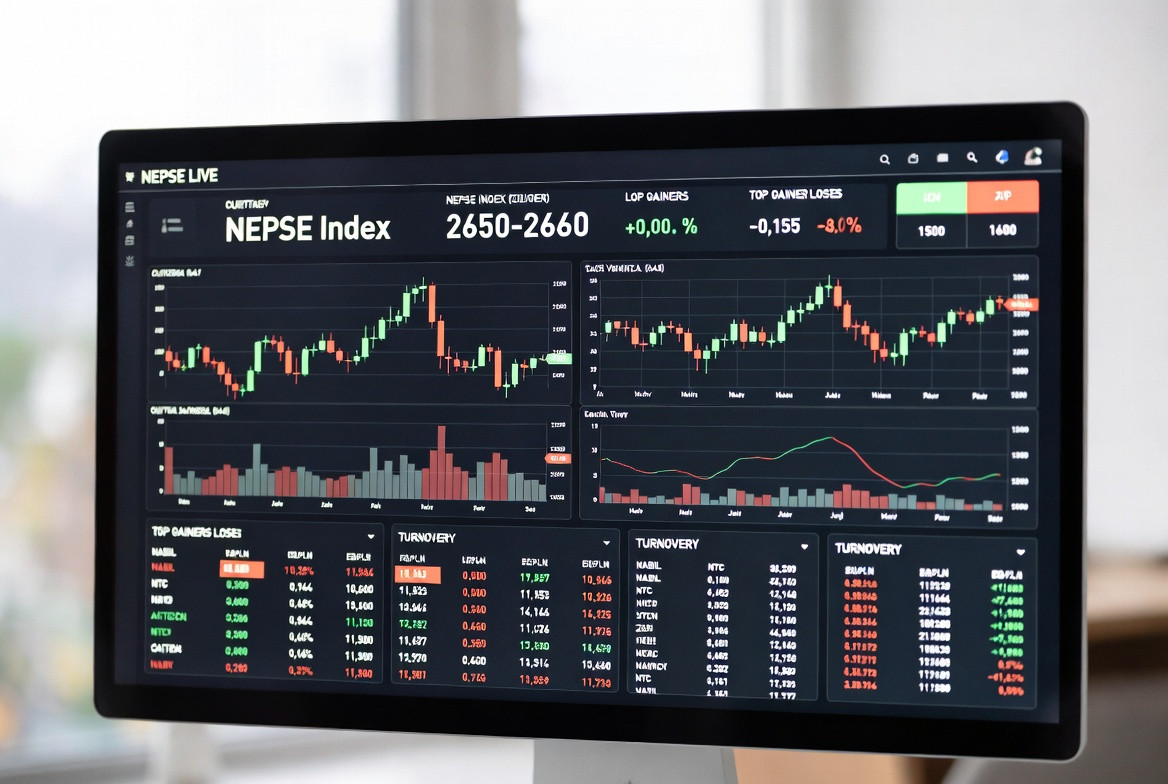
Kathmandu- Nepal's stock market has been on a steady downward trend in recent months, with the Nepal Stock Exchange (NEPSE) index falling to around the 2,600 point mark, its lowest level in six months.
Despite the formation of a new government and the announcement of new policies, investor sentiment has remained weak. Market data show that optimism expected after the government led by Rastriya Swatantra Party (RSP) senior leader Balen Shah took office has failed to materialize.
Ahead of the February 21 election, the RSP had pledged several stock market friendly policies in its election manifesto. However, the market has continued to decline since the new government assumed office.
On March 25, the day before Prime Minister Balen Shah was sworn in, the NEPSE index stood at 2,950.16 points. By last Friday, it had fallen to around 2,600 points, marking a decline of about 350 points during the tenure of the new government.
The market had previously closed at 2,597 points on December 24. Over the following six months, the benchmark index climbed to a high of 2,970 points on March 24 before entering an almost uninterrupted downward trend.
Budget and monetary policy fail to lift sentiment
Trading trends show that the market started weakening immediately after the national budget was unveiled.
Investors had long demanded that capital gains tax on share transactions be recognized as the final tax under the law. Although it was already treated as the final tax in practice, the legal provision had not been explicitly established. Investors had raised the issue with Finance Minister Dr Swarnim Wagle.
Responding to the demand, Wagle included a provision in the budget for fiscal year 2026/27 formally recognizing capital gains tax as the final tax. Even so, the stock market failed to respond positively.
The budget also introduced 10 measures aimed at strengthening the capital market, including attracting investment from non resident Nepalis and restructuring the Nepal Stock Exchange. However, these announcements had little impact on market performance.
A day before Wagle presented the budget on May 27, the NEPSE index had gained five points to close at 2,782.
The budget was unveiled on May 29, and many investors expected the market to hit the positive circuit limit in the following session. Instead, the benchmark index fell 26.72 points on the first trading day after the budget to close at 2,755.
Since the budget announcement, the NEPSE index has declined by another 86 points. Trading activity also indicates that investors have largely adopted a wait and watch approach, with overall market participation remaining subdued.
Ghanshyam Pandey, president of the Nepal Shareholders Association, said the budget contained several positive measures, but the arrest of some businesspersons created uncertainty among investors.
"The arrests created confusion among investors. They started wondering which company could be targeted next," Pandey said. "Large investors are the ones who generally drive the market higher. They became cautious after the budget, preventing the market from gaining momentum."
After the market failed to recover following the budget, investor attention shifted to the monetary policy announced by Nepal Rastra Bank. However, the policy also failed to deliver any significant measures for the stock market.
The monetary policy, arguably one of the shortest in the central bank's history, introduced a provision allowing higher margin lending only against shares of companies with strong net worth and sound financial health. Market participants say the measure has not supported investor confidence.
Nepal Rastra Bank Governor Dr Bishwo Nath Poudel unveiled the monetary policy on July 8. The market has traded only three sessions since then, but the benchmark index has declined in all three, losing a total of 51 points.
On the trading day before the policy was announced, the NEPSE index had risen to 2,651 points. It has since fallen steadily to around 2,600 points.
Former Nepal Rastra Bank Governor Chiranjibi Nepal said the market has reacted to the central bank's decision to make lending more selective based on the financial strength of listed companies.
"About 70 percent of our stock market consists of banks and financial institutions. Policies introduced by the central bank naturally have a major influence on the market," Nepal said. "That influence is visible now."
According to him, many investors hold shares of both financially strong and weak companies. The new policy limiting loans against shares of weaker companies has dampened market sentiment.
Kamal Dhital, chief executive officer of Pahi Investment Pvt Ltd, Broker No. 79, said investors had been waiting for the monetary policy after the budget, but it failed to introduce any meaningful measures for the capital market.
"The monetary policy offered nothing significant for the stock market," Dhital said. "Investors are now looking toward the Securities Board for the next policy direction."
Market data support his assessment. Between the budget announcement and the day before the monetary policy was released, the NEPSE index fluctuated but declined by only 21 points. Since the monetary policy came into effect, however, it has dropped 51 points in just three trading sessions.
Pandey argued that the current decline cannot be attributed solely to the monetary policy, as it neither introduced major incentives nor imposed harsh restrictions on the stock market.
He said the market has also come under pressure because many investors began booking losses after the index fell to around the 2,600 level.
"The fiscal year closing has forced many investors to sell shares to settle their accounts. Brokers have also been asking clients to sell in order to complete settlements," Pandey said. "At the same time, brokers have tightened credit limits, which has added further pressure on the market."
He added that Nepal's stock market is often heavily influenced by sentiment and speculation, which has further contributed to the ongoing decline.
© 2026 All right reserved to biznessnews.com | Site By : Sobij
© 2026 All right reserved to biznessnews.com | Site By : Sobij