
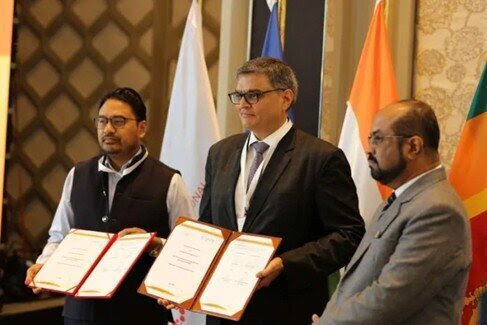
Colombo - The International Centre for Integrated Mountain Development (ICIMOD) and the International Solar Alliance (ISA) have signed a Memorandum of Understanding (MoU) to foster cooperation in scaling up solar energy solutions across the common member countries.
The MoU formalises a strategic partnership aimed at promoting decentralised solar technologies, improving energy access in remote mountain communities, and supporting climate-resilient development in the common member countries.
Through this collaboration, ISA – a treaty-based global intergovernmental organisation dedicated to advancing solar power adoption for a carbon-neutral future – and ICIMOD will work together to identify scalable solar interventions across sectors, co-develop proposals, projects and programmes, strengthen technical capacity and technology transfer, and facilitate knowledge sharing and advocacy among common member countries.
Pema Gyamtsho, Director General of ICIMOD, stated, 'This partnership with ISA marks a significant step toward bringing clean, reliable, and context-specific solar solutions to the mountains. It reinforces our shared commitment to sustainable energy transitions and climate resilience in the Hindu Kush Himalya region.'
Ashish Khanna, Director General of ISA, emphasised, "Our MoU with ICIMOD, signed at ISA’s 7th Regional Committee Meeting in Colombo, supports our strategy to move from Ambition to Action through Productive Use of Renewable Energy (PURE) initiatives across the Hindu Kush Himalaya, beginning with the ISA Country Partnership Strategy for Bhutan as a pioneering model for mountain-focused renewable energy transitions, as part of our broader engagement."
The partnership aligns with both organisations’ vision to accelerate the uptake of renewable energy, contribute to national climate goals and Sustainable Development Goals (SDGs), and promote regional cooperation for a greener, more equitable future.
The Hindu Kush Himalaya (HKH) region stretches 3,500km across Asia, spanning eight countries – Afghanistan, Bangladesh, Bhutan, China, India, Myanmar, Nepal, and Pakistan. Encompassing high-altitude mountain ranges, mid-hills, and plains, the zone is vital for the food, water, and energy security of up to two billion people and is a habitat for countless irreplaceable species. It is also acutely fragile, and vulnerable to the impacts of the triple planetary crisis of climate change, pollution, and biodiversity loss.
© 2026 All right reserved to biznessnews.com | Site By : Sobij
© 2026 All right reserved to biznessnews.com | Site By : Sobij