
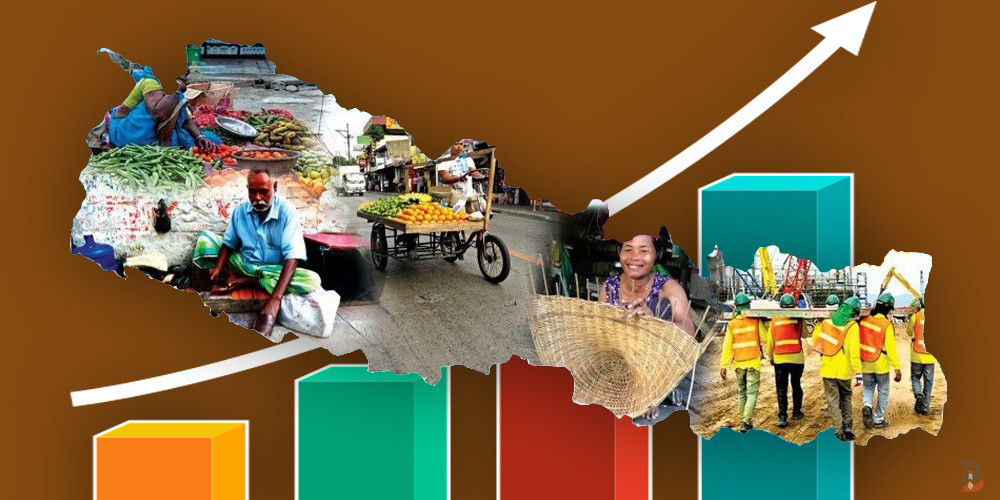
Kathmandu- Nepal’s economy is estimated to have expanded by 3.51 per cent in the third quarter (mid-January to mid-April) of the current fiscal year 2025/26, according to preliminary estimates released by the National Statistics Office.
The Quarterly National Accounts report attributes the growth to stronger performance in electricity generation and distribution, banking and financial services, non-life insurance, transport and storage, and wholesale and retail trade compared with the same period last year.
According to the report, 16 of the country’s 18 industrial sectors recorded positive growth during the review period. Only public administration and defence, and manufacturing contracted. However, lower imports of construction materials, a decline in paddy production and reduced domestic output of some goods kept overall economic growth at a moderate level.
The electricity and gas sector recorded the highest growth of 24.88 per cent, driven by increased hydropower generation and electricity distribution, making it the largest contributor to economic expansion. The financial and insurance sector followed with growth of 10.27 per cent, supported by higher bank deposits, increased lending and expanding insurance business.
The transport and storage sector expanded by 7.83 per cent, while wholesale and retail trade grew by 5.25 per cent, reflecting improved domestic production and imports. Information and communication grew by 4.87 per cent, followed by professional, scientific and technical services at 4.19 per cent and administrative and support services at 3.59 per cent. The construction sector expanded by 2.75 per cent, while human health and social work activities grew by 2.19 per cent. Real estate activities increased by 2.05 per cent, accommodation and food services by 1.72 per cent, other services by 1.60 per cent, and education by 1.22 per cent.
The agriculture, forestry and fisheries sector, the largest contributor to Nepal’s economy, grew by only 1.58 per cent. Although paddy production declined, modest increases in livestock, vegetables, fruits and forestry products helped keep the sector in positive territory.
Meanwhile, the manufacturing sector contracted by 0.54 per cent, while public administration and defence shrank by 1.59 per cent, indicating that Nepal’s productive sectors have yet to fully recover.
Seasonally adjusted data show the economy expanded by just 0.58 per cent compared with the second quarter of the current fiscal year. Eleven of the 18 industrial sectors recorded growth, while seven contracted.
Even after seasonal adjustment, the electricity and gas sector remained the fastest-growing sector with growth of 6.87 per cent. Mining and quarrying expanded by 2.23 per cent, while wholesale and retail trade grew by 2.02 per cent. However, accommodation and food services contracted by 2.30 per cent, while the financial and insurance sector declined by 1.07 per cent, manufacturing by 0.83 per cent, and agriculture by 0.04 per cent.
The National Statistics Office, which has been publishing quarterly national accounts since fiscal year 2010/11 using 2010/11 as the base year, said the latest estimates indicate that Nepal’s economic growth continues to rely largely on the energy, banking and service sectors. However, sluggish agricultural growth, continued weakness in manufacturing and slow recovery in construction suggest that the country’s production-based economy remains under pressure despite the overall positive growth trajectory.
© 2026 All right reserved to biznessnews.com | Site By : Sobij
© 2026 All right reserved to biznessnews.com | Site By : Sobij