
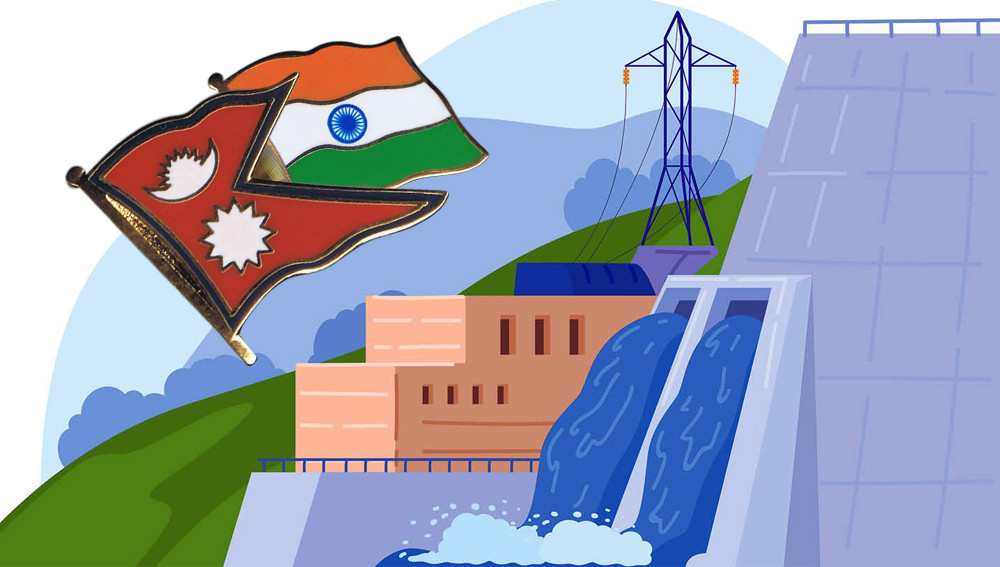
Kathmandu-The 13th meeting of the Nepal-India Joint Working Group (JWG) at the joint secretary level on energy cooperation began in Pokhara on Tuesday, with discussions focused on strengthening bilateral energy ties through the expansion of cross border power transmission infrastructure, facilitation of electricity trade, and a review of the implementation of previous agreements.
The Supreme Court's order concerning the 480 MW Phukot Karnali Hydropower Project, which is being developed by India's state owned NHPC Limited, is also expected to feature prominently in the high level discussions.
The Nepali delegation is led by Sandip Kumar Dev, Joint Secretary at the Ministry of Energy, Water Resources and Irrigation, while the Indian delegation is headed by Pankaj Kumar, Joint Secretary in charge of power transmission at India's Ministry of Power.
According to Nepal's Ministry of Energy, the meeting will discuss the strengthening and expansion of cross border transmission systems, measures to facilitate electricity imports and exports, technical and policy issues related to power trade, and the implementation status of previous bilateral understandings.
The meeting will also review progress on decisions made during the 12th JWG meeting held in New Delhi last year. That meeting agreed to increase the electricity exchange capacity through the Dhalkebar Muzaffarpur 400 kV cross border transmission line from 800 MW to 1,000 MW.
The two sides had also agreed to prepare the detailed project report for the Chameliya Joljibi 220 kV transmission line, jointly develop the Inaruwa Purnea and Dododhara Bareilly 400 kV cross border transmission lines under a joint investment model, build additional transmission infrastructure to support higher electricity exports, and further streamline the approval process for power exports.
The Phukot Karnali Hydropower Project is expected to be another key issue during the talks. In September last year, Nepal's Supreme Court, while ruling on a petition related to the project, directed the government to review the provision under which Nepal would receive 21.9 percent of the project's electricity free of charge.
The court instructed the government to amend the memorandum of understanding so that Nepal's share of free electricity would be increased as much as possible in proportion to its investment in the project.
Following the verdict, NHPC expressed concern that revising the agreement in line with the court's order could undermine the project's financial viability. The issue has implications not only for the 480 MW Phukot Karnali project but also for NHPC's planned investments in the 800 MW West Seti and 450 MW Seti River 6 hydropower projects, bringing the combined capacity to 1,730 MW.
According to sources at the Ministry of Energy, uncertainty surrounding the free power provision has raised concerns among Indian investors. The Indian side has argued that applying a uniform free power requirement across all projects could adversely affect project costs and financial returns. It has also indicated that investment decisions on several large hydropower projects could be delayed if the issue remains unresolved.
Against this backdrop, the Pokhara meeting is being viewed not only as a technical forum but also as an opportunity to reinforce the confidence of Indian investors in Nepal's hydropower sector. Energy officials believe that reaching a mutually acceptable solution while respecting the Supreme Court's ruling would help create a clearer and more reliable investment environment.
At present, Indian government and private sector entities have direct or indirect interests in hydropower projects in Nepal with a combined installed capacity of around 24,805 MW.
These include Arun III, Upper Karnali, West Seti, Seti River 6, Phukot Karnali, Lower Arun, Arun IV, the Tamor Storage Project, Karnali Chisapani, Pancheshwar, Budhigandaki, and Mugu Karnali. Government data and bilateral agreements indicate varying levels of Indian involvement or long term interest in these projects. If all move forward, they are expected to attract more than Rs 1.5 trillion in Indian investment.
Officials say the outcome of the Pokhara meeting will influence not only the future of the Phukot Karnali project but also investor confidence, the pace of future hydropower investments, and the long term direction of Nepal India energy cooperation.
The recommendations and decisions from the JWG meeting will be presented at the Nepal India Joint Steering Committee (JSC) meeting at the secretary level on Wednesday. The Nepali side will be led by Energy Secretary Sarita Dawadi. The meeting is expected to take further decisions on bilateral energy cooperation, cross border transmission infrastructure, and the expansion of electricity trade.
© 2026 All right reserved to biznessnews.com | Site By : Sobij
© 2026 All right reserved to biznessnews.com | Site By : Sobij