
Kathmandu- After three-decade maintaining a fixed exchange rate with the Indian Rupee, discussions on revising it have begun.
Major development partners, including the World Bank, are recommending a policy review, citing concerns over Nepal’s economic competitiveness.
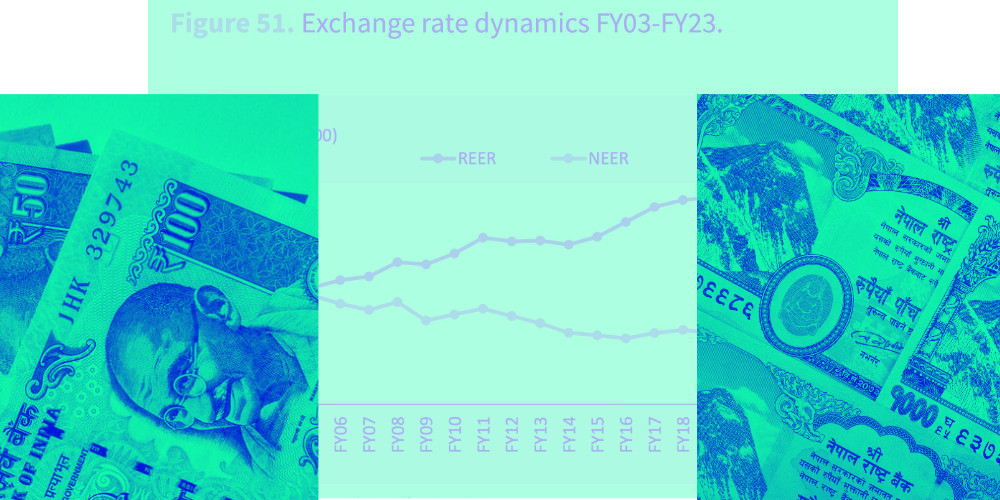
Since 1993, the exchange rate has been fixed pegging at 1 INR = 1.6 NPR. However, Nepal’s higher inflation compared to India has led to an overvaluation of the Nepali Rupee in real terms, while its nominal exchange rate has declined. Though the Rupee has weakened against the US Dollar, its real exchange rate with the Indian Rupee has increased, reducing Nepal’s trade competitiveness.
A World Bank report (October 2023) highlighted Nepal’s rising Real Effective Exchange Rate (REER), which is limiting exports. World Bank officials have repeatedly raised this issue in high-level discussions.
Nepal’s economy has long been considered an underperformer, struggling with low labor productivity, skilled worker migration, inflation, and the fixed exchange rate. Among landlocked, high-remittance economies, Nepal ranks the weakest in labor productivity, particularly in industry and agriculture. Its industrial workforce produces only one-third of what workers in comparable economies achieve.
Between 1996 and 2006, Nepal’s labor productivity gap with peer countries was small, but it has widened significantly over the past two decades. Compared to Bangladesh, Laos, Bolivia, the Kyrgyz Republic, Honduras, and El Salvador, Nepal and Honduras have experienced negative industrial productivity growth. Nepal’s per-worker industrial output declined between 2007 and 2014.
The exchange rate is also a key factor in Nepal’s declining exports. While the fixed peg initially kept inflation in check, Nepal’s inflation rate has been 1.1 percent higher than India’s since 2015. Though the Nepalese Rupee has depreciated against the US Dollar, it remains overvalued in real terms, reducing Nepal’s export competitiveness.
The World Bank estimates that a 10 percent overvaluation in the exchange rate could reduce exports by over 4 percent. Despite a declining nominal exchange rate, the real exchange rate has surged, attributed to strong remittance inflows and higher inflation.
The debate over revising the exchange rate is not new. Opponents fear devaluation would increase import costs and drive inflation, while proponents argue that an overvalued currency makes Nepalese products uncompetitive globally.
Many believe that without governance reforms and increased domestic production, devaluation could lead to hyperinflation, which Nepal’s economy is not prepared to handle.
© 2026 All right reserved to biznessnews.com | Site By : Sobij
© 2026 All right reserved to biznessnews.com | Site By : Sobij