

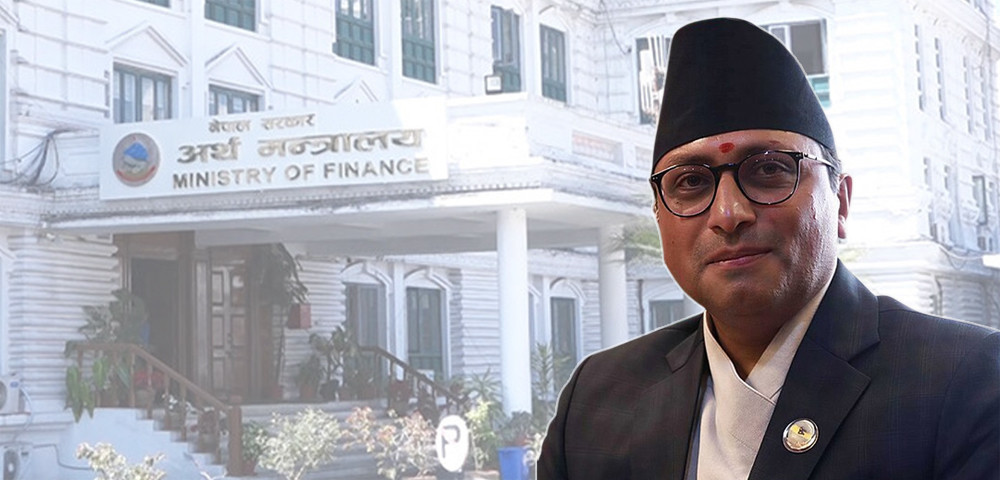
Kathmandu-The government has released a new Finance Position Paper outlining structural reforms to address Nepal’s long-standing economic and governance challenges. The document, prepared under Finance Minister Dr. Swarnim Wagle, sets a clear direction for improving governance, boosting investment, and shifting the economy toward sustainable growth.
According to the Minister Wagle , Nepal’s failure to achieve prosperity is not due to a lack of resources, but weak governance, policy inconsistency, and poor implementation.
It identifies distorted incentive structures as the core problem. 'Expensive elections, opaque political financing, and heavy party systems have turned politics into a profession rather than public service, encouraging corruption and crony capitalism,' he added.
According to him, the economy has moved away from value creation. 'Instead of promoting entrepreneurship and innovation, policies have favored rent-seeking through licenses, contracts, and regulatory control. This has discouraged new entrants and limited competition.'
'The government also acknowledges confusion over the roles of the state and the market. Frequent policy shifts between state dominance and market reliance have created instability. Key areas such as competition policy, consumer protection, and regulatory systems remain weak,' he mentioned in paper.
The paper highlights that lack of property rights protection, poor contract enforcement, and regulatory uncertainty have reduced investor confidence. As a result, the private sector has struggled to expand.
On social policy, the he warns that expansion of welfare programs without assessing long-term fiscal impact has created risks for future generations. He notes that such programs have failed to significantly reduce inequality or increase productivity.
Wagle also points to Nepal’s growing dependence on foreign employment and remittances due to limited domestic job creation. He stresses that the country has not effectively utilized its demographic dividend.
To address these issues, the government proposes broad structural reforms. These include promoting competition, encouraging innovation, enabling new businesses to enter the market, and improving governance systems.
The paper calls for a shift from a rent-seeking economy to one focused on productive investment and job creation. It also prioritizes policy stability, transparency, and efficient public service delivery.
The government says the document will guide future policy decisions and help build a more accountable state and a stronger economy.
© 2026 All right reserved to biznessnews.com | Site By : Sobij
© 2026 All right reserved to biznessnews.com | Site By : Sobij