
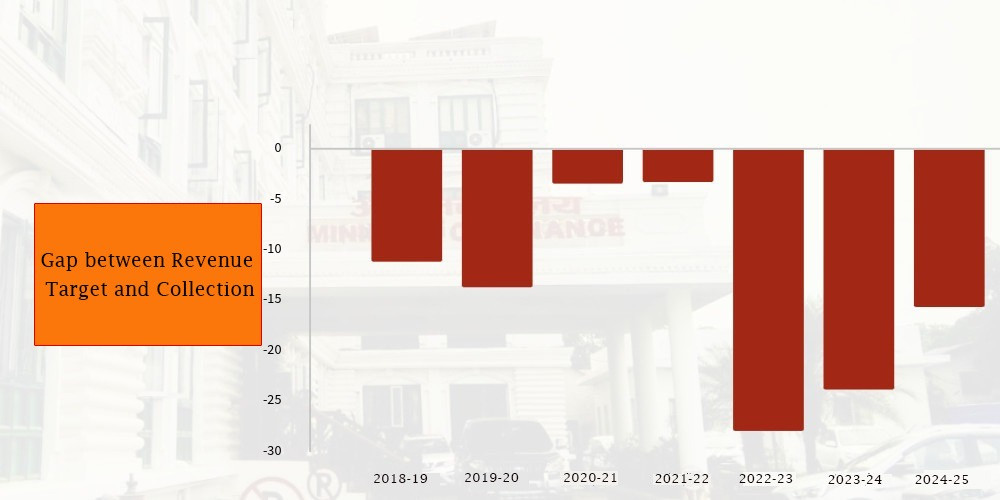
Kathmandu – The government has failed to meet its revenue target for the past half-decade. Since the implementation of fiscal federalism, the government has consistently failed to collect revenue as targeted.
In the last fiscal year 2024- 25, the government again fell short of its revenue target. Despite double-digit growth compared to the previous year, revenue collection reached only 84 percent of the target.
The government had set a revenue target of Rs 1.419 trillion for last fiscal year, but collection stood only at Rs 1.196 trillion.
This trend of failing to meet revenue targets has continued for several years.
In order to create a large-sized budget and allocate funds for politically motivated programs, the government sets high revenue targets.
However, low revenue collection continues to strain the federal treasury.
Not just last year—achieving the revenue target in the current fiscal year 2025-26 also seems challenging.
To meet the target, revenue collection must increase by 25 percent compared to last year. Achieving such a growth rate would require high economic growth. But with projected economic growth and inflation both estimated at 6 percent, increasing revenue by 25 percent is a tall order.
Generally, a one percent rise in economic growth leads to only about 1.4 percent growth in revenue. If inflation is at 6 percent, then achieving more than 15 percent growth in revenue would require significant administrative reforms and rapid economic acceleration.
Past experiences, however, do not support such optimism.
As the revenue base has already become high, the growth rate is narrowing. Still, the government is now compelled to chase a 25 percent growth rate. The government has set a revenue target of Rs 1.480 trillion for this year. Achieving this would require significant increases in imports.
Failing to meet revenue targets continues to directly pressure public finances. To justify large budgets—including essential obligations—the government sets ambitious revenue goals. When these goals are not met, the budget commitments become unavoidable obligations. The government is then forced to take loans to fulfil those commitments.
With external borrowing not being effectively utilized, the government continues to rely more on domestic loans, which keeps increasing the debt burden.
Various studies have shown that without a major restructuring, achieving significant growth in revenue is unlikely under the current conditions.
In terms of revenue as a share of GDP, Nepal ranks among the strongest in South Asia. After the Maldives, Nepal collects about 20 percent of its GDP as tax revenue. Previously, this ratio even reached 24 percent, similar to the United States—but it has now declined.
Compared to India, Bhutan, Bangladesh, Sri Lanka, and Pakistan, Nepal’s revenue collection is stronger relative to the size of its economy. A recent World Bank report shows Nepal’s performance in revenue collection is comparatively robust.
Despite high tax rates compared to other sectors, revenue collection remains low across South Asia. However, the status of the Maldives and Nepal is considered satisfactory.
Nepal’s potential revenue gap is estimated to be just one percent. In contrast, India collects four percent less revenue than it should, and Sri Lanka has the highest revenue gap in the region.
Compared to other emerging economies, Nepal’s tax-to-GDP ratio is not only balanced, but the share of revenue spent on debt servicing is also among the lowest in South Asia. Emerging economies spend, on average, 9 percent of their revenue on debt servicing, but Nepal’s expenditure is below this average, according to the World Bank publication "Taxing Time."
The South Asian average is nearly three times higher than the emerging market average—around 26 percent. Some countries in the region spend up to 30 percent of their revenue on debt repayment.
Despite strong revenue collection figures, the data is more of a burden than a cause for celebration for the government. With risks of leakage and mismanagement still present, there is little hope for significant increases.
According to the study, revenue collection under the current economic structure is already high and can increase at most by one percentage point of GDP.
Even though Nepal’s revenue-to-GDP ratio is high, it is considered risky.
Since revenue collection in Nepal heavily depends on trade and consumption, it is vulnerable to future risks, according to a World Bank economist.
'Although Nepal collects more than 20 percent of its GDP in revenue, it is heavily dependent on imports, which creates long-term pressure on foreign exchange reserves,' said Joë Li-Chi, Senior Economist at the World Bank South Asia office.
To increase revenue by one billion rupees, imports need to increase by up to Rs 30 billion. If remittance inflows don’t grow in parallel, it will pressure foreign currency reserves and destabilize external conditions, she added.
Nepal’s economy has faced such situations multiple times in the past.
© 2026 All right reserved to biznessnews.com | Site By : Sobij
© 2026 All right reserved to biznessnews.com | Site By : Sobij