
Kathmandu -Three months have passed since the government led by Balen Shah took office. With the formation of the new government, there were expectations of the economy improvement , recovery of private sector confidence, and the stock market would benefit as a result.
However, three months later, the situation in the stock market appears to be the exact opposite. Both the benchmark index and investors' wealth have declined significantly.
An assessment of the Balen government's first three months sends a clear message from the stock market.
Having capable people leading the economy is not enough. They must also introduce policy decisions that inspire confidence, communicate a clear economic direction, and create an investment friendly environment. The ongoing decline in the stock market suggests that investors have lost not only money but also some of their initial confidence in the government.
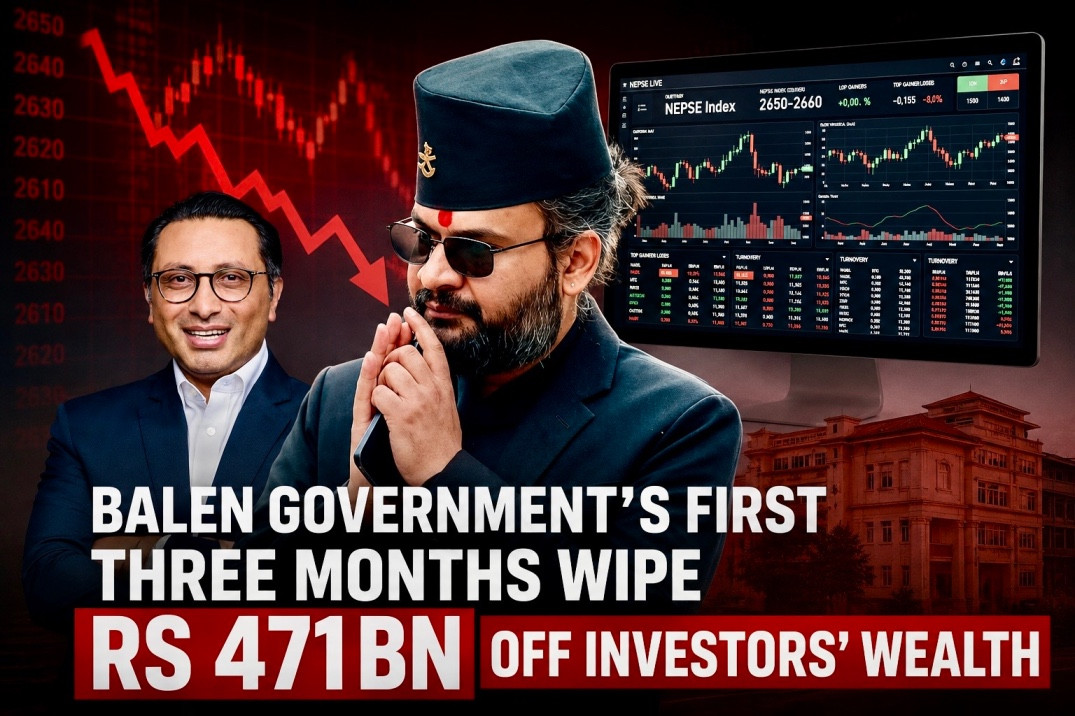
When the government was formed on March 26, the Nepal Stock Exchange (NEPSE) index stood at 2,950.16 points. By Friday, it had closed at 2,649.76 points. Over the three month period, the benchmark index fell by around 301 points.
During the same period, market capitalisation declined from Rs 5.009 trillion to Rs 4.534 trillion. As a result, investors' wealth has shrunk by approximately Rs 471 billion.
Trading patterns also reflect investor sentiment. Of the 62 trading days since the government took office, the market advanced on only 23 days while it declined on 39 days.
The downturn accelerated after the government unveiled the national budget.
The NEPSE index, which stood at 2,766.78 points when the budget was announced on May 29, has since fallen by more than 117 points. Of the 20 trading sessions following the budget announcement, the market closed higher on only five days and lower on 15.
The decline has not been limited to a single sector or company. Except for the manufacturing sector, most sectoral indices have fallen.
The Others Index has dropped by nearly 20 percent, the Investment Index by 13.57 percent, the Development Bank Index by 11.51 percent, and the Microfinance Index by 10.18 percent. This indicates widespread negative sentiment across the market.
When the government assumed office, investors had high expectations from the new leadership. The appointment of Prime Minister Balen Shah, Finance Minister Dr Swarnim Wagle, National Planning Commission Vice Chair Dr Gunakar Bhatta, Nepal Rastra Bank Governor Dr Bishwo Poudel, and Nepal Securities Board Chair Dr Gopal Bhatta, all of whom are well versed in economics and finance, raised hopes that economic policies would become clearer and the market would move in a positive direction.
However, those expectations have yet to materialise. Finance Minister Wagle has repeatedly said that he is not focused on the stock market's day to day fluctuations. He has also argued that the government's crackdown on financial crimes may have created temporary anxiety among investors. Investors, however, expected something different. They hoped that the country's economic leadership would reassure the private sector, send investment friendly signals, and introduce concrete reforms to strengthen the capital market.
According to market analysts, several factors are driving the current downturn. These include sluggish economic activity, weak private sector investment, expectations of increased initial public offering (IPO) supply following the appointment of a new leadership at the securities regulator, and uncertainty surrounding the Bank and Financial Institutions Bill currently under discussion in Parliament, particularly provisions requiring the separation of banks from business groups. Together, these factors have discouraged fresh investment from entering the market.
One striking aspect is that Nepal's banking system is currently holding excess liquidity of around Rs 1.4 trillion. With weak demand for credit, Nepal Rastra Bank has been absorbing liquidity on a daily basis at an interest rate of just 2.75 percent. Under normal circumstances, such abundant liquidity and low interest rates would be expected to provide strong support to the stock market. This time, however, that has not happened.
This suggests that the problem is not a shortage of money but a shortage of confidence. Investors expected the government to present a clear economic roadmap, adopt policies that would encourage private sector investment, and demonstrate a strong commitment to developing the capital market. In the absence of such signals, a "wait and see" approach has come to dominate investor sentiment.
© 2026 All right reserved to biznessnews.com | Site By : Sobij
© 2026 All right reserved to biznessnews.com | Site By : Sobij