
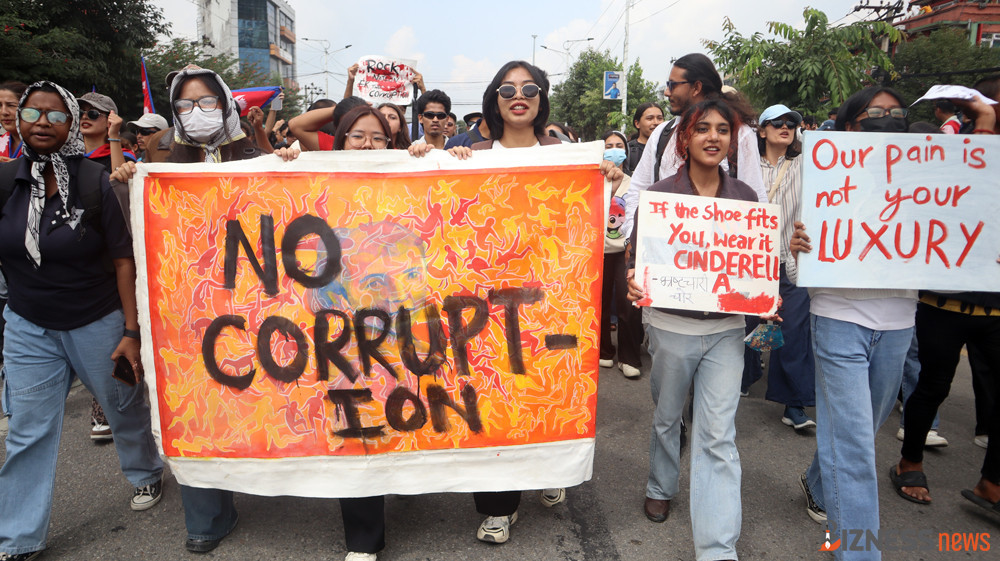
Kathmandu - At least 19 were killed so far and hundereds more injured on Monday after security forces opened fire on young demonstrators protesting against corruption and misgovernance.
The protest , largely peaceful throughout the morning between 9 am to 12 pm , turned tense around midday as thousands of protesters marched towards the Parliament building. A few managed to breach its gates, resulting a heavy-handed response.
Instead of controlling the crowd through negotiation or non-lethal means, authority resorted to live ammunition.
Witnesses described scenes of chaos as students fell to the ground while others tried to carry the wounded to safety. Hospitals across the capital were soon overwhelmed, with doctors warning of critical shortages of blood.
The government has imposed a curfew in several parts of Kathmandu, further hampering rescue efforts as ambulances struggle to reach those in need.
Streets once filled with chants for accountability are now marked by grief, anger, and fear.
Witnesses described police firing even at students carrying schoolbags.
The brutality of the KP Oli–led government’s crackdown, critics say, appears more inhumane than the Royal Nepal Army’s suppression of the 2006 pro-democracy movement under Former King Gyanendra.
Frustrated by rampant corruption and systemic disorder, Nepal’s younger generation gathered in cities nationwide.
Known as Generation Z-those born between 1997 and 2012-these youths had until now channeled their anger mainly through social media. On Monday, their dissent spilled onto the streets in unprecedented numbers.
Unlike political party cadres or student wings that often vandalize property and hurl stones at police, Gen Z demonstrators relied on nonviolent resistance, chanting slogans and holding placards.
Inspired by recent youth-led uprisings in the Philippines and Indonesia, they said they were protesting a political system that rewards only the well-connected while ordinary citizens continue to struggle.
'Are the leaders not taking the youth seriously? Do they think they can just do whatever they like? We are not the type to stay silent and suppressed forever. Since yesterday, I’ve been scared that something could happen, but even in such a situation, we will not sit in fear. Look at the reality and listen to the voices of the youth. Age and time spare no one,' said Revika, a student protester.
Revika’s words echoed across Maitighar in Kathmandu, where hundreds under the age of 28 rallied against corruption, state irregularities, and the proposed social media ban.
Without party banners or organizational ties, they gathered independently, voicing dissatisfaction. Later in the day, the Gen Z movement, citing infiltration, urged participants via social media to return home.
But the crackdown intensified. Curfews were imposed in Baneshwor, Sheetal Niwas, the Vice President’s Office in Lainchaur, Narayanhiti Palace Museum, and Singha Durbar. Yet, protests continued into the evening in Baneshwor.
Protests also turned violent outside the capital. In Pokhara, a youth was shot and injured. Gunfire and curfews were reported in Itahari killing one and Jhapa, while demonstrations erupted in several other cities.
For months, young people had been highlighting on TikTok the stark contrast between the lavish lifestyles of politicians’ children and the hardships faced by ordinary Nepalis. Videos raised pointed questions: how can leaders’ children, from families with modest incomes, afford such extravagance? How were billion-rupee empires built without legitimate earnings?
Hashtags like #OurTaxYourLuxury, #Enough, and #NepoKids have since gone viral, fueling the online-to-offline protest movement.
On social media, outrage is now mounting against what many call the government’s 'massacre approach.' Demands are growing for the resignation of Prime Minister Oli and Home Minister Ramesh Lekhak.
The Supreme Court Bar Association also condemned the crackdown, calling it a 'serious attack on democratic freedoms.'
In a statement, Secretary Raman Kumar Karna said the incident had exposed the authoritarian face of the state administration.
© 2026 All right reserved to biznessnews.com | Site By : Sobij
© 2026 All right reserved to biznessnews.com | Site By : Sobij