
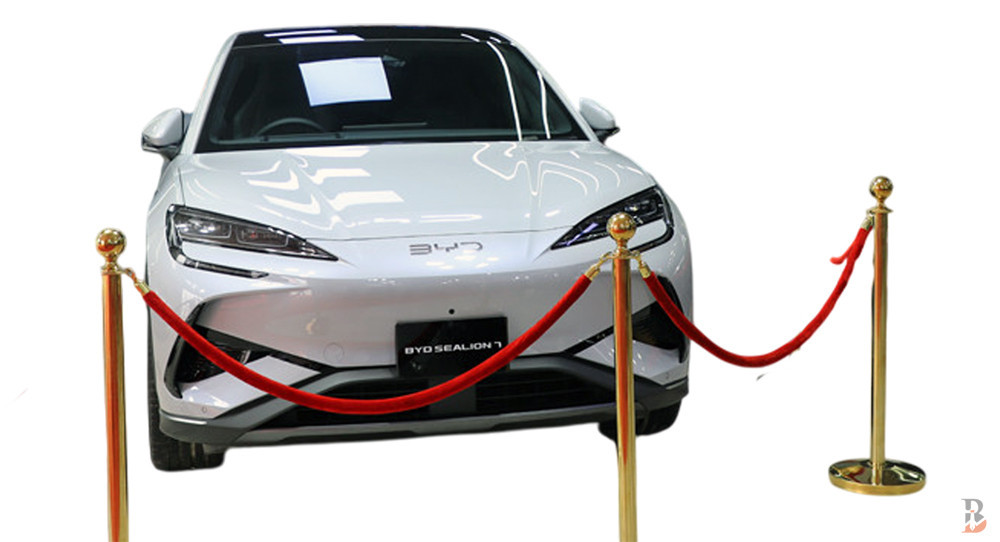
Kathmandu- BYD’s official distributor in Nepal, Cimex Inc. Pvt. Ltd., has reportedly brought the new electric car, the Sealion 7, into the country without securing the required import clearance.
The company had imported the vehicle for commercial sale.
However, it applied for import approval from the Department of Transport Management only after the vehicle had already arrived at Rasuwa Customs.
While the department was still reviewing the submitted documents, Cimex allegedly used a legal grey area to import these cars by providing a financial guarantee.
By bypassing the regular customs clearance process, Cimex is said to have used the 'exhibition import' route-typically reserved for display or testing purposes-to bring the Sealion 7 into Nepal.
On Tuesday, five units were reportedly released using this method.
The company had originally initiated the process to import 20 units of the Sealion 7. Despite not yet receiving approval for sale, it plans to officially unveil the vehicle in the Nepali market this Friday.
Under Nepali law, all vehicle imports must receive mandatory approval from the Department of Transport Management.
In recent months, the government has increased tight monitoring of electric vehicle imports, particularly regarding motor power specifications.
The Sealion 7 model previously brought into Nepal came with a 150 kW motor, raising concerns within the department, which has now requested additional documents to verify the motor specifications of the new batch.
Cimex has claimed that the recently imported units are equipped with a 100 kW peak power motor.
Records show that on August 9, 2024, Cimex imported a Sealion 7 with a 150 kW motor, valued at 230,000 Chinese Yuan before customs. In contrast, the current batch is valued at 182,100 Yuan, and features an 82 kWh battery pack.
Internationally, the Sealion 7 is sold with 230 kW or similarly powerful motors.
There is speculation that BYD may have developed a lower-powered version specifically for the Nepali market, possibly for testing.
However, the Department of Transport has asked for verification, and Cimex is said to be preparing the required documents.
Documents submitted by Cimex indicate that the current model under review weighs over 2,100 kilograms and features a 100 kW motor.
However, mechanical engineers have raised concerns about this configuration, pointing to a questionable weight-to-power ratio.
They argue that pairing an 82 kWh battery with a 100 kW motor is technically inconsistent.
'If the department’s mechanical engineers thoroughly evaluate the specs, they will likely find that a 100 kW motor doesn't match the car’s weight and performance profile,”'said one engineer.
'While it may not be entirely false, it’s fair for the department to question whether the vehicle is being downrated to bypass regulations.'
In addition, Cimex has also been found importing SIM cards for use in BYD vehicles-a topic previously reported by BiznessNews.
Since SIM cards fall under telecommunications imports and vehicles under mechanical imports, the department may also have questioned Cimex regarding this issue.
 Why did BYD distributor Cimex Inc import SIM Cards? Each worth Rs 58,587
© 2026 All right reserved to biznessnews.com | Site By : Sobij
© 2026 All right reserved to biznessnews.com | Site By : Sobij