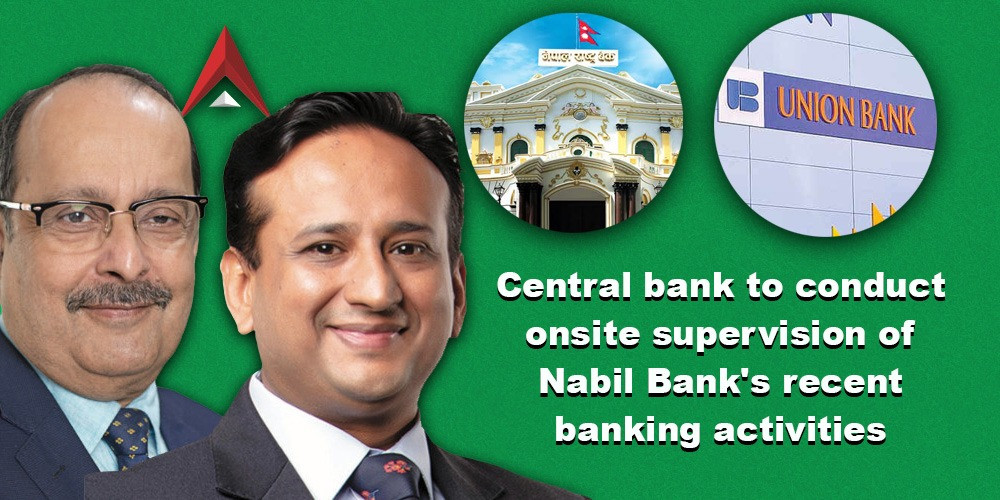
Kathmandu- Nepal Rastra Bank (NRB) is set to conduct onsite supervision of Nabil Bank next week. The central bank's Bank Supervision Department is preparing to include Nabil Bank in its list of institutions for onsite supervision.
According to NRB, there are two types of supervision: off-site and onsite. Onsite supervision involves regular (risk-based) and special inspections of banking and financial institutions, while off-site supervision includes regular surveillance, monitoring through a supervisory information system, and tracking large and related party exposures.
During the upcoming onsite inspection, NRB will review Nabil Bank's recent banking activities, conduct special inspections, and carry out an in-depth study of the bank’s operations over the past three years. The review will cover various aspects, including the status of the board of directors, the bank’s strategic and business action plans, internal control systems, capital planning and adequacy, liquidity, market and interest rate risks, operational risk management, off-balance sheet transactions, and issues related to money laundering, among others.
An official from the Supervision Department, speaking on condition of anonymity, confirmed that the supervision team will also examine concerns raised about the bank’s directors, focusing particularly on its credit flow, credit classification, Basel reports, and asset valuation.
Meanwhile, the central bank is expected to be reviewed nexus between Nabil Bank's board of directors and Union Bank of Colombo in Sri Lanka.
The Chaudhary Group acquired Union Bank of Colombo, Sri Lanka’s eighth-largest bank, in 2022. Following this acquisition, Nirvana Chaudhary became Chairman, Malay Mukherjee a Director, and Sanjay Pokharel, a director at Nabil Investment Banking, also joined the board. The Sri Lankan Central Bank sought clarification from NRB regarding the legal provisions governing such appointments. In response, NRB acknowledged gaps in Nepali regulations and emphasized the need for legal updates, thus paving the way for Nirvana Chaudhary to become Deputy Chairman of Union Bank in December 2024.
The Chaudhary Group has also invested in NB International, a tax haven-based company in Ireland, with Rahul Chaudhary, Binod Chaudhary’s son, being a non-resident Nepali citizen. Nepali law exempts non-resident Nepali citizens from investing in Nepal and receiving dividends. There are suspicions that the Chaudhary Group used Nabil Bank's dividends to purchase Union Bank of Colombo, potentially placing pressure on Nabil Bank's capital.
Nabil Bank has been also under pressure due to cash dividends paid out in the last two years. The central bank recently rejected Nabil Bank’s proposal to issue preference shares, citing a violation of its unified directive on such issuances.
On September 2, 2024, Nabil Bank's special general meeting approved a plan to issue non-redeemable, unsecured preference shares worth Rs 5 billion, along with a 10 percent cash dividend. However, the bank’s primary capital fund has been strained by these dividend payouts, and by the second quarter of the current fiscal year, its capital adequacy ratio (CAR) had dropped to 9.04 percent , nearing the regulatory minimum.
In response to this strain, Nabil Bank sought approval to issue preference shares with a 10-year maturity period. However, NRB rejected the application, reinforcing its directive prohibiting repayment timelines for preference shares.
Despite continued lobbying by Nabil Bank, NRB maintained its firm stance, stating that institutions must comply with the central bank’s directives. The source also indicated that granting permission for a special general meeting again for the same purpose would not be appropriate from a regulatory perspective
.
As per NRB’s Capital Adequacy Ratio (CAR) guidelines, banks are required to maintain a minimum total capital ratio of 8.5 percent. If CAR falls below this minimum, NRB can stop dividend distributions and credit flow.
Meanwhile, Nabil Bank’s Non-Performing Loans (NPLs) had reached 4.93 percent by the second quarter of the current fiscal year. If the bank fails to reduce its NPLs in the remaining period of the fiscal year, it is likely that its CAR will fall below the required minimum.
© 2026 All right reserved to biznessnews.com | Site By : Sobij
© 2026 All right reserved to biznessnews.com | Site By : Sobij