
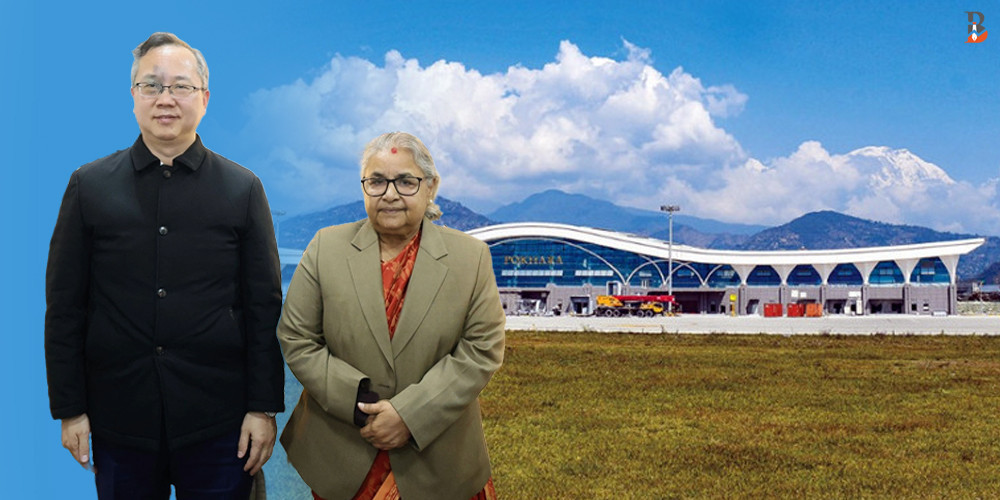
Kathmandu -China strongly protested a corruption case filed against a Chinese contractor involved in the Pokhara International Airport project, a flagship of the Belt and Road Initiative.
Chinese Ambassador to Nepal Chen Song urged the Nepali side to avoid linking China or Chinese institutions to the case.
After his three-year term, Ambassador Chen is returning to Beijing later this month. He arrived in Kathmandu in January 2023 and was recalled with a promotion to director general.
The current period is diplomatically sensitive in Nepal due to the upcoming House of Representatives election. Traditionally, ambassadors of major countries remain in their posts during such times.
Ambassador Chen expressed dissatisfaction over linking China and Chinese companies to the Pokhara airport corruption case and requested the Prime Minister’s support. This is China’s first formal high-level protest with the Nepalese government.
Ambassador Chen argued that China CAMC Engineering, a Chinese state-owned enterprise, cannot be involved in corruption under Chinese law. He said the Pokhara airport issue is a result of Nepal’s internal political and administrative disputes, and China or Chinese institutions have no role in it.
Before meeting the Prime Minister, Ambassador Chen met several ministers, senior officials, and Chinese stakeholders, expressing deep dissatisfaction and concern.
A senior government official said the Chinese side considers it unjust to name a Chinese company as a defendant in the corruption case. Ambassador Chen suggested that external forces and their agencies deliberately internationalized the issue.
On Mangsir 21, the Commission for the Investigation of Abuse of Authority filed a corruption case at the Special Court, concluding that serious irregularities occurred during the construction of Pokhara International Airport. The commission named 55 defendants, including five former ministers, ten former secretaries, and China CAMC Engineering.
The commission demanded the recovery of 8.36 billion rupees from each defendant. The charge sheet states that the contractor attempted to secure the project with malicious intent and influence the decision-making process in a project built with Chinese assistance.
The memorandum of understanding mentioned that the Government of Nepal would provide solid and adequate support to the contractor during the tender process. Based on this provision, the Civil Aviation Authority of Nepal awarded the engineering, procurement, and construction contract, according to the commission.
Of the loan taken from China Exim Bank for the project, 25 percent is interest free, while the remaining amount carries an annual interest rate of 2 percent. The loan has a repayment period of 20 years, including a seven year grace period.
Although Ambassador Chen again urged the Prime Minister not to link China or Chinese institutions to the case, Prime Minister Karki clearly stated that the anti graft commission is an independent and autonomous constitutional body and that the government cannot interfere in its investigation process.
The charge sheet alleges that the defendants colluded to evaluate and select a technically weak and financially overpriced proposal. It also includes allegations that illegal negotiations were conducted by forming advisory groups twice, despite no such provision existing in the Public Procurement Act.
China has consistently presented the Pokhara International Airport project as an important example of its presence in South Asia under the BRI. For this reason, the corruption case appears to have created ripples not only at the legal level but also at the diplomatic level.
During the meeting, Ambassador Chen also urged Nepal to control anti China activities, activities related to Tibetan refugees, and any potential anti China actions along the northern border.
In response, Prime Minister Karki reiterated Nepal’s full commitment to the One China policy and stated clearly that Nepali soil would not be allowed to be used against any neighboring country. Ambassador Chen also conveyed that China is ready to expand cooperation with Nepal under the BRI, stressing that mutual trust and cooperation are essential.
Nepal and China signed the BRI framework agreement in 2017. It was updated in December 2024 during the China visit of then Prime Minister KP Sharma Oli. Of the ten projects proposed by Nepal during that visit, none has moved into implementation so far.
© 2026 All right reserved to biznessnews.com | Site By : Sobij
© 2026 All right reserved to biznessnews.com | Site By : Sobij