

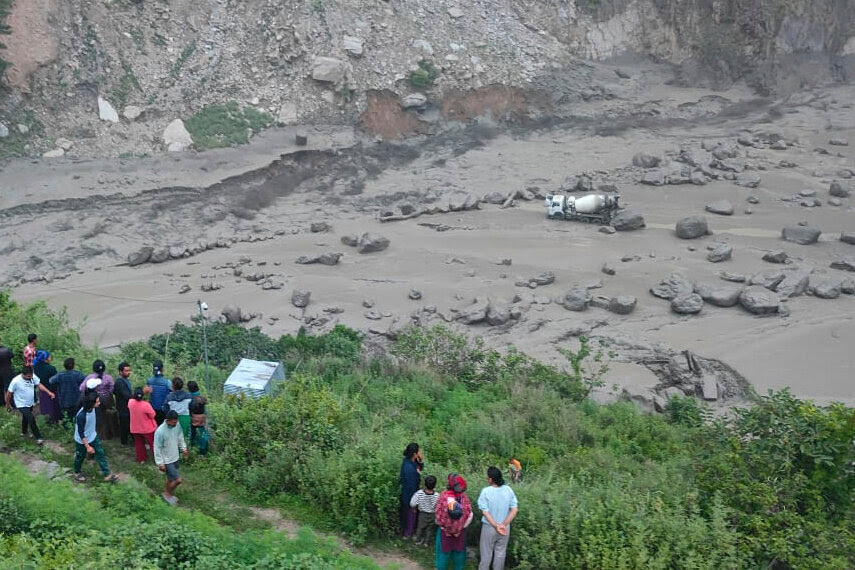
Kathmandu - The International Centre for Integrated Mountain Development (ICIMOD) has stated that extreme rainfall was not the cause of the devastating flood that struck Rasuwa District, Nepal, early Tuesday morning.
While the exact cause remains undetermined, early indications point to a possible glacial or landslide lake outburst in the upper catchment of the Trishuli River in the Tibetan Autonomous Region of China.
ICIMOD emphasized that current weather models and satellite data show no evidence of intense rainfall in the days leading up to the flood.
'Preliminary analysis using global and regional forecasting systems, including HIMAWARI-8 cloud imagery and NOAA’s Global Forecast System, suggests that extreme rainfall was not the primary trigger of the event,' said Pradeep Man Dangol, Senior Hydrology Research Associate at ICIMOD.
Glacial Lake Outburst Suspected
According to ICIMOD, one glacial lake upstream of the Trishuli River was previously identified as high-risk in a 2021 inventory and is now under close scrutiny. 'The size and number of glacial lakes in the basin have significantly increased—by 33 percent and 16 percent respectively—between 1990 and 2020,' Dangol added.
Due to persistent monsoon cloud cover, investigators have been unable to obtain clear satellite images to verify whether any glacial lake breached or experienced sudden volume changes.
ICIMOD is calling for a joint, multidisciplinary investigation involving geologists, glaciologists, hydrometeorologists, and remote sensing experts.
River Damming Ruled Out — For Now
Social media footage and initial field reports suggested that the floodwaters may have originated from the Lende Khola tributary in Kerung, Rasuwa, which flows into the Bhotekoshi Nadi, a major tributary of the Trishuli River. However, hydrological data from Nepal’s Department of Hydrology and Meteorology showed no sharp fluctuations typical of temporary damming or a sudden breach.
'Current water-level records do not support the hypothesis of river damming, though field verification in upstream areas is still required,' ICIMOD noted.
Growing Complexity of Mountain Hazards
ICIMOD experts say this event highlights the increasing unpredictability of mountain disasters in the context of global climate change.
'It’s becoming increasingly difficult to predict how mountain hazards will occur,' said Qianggong Zhang, Head of Climate and Environmental Risk at ICIMOD.
'Floods are not always caused by heavy rain, and response plans must consider multiple, overlapping triggers.'
Director General Pema Gyamtsho expressed deep concern over the region’s vulnerability, 'While it’s too soon to say what exactly triggered the Rasuwa floods, one thing is clear: rising global temperatures are making mountain hazards more frequent, intense, and complex. Just this June, we saw lake outburst events in Nepal, Afghanistan, and Pakistan. This flood further confirms our Monsoon Outlook’s prediction of a high-hazard summer.'
He stressed the urgent need for increased investment in disaster monitoring and early warning systems:
'To protect lives, we must scale up the best technologies and strategies for disaster preparedness. ICIMOD stands ready to work with partners across the region and globally to meet this critical challenge.'
© 2026 All right reserved to biznessnews.com | Site By : Sobij
© 2026 All right reserved to biznessnews.com | Site By : Sobij