

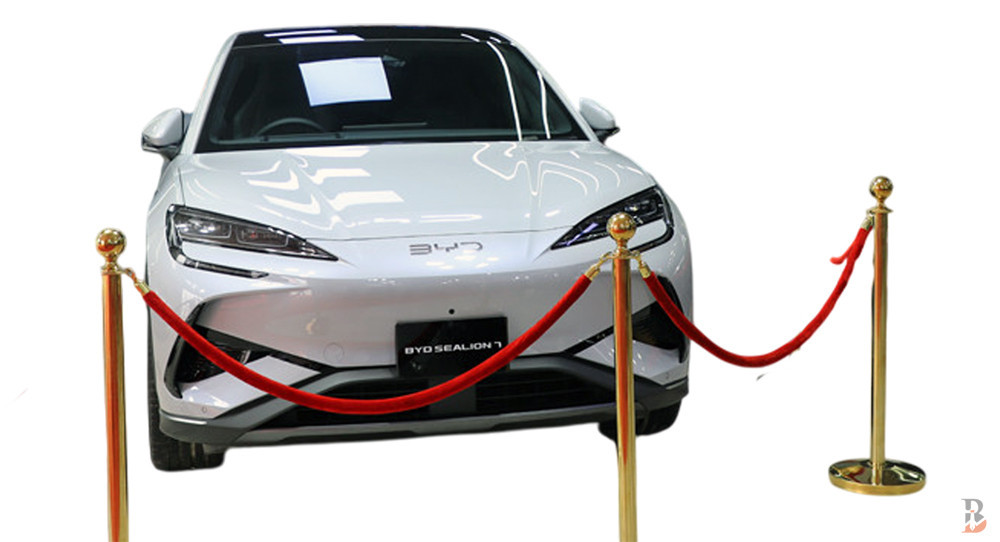
Kathmandu – Cimex Inc, the official distributor of BYD vehicles in Nepal, has once again deceived consumers after earlier controversies over tax evasion in car imports and charging repair costs equal to the price of a new vehicle.
The company had announced a 10-year warranty on BYD cars, which has now been found to be insurance-based rather than provided by the original equipment manufacturer (OEM).
The OEM warranty covers only eight years, while the remaining two years are covered through an insurance policy.
Cimex Inc, did not inform customers that the additional two-year warranty was insurance-based. Buyers were simply told that they would receive a 10-year warranty when purchasing a BYD car.
A few months ago, Cimex entered into an agreement with an insurance company to introduce a new customer scheme called ‘Comprehensive Extended Warranty.’
However, this scheme was launched without prior approval from the Nepal Insurance Authority, which is mandatory before issuing any insurance-related policy.
Despite this legal requirement, the insurance company signed the agreement with Cimex, turning a blind eye because it ensured business for the next ten years.
Globally, such insurance-backed extended warranty models were introduced years ago but did not succeed. BYD appears to have revived this approach in Nepal through Cimex, misleading consumers and even the regulatory body.
In Nepal, the management and decision-making of BYD’s operations are largely handled by Chinese employees, with Cimex Inc serving mainly as a legal front.
An ‘extended warranty’ refers to any warranty offered beyond what the manufacturer provides.
Cimex claimed to offer a 10-year warranty on BYD vehicles but did not clarify that only eight years were covered by the manufacturer and two years by insurance.
When an extended warranty is issued through insurance, consumers must be clearly informed. Moreover, the insurance company must receive regulatory approval before issuing such a policy.
According to an official at the Nepal Insurance Authority, only recently have some insurance companies obtained approval for such products.
Previously, both Cimex and the insurance company issued these policies without authorization.
The official confirmed that consumers must be explicitly informed when an extended warranty is insurance-based, but in this case, neither Cimex nor the insurance company disclosed this information.
Even in China, BYD does not offer a 10-year warranty. In all countries where BYD’s electric vehicles are sold, the standard warranty is eight years.
Thus, the manufacturer’s warranty for BYD vehicles in Nepal is also only eight years.
Without informing customers, Cimex entered into a deal with an insurance company that requires every buyer to maintain full insurance with that same company for ten years to claim the extended two-year warranty.
The company officially announced this 10-year warranty in mid- April though the necessary approval from the Insurance Authority was obtained only two months ago.
Details of the Cimex and insurance company agreement for the two-year extension:
The insurance company agreed to partner with Cimex because the deal guaranteed business for a decade. Under the agreement, the manufacturer covers the first eight years, and for the final two years, Cimex pays a small insurance premium to the company.
To qualify for the extended warranty, customers must maintain full insurance coverage with the designated insurer for ten years and service their vehicles only at Cimex’s authorized centers. It is unclear whether the warranty will remain valid if the car is resold.
In the first year, Cimex agreed to pay the premium amount. As per the agreement, Cimex pays 0.1 percent of the total value of the components covered under the extended warranty (such as the battery, motor, and controller) to the insurance company upfront.
For example, if these components are currently valued at Rs 2.5 million, Cimex will pay Rs 2,500 (0.1 percent) to the insurer when the car is sold.
This arrangement benefits both the insurer and Cimex, as it gives the appearance of a 10-year warranty and helps attract customers.
However, the conditions make it nearly impossible for most buyers to actually benefit from the warranty.
Most Nepali car owners stop maintaining full insurance after paying off their bank loans. If the buyer switches to another insurance company or sells the car, the extended warranty automatically becomes void.
Regulatory authorities must ensure that such policies are designed to protect consumers, not just to benefit car dealers and insurance companies.
© 2026 All right reserved to biznessnews.com | Site By : Sobij
© 2026 All right reserved to biznessnews.com | Site By : Sobij