
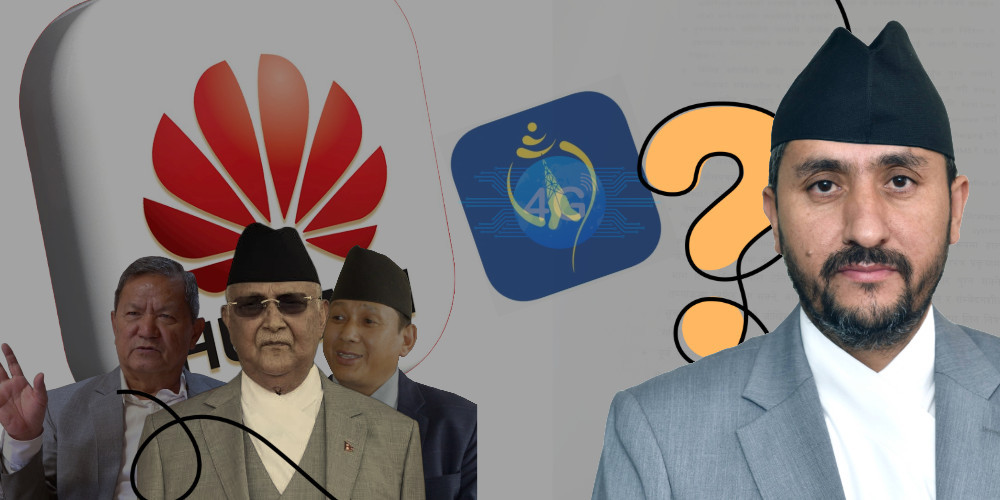
Kathmandu- A committee formed to review Nepal Telecom’s plan to award its billing system contract to Huawei has raised a series of pointed questions about the process and its risks.
The Ministry of Communication and Information Technology formed the committee under former secretary Maniram Gelal. Members included joint secretaries Gaurav Giri, Aadesh Khadka and Krishna Pant. Nepal Telecom was represented by Kamal Lamichhane and the Telecommunications Authority by Pradeep Paudel.
The committee examined the contract steps, the possibility of vendor dominance and the handling of sensitive systems.
The report does not tell Nepal Telecom to continue or cancel the contract. However, it does outline several issues, including missing legal procedures, questionable evaluation steps and a high chance of vendor lock.
Nepal Telecom does not have to follow the Public Procurement Act directly. It must create internal procedures that align with the principles of the Act.
The committee found that Nepal Telecom had not approved such procedures and had instead relied only on financial regulations. This created a legal gap. The committee stated that the main legal approval for the purchase was missing.
It also found irregularities in forming the evaluation committee. The law requires at least one legal representative. Nepal Telecom did not include one for this billing procurement.
A Supreme Court order had directed Nepal Telecom to create a ‘Gartner’ listing to ensure a reliable and high quality billing system. The committee found that this was ignored.
Minister Jagadish Kharel said he would not issue directions based on the report. He said the decision rests with Nepal Telecom. Ministry officials said Nepal Telecom would still be informed about the findings.
The committee warned that the current plan could lower service quality and raise long term costs.
It found unclear terms for future technology and equipment. These gaps could increase Nepal Telecom’s liability over time.
The report flagged a major concern. All three of Nepal Telecom’s core systems could fall under Huawei’s control. Nepal Telecom said it would maintain oversight. The committee said the risk remains. If one company controls the core, RAN and billing systems, the risk to service quality and data security grows.
The committee traced the origins of the plan to the previous government led by KP Sharma Oli. It said political backing had created a setup that favoured Huawei. Nepal Telecom continued to follow that path even after the government changed.
The financial proposal was about to be opened with only Huawei qualified when the Oli government collapsed. The process had been shaped by coordination between KP Sharma Oli and then minister Prithvi Subba Gurung.
After the new government took office, Minister Kharel halted the process and formed the study committee.
The earlier tender had only one bidder and no Chinese company. It was cancelled.
The new tender was issued with changes that favoured Chinese firms. The specifications were adjusted to allow lower grade hardware.
This benefited Huawei.
The current billing system uses Intel 2.4 and RISC 5 gigahertz hardware. The revised tender recognises only 2.4 for both categories. Market hardware has already moved to Intel 2.7. RISC is also being pushed down from 5 to 2.4.
This again benefits Huawei, which uses older equipment because it cannot access new hardware after the 2019 restrictions from the United States and Europe.
Other companies use newer, higher grade equipment. They cannot match Huawei’s lower cost because they no longer make older models. As a result, Huawei fits the cheaper class and gains an advantage.
The final bidders are Huawei and Hail Cloud. Hail Cloud was once a ZTE subsidiary, later bought by Alibaba. It remains a strategic partner of ZTE.
The committee said sensitive telecom services cannot rely on a single company. Telecom services are linked to privacy. States normally enforce balance.
Here, the committee found that political influence had given one company an advantage.
Nepal Telecom issued the tender in a way that conflicted with a Supreme Court order requiring balance between systems. The court had warned that vendor dominance across core, RAN and billing increases the risk of manipulation. Nepal Telecom still moved forward with a tender that eased Huawei’s entry.
The tender accepted outdated technology. This again favoured Huawei. It raised the chance that Huawei could win with cheap hardware and gain monopoly control of sensitive systems.
Huawei already controls two of Nepal Telecom’s main systems. Billing was the only major system it did not control. This tender would complete its control.
The committee pointed to patterns seen in the 4G project. It said collusion and manipulation had helped Huawei then and were now being repeated. During the 4G tender, Mooniver was disqualified, leaving only Huawei and ZTE. Huawei won the larger package.
The 4G project cost more than 19 billion rupees. Parliamentary committees raised questions about corruption. The CIAA did not act strongly. Investigations are still said to be ongoing.
Because Chinese companies were involved, political resistance weakened. Oversight reduced. Huawei used this pattern again.
The same individuals in management and politics were involved. The same route used in the 4G project was used in the billing case.
Nepal Telecom argued that the 4G cost was high because equipment supported 5G. Private operators completed similar work at half the cost. The committee said the 4G quality was limited instead. Huawei did not install small cells. This harmed 4G performance.
The committee said Huawei had not met previous obligations. A company that fails to meet obligations should be disqualified from new tenders. Instead, suspended managing director Sangita Pahadi cleared Huawei for the billing tender.
© 2026 All right reserved to biznessnews.com | Site By : Sobij
© 2026 All right reserved to biznessnews.com | Site By : Sobij