

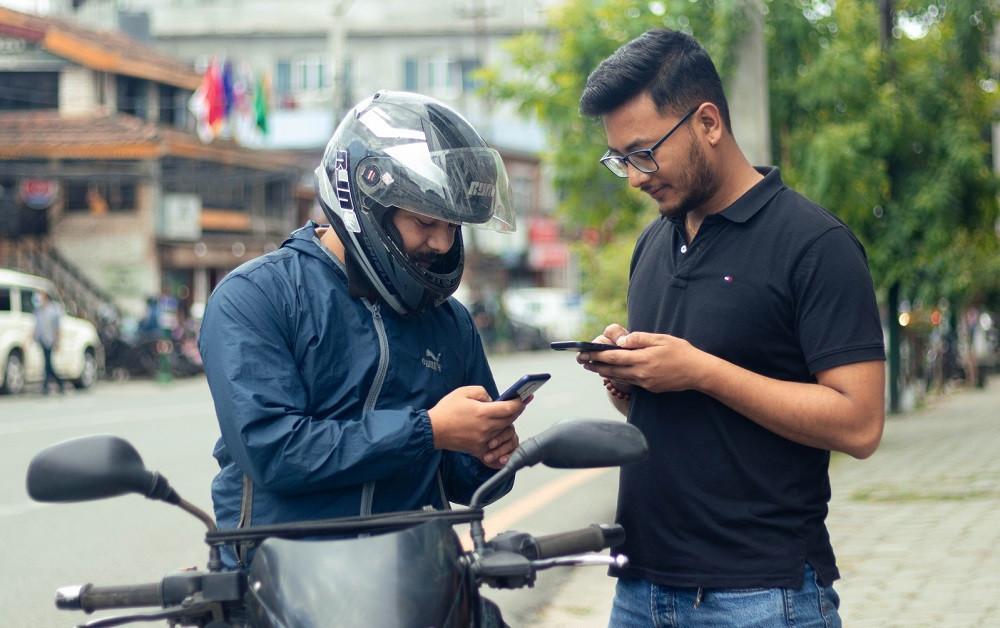
Kathmandu-The government is preparing a central standard to regulate motorcycle and scooter-based passenger services, with the Department of Transport Management drafting the “Digital Mobility Service Operation Standards 2082.”
Provincial governments have been regulating ride-sharing services in different ways, but the new framework aims to bring uniformity across the country. The department has begun consultations with stakeholders on the draft.
Under the proposal, service providers must obtain approval from the department and register in a central system to operate digital mobility services. Applications can be submitted either physically or online in a prescribed format.
A Digital Mobility Service Quality and Standards Testing Committee will assess whether providers meet the required standards, with the Director General making final decisions based on its recommendations.
Service providers will be responsible for maintaining records of operators, vehicles and personnel, ensuring service quality, updating documents, and paying applicable taxes and revenues.
The department will oversee the central system, update it regularly, and monitor nationwide compliance.
Ride-sharing services already regulated under provincial laws will be required to integrate into the central system through APIs. Vehicles used in digital mobility services must obtain operational approval under federal or provincial laws, and their registration must specify “Digital Mobility Service.”
These vehicles will be treated as public transport and must be renewed annually according to provincial regulations. Drivers will be allowed to work part-time under the system.
The draft sets clear standards for vehicles. Two-wheelers must be less than 15 years old, meet national emission standards if they use combustion engines, and, in the case of electric models, have at least 1.5 kW motor power and a speed exceeding 40 km per hour.
Four-wheelers must also be less than 15 years old, comply with emission standards, and, if electric, have a minimum motor power of 40 kW and at least 200 liters of boot space.
Drivers must be at least 18 years old, have held a license for more than one year, be free from substance abuse, physically and mentally fit, without criminal records, capable of using smartphone applications, and possess basic knowledge of traffic laws.
Service providers must test drivers before onboarding them and ensure they are covered by life insurance and enrolled in the Social Security Fund.
The department will also regulate service applications by integrating them into the central system, approving their operation, monitoring transactions, and handling customer complaints. The move follows a Supreme Court directive to bring such services under a legal framework.
The draft also proposes fare regulations, requiring transparent pricing in apps based on distance, with a minimum charge equivalent to three kilometers even for shorter trips. Surge pricing will be capped at 30 percent above the base fare for two-wheelers and 40 percent for four-wheelers, replacing current practices where fares can rise by 100 to 200 percent.
Service providers will be required to arrange the necessary applications, vehicles and drivers themselves. If these are sourced through agreements with third parties, revenue sharing must follow agreed terms.
Vehicles must obtain route permits similar to public transport, and those operating across multiple provinces must secure permits from a vehicle testing office. No vehicle will be allowed to hold more than two route permits.
The draft also introduces provisions on social security and insurance. All workers must be enrolled in the Social Security Fund, with contributions from both providers and workers in line with existing laws.
The minimum monthly contribution is proposed at Rs 5,000, to be set through mutual agreement. The system must automatically deduct contributions and display them in the app along with the worker’s identification details.
An accident fund will also be established, with one percent deducted from each fare and an additional 0.5 percent contributed by service providers from their daily income. The fund will cover insurance, medical expenses and financial support for dependents.
In case of death or total disability, compensation of Rs 1 million is proposed, while other injuries will receive between Rs 50,000 and Rs 200,000 depending on severity. The department has included various provisions and schedules in the draft and plans to finalize it after consultations before submitting it to the ministry for approval.
© 2026 All right reserved to biznessnews.com | Site By : Sobij
© 2026 All right reserved to biznessnews.com | Site By : Sobij