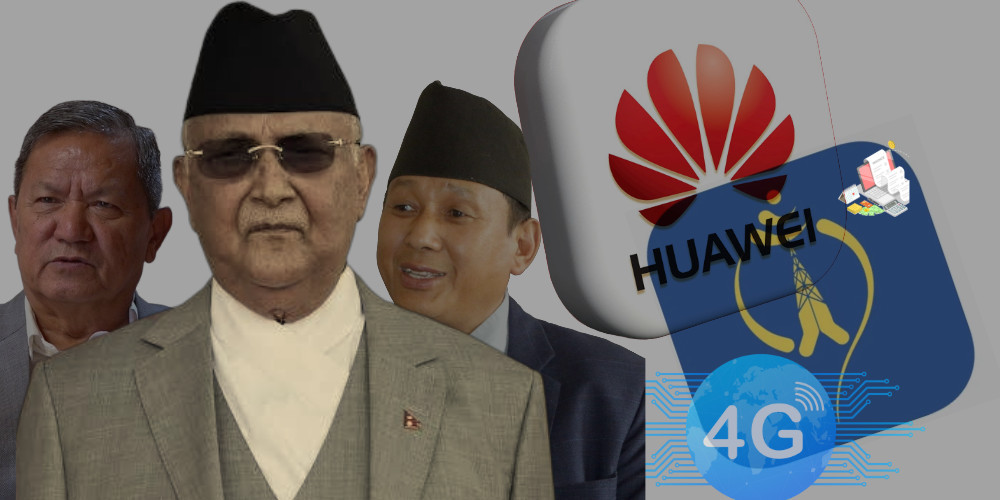
Kathmandu – Among the biggest beneficiaries after CPN-UML Chair and outgoing Prime Minister KP Sharma Oli assumed power is Huawei, the Chinese multinational company.
With Oli’s backing, Huawei has gained a monopoly over state-owned Nepal Telecom. Over the past decade, it has become dependent on Huawei, creating a 'vendor lock-in', meaning crucial Nepal Telecom's technologies are controlled by just one firm, leading to quality issues and heavy losses.
Telecom services rely on three key systems: the Line Access Network (core system, power, and transmission), the Radio Access Network, and billing. Huawei already dominates the first two and is now set to take over billing as well.
Such dominance by one company’s technology has left Nepal Telecom’s business strategy failing on one hand and highly risky on the other, according to experts.
Private operators, by contrast, have adopted mixed technologies. For example, Ncell uses both ZTE and Huawei technology.
But Nepal Telecom, citing procurement procedures, has become overly dependent on a single vendor, creating immense risks at business, technical, and overall communications levels.
'This isn’t just a business issue; it’s also a strategic matter. But such a monopoly by a single company can never be good,' said one Nepal Telecom official seeking anonymity.
The dominance of a single vendor over Nepal Telecom’s core and sensitive systems even defies basic commercial common sense. There had been efforts to amend regulations to end such dependency, including discussions during the 4G tender process, but no progress was made.
Currently, all 2G and 3G networks — which provide voice and data services — are powered entirely by Huawei technology. Both the network and core systems are controlled by Huawei, and the company also holds the maintenance responsibility.
'With so much control in the hands of one company, it automatically gains access to and control over all of Telecom’s data. If billing also goes to Huawei, it will become a complete vendor lock,' said another Nepal telecom engineer.
Huawei has already prepared the ground for its dominance in 5G as well. Once this happens, Nepal Telecom will become fully dependent on Huawei. While Huawei’s technology is advanced and competitively priced, many argue that a mixed-model approach is essential for a telecom operator.
Relying on a single company creates two risks: First, if any failure occurs, services could collapse entirely. Second, it causes financial losses. If all systems belong to one company, Nepal Telecom will have no option but to pay the price it sets. But with mixed technologies, operators can bargain, ensuring price competitiveness — a strategy Ncell has adopted.
Oli’s Protection: From Parbat Gurung to Prithvi Subba Gurung
Huawei’s dominance in Nepal Telecom owes more to political protection than managerial strategy. During Oli’s earlier tenure as Prime Minister, Parbat Gurung served as Communications Minister. Under Parbat, Huawei entered Nepal Telecom via the 4G project, taking over most of the sensitive infrastructure.
Minister Parbat Gurung facilitated Huawei, with mediation from Oli’s trusted business partners who had investments in media and hydropower. Despite irregular evaluations and costs, Huawei secured Nepal Telecom’s business.
Later, during Oli’s more recent term, Prithvi Subba Gurung was Communications Minister. With his support, Huawei is now set to secure the billing contract. Despite the company being blacklisted elsewhere, arrangements have been made to ensure Huawei wins the bid.
Oli’s ties with Huawei run so deep that the company has consistently enjoyed his backing in all dealings.
Sensitive Services and a Pre-Set 'Arrangement Model'
Telecommunication is not just a business; it is directly linked to citizens’ privacy. That is why governments usually enforce strict standards. In Nepal, however, Huawei has been allowed to dominate under the Prime Minister’s protection.
The new billing system tender evaluation has concluded, and Huawei is set to win. From the tender specifications onward, the process was tailored in its favor.
This was done in violation of a Supreme Court directive. A joint bench of Justices Dr. Nahkul Subedi and Mahesh Sharma Poudel had instructed that Nepal Telecom maintain balance between different systems. With the same company controlling the core, RAN, and billing, vendor manipulation risks would rise — making it possible for weaknesses in one system to be concealed in another.
Yet, ignoring this directive, Nepal Telecom structured its tender to suit Huawei, even accepting outdated technology. The bid specifications lowered hardware requirements to Huawei’s level. For example, while the current billing system uses Intel 2.4 and RISC 5 gigahertz hardware, the new tender limited both categories to 2.4, even though the global standard has already advanced to Intel 2.7. Similarly, RISC has been capped at 2.4 instead of 5.
Huawei, restricted by US and European bans, only has access to equipment manufactured before 2019. The tender specifications were adjusted accordingly to ensure its eligibility.
As a result, Huawei not only stands to win with substandard, cheaper equipment, but will also gain monopoly control over sensitive systems.
Previously, Huawei lacked billing technology in Nepal Telecom. This tender now creates a complete vendor lock situation, ensuring Huawei’s full control.
Huawei’s Mismanagement in the 4G Project
Because of Huawei’s misconduct, Nepal Telecom’s 4G services have failed to deliver expected results. Even the regulator, Nepal Telecommunications Authority, has found Telecom’s 4G performance poor, corroborated by user experience.
Huawei was the primary supplier and installer for the 4G project, handled through a Hong Kong-based company called China Communications Services Corporation Limited
(CCSI). But it repeatedly violated agreements, installing substandard equipment. Out of the Rs 19 billion project, Huawei executed Rs 17 billion worth of work.
One major breach involved antennas. Although the agreement specified US, Canadian, European, Finnish, and Australian-made equipment, Huawei claimed unavailability and installed Chinese antennas instead. This breach is currently under investigation by the Commission for the Investigation of Abuse of Authority (CIAA).
Equipment origin matters greatly for durability. Despite the agreement, Huawei used Chinese-made antennas, with the then Telecom chief admitting this. Payments for these unauthorized devices are now under CIAA probe.
More importantly, Huawei has failed to install a key piece of equipment — 'small cells' — crucial for enhancing coverage between towers and in difficult terrain. Telecom’s 4G expansion contract required Huawei (via CCSI) to install 6,000 small cells worth Rs 7 billion. The company never fulfilled this obligation.
The absence of small cells has drastically reduced 4G quality. Service in underground areas and building interiors has failed. Instead of fulfilling the contract, Huawei has now stated it won’t install them at all.