
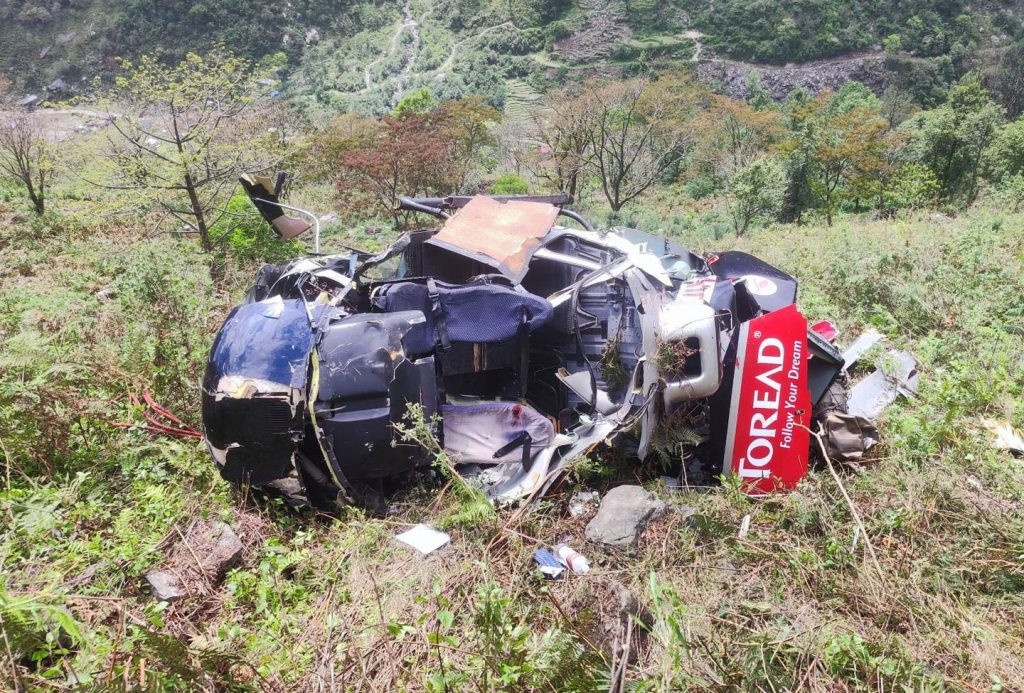
Kathmandu- A final investigation report into the May 5, 2023, crash of a Simrik Air helicopter in Sankhuwasabha has identified pilot overcorrection and a critical lack of standard safety procedures as the primary causes of the fatal accident.
The accident, which occurred during a cargo sling operation for the 'Upper Arun' hydropower project, resulted in the death of one passenger (identified as a local helper) and left the Pilot-in-Command (PIC) with serious injuries.
According to the Aircraft Accident Investigation Committee, the helicopter (registration 9N-AJZ) was on its 17th mission of the day when the pilot attempted a 'left skid contact partial hover' to disembark crew members on uneven terrain. This maneuver involves keeping the aircraft horizontal while only one landing skid touches the ground.
While in this delicate position, the helicopter experienced a sudden shift in its Center of Gravity (CG). In an attempt to stabilize the aircraft, the pilot provided an 'overcorrection input' to the left control stick (cyclic), causing the spinning rotor blades to tilt and strike a large drilling machine stationed nearby. The impact caused the pilot to lose control; the helicopter slid down a slope, struck its tail rotor, and toppled several times before coming to a rest.'
The investigation found that while the helicopter was airworthy and the pilot was highly experienced with over 5,000 hours on this aircraft type, several safety protocols were bypassed:
Untrained Personnel: The passenger who died was a local resident who was not trained for special helicopter operations and did not receive a safety briefing before the flight.
Regulatory Void: At the time of the accident, there were no published requirements or Standard Operating Procedures (SOPs) in Nepal for partial hover operations, despite many operators frequently performing them.
Environmental Factors: Weather was ruled out as a cause, as conditions were reported as fair and clear with calm winds.
Industry-Wide Changes
In the wake of the tragedy, the committee issued several urgent safety recommendations to the Civil Aviation Authority of Nepal (CAAN). As a direct result, simulator training became mandatory for all helicopter pilots in Nepal starting January 1, 2024.
Additionally, Simrik Air has since developed and applied for official approval of new SOPs specifically for partial hovering operations to prevent future recurrences. The committee emphasized that pilots must now ensure that only trained personnel are allowed on board during high-risk sling missions.
© 2026 All right reserved to biznessnews.com | Site By : Sobij
© 2026 All right reserved to biznessnews.com | Site By : Sobij