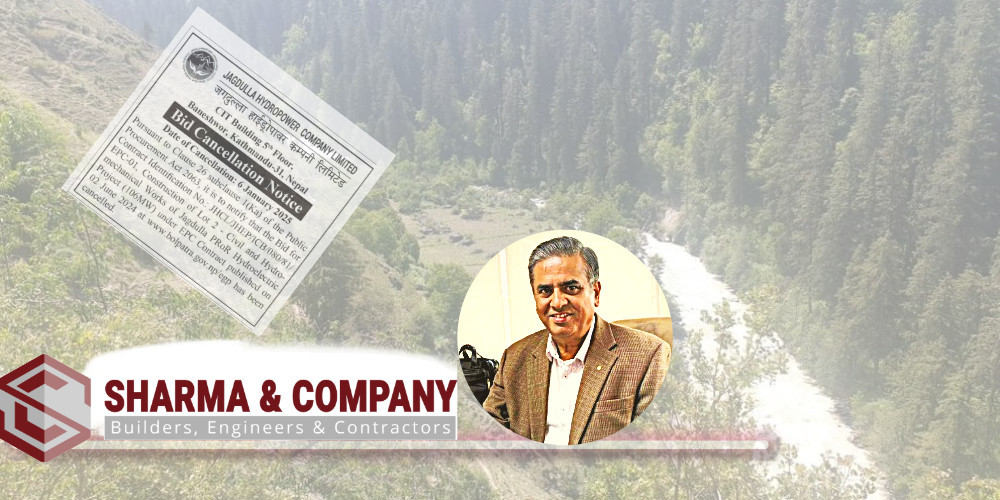
Kathmandu- Jagdulla Hydropower Company Limited has unexpectedly canceled the tender process for its 106 MW hydropower project, which has raised concerns and could lead to significant delays.
The international tender for the project was initially announced on June 2, with the submission deadline being extended four times. By the final deadline on October 4, seven companies had submitted their bids, leading to optimism that the project—considered one of the most promising hydropower developments in Karnali—would proceed.
The project, highly anticipated due to its potential, was expected to move forward swiftly, with financial proposals to be invited from the technically shortlisted companies. However, the process took an abrupt turn when Sanjiv Sapkota, the Chief Executive Officer of Jagdulla Hydropower, issued a surprising notice on Monday, announcing the cancellation of the entire tender. This decision not only delayed the project but also raised concerns about escalating costs and financial uncertainty, leaving banks—both public and private—that had already committed to financing the project in a state of limbo.
The tender was based on the Engineering, Procurement, and Construction (EPC) model. Some of the well-known companies that bid for the project included JIEC and Sharma & Company, Chinese firm Zhongding International, RSC and Avir, High Himalaya Hydro Construction and AGE Company, Sinohydro Corporation, JCE and ANK Joint Venture, Rail Vikas Nigam, Patel Engineering, Lama Construction, and Om and Fewa JV Construction. Despite the qualifications and reputations of these companies, Jagdulla Hydropower declared all the bids technically unqualified, leading to the termination of the tender. Sources suggest that undisclosed behind-the-scenes factors may have influenced this decision, raising doubts about the process’s transparency.
This cancellation has raised significant concerns about the project’s future, its impact on regional development, and the confidence of investors in Nepal’s hydropower sector.
In the past, CEO Sanjiv Sapkota, who was appointed with the support of former Minister of Energy, Water Resources, and Irrigation, and Maoist leader Shakti Bahadur Basnet, had been working to secure the contract for the joint application of JIEC, Sharma & Company, and Chinese company Zhongding International. Maoist leaders had reportedly put pressure on Sapkota to award the contract to the same company. However, the technical committee briefed Sapkota, informing him that the company in question would fail the technical evaluation, while the remaining six companies would pass.
Following this briefing, the process was put on hold for an extended period. When it became clear that Sharma & Company could not be technically selected, further pressure was applied on CEO Sapkota by the Maoist leaders and other associates.
As Sharma & Company was no longer a viable option, some Maoist leaders and their contacts reportedly suggested that the entire tender process be canceled instead. CEO Sapkota, acting on this suggestion, bypassed the board of directors and abruptly canceled the tender, according to sources.
The 106 MW project, which was initially set to be completed in five years, had an estimated cost of around 23 billion rupees. Financial arrangements had already been finalized, with 16 billion rupees secured through loans and 7 billion rupees through equity investment.
The project’s shareholding structure included a 26 percent stake held by the Electricity Generation Company as a founder shareholder. Other stakeholders included Hydroelectricity Investment and Development Company Limited (HIDCL) with 10 percent, Nepal Electricity Authority with 9percent, and the governments of Karnali Province, Jagadulla Rural Municipality, and Mudkechula Rural Municipality, each holding a 1percent stake. Public shareholders were allocated 33percent, with 10percent reserved for affected residents of Dolpa District, and 3 percent each for transmission line-affected residents and project employees.
The project has already obtained the Detailed Project Report (DPR) and environmental clearance from the Ministry of Forests and Environment. Compensation for the acquisition of 255 ropanis of land has also been completed.
Nepal Infrastructure Bank Limited is leading the financial management of the project, with an investment of 4.7 billion rupees. Nabil Bank is contributing 4 billion rupees, HIDCL 4 billion rupees, Laxmi Sunrise Bank 2 billion rupees, and Everest Bank 1.5 billion rupees. The project is expected to take five years to complete.
The project received its electricity production survey license on July 2, 2017, and its transmission line survey license on January 1, 2020. A power purchase agreement (PPA) for the electricity generated by the project was signed in April of this year.
Designed as a semi-reservoir hydropower project, the project features a gross head of 789 meters and will generate 623 GWh of energy annually. The design includes the construction of a 23-meter-high and 93-meter-long dam at Hurikot, Jagadulla Rural Municipality-1, and the construction of a 6.1-kilometer-long tunnel.