
Kathmandu-The dream of balancing the country’s foreign trade through goods exports and creating a surge in job opportunities has almost fallen apart. Although the government has yet to officially announce it, the slogan that once dominated speeches is now fading.
Despite efforts over the past five decades, the country has failed to produce goods, find foreign markets for them, and sustain exports.
Both the government and the private sector have failed on this front. The impact has been partially mitigated by the convenient support of remittances.
As reliance on remittances has increased, non-government initiatives have begun promoting service exports as an alternative. They argue that exporting services presents new opportunities.
A study conducted some time ago by IIDS revealed that, even today, information technology generates more foreign currency than tourism.
Encouraged by this finding, the government has started incorporating plans in budgets and policy statements to generate jobs and foreign currency through service-based enterprises and exports.
During the tenure of Pushpa Kamal Dahal Prachanda as prime minister, the budget even set ambitious targets of trillions of rupees in exports and hundreds of thousands of jobs within a decade.
However, the reality of this push for knowledge-based entrepreneurship and transforming the population into human capital is far from what is being promised. Is the level of education and learning anywhere close to what is being claimed?
Clearly, it is not.
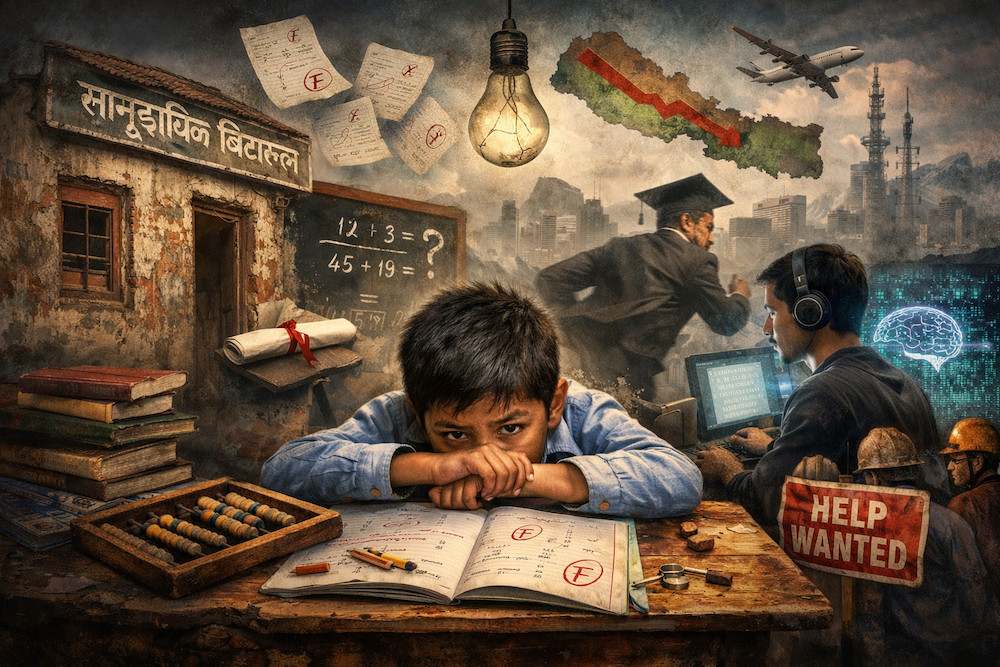
A government body has been studying learning levels for the past decade. Research by the Educational Quality Testing Center shows that learning outcomes are extremely weak. Students struggle with basic arithmetic operations such as addition, subtraction, multiplication, and division.
The crisis is particularly severe in community schools, where more than 70 percent of students are enrolled, according to researcher Dr. Uttam Sharma.
Speaking at a policy conclave organized by IIDS in Kathmandu, Sharma highlighted significant learning challenges in Nepal. He pointed out that third-grade students from Nepali-speaking families struggle with proper pronunciation of Nepali words.
Moreover, 32 percent of fifth graders are unable to solve basic addition and subtraction problems, while 21 percent of ninth graders face difficulties with simple division. These findings are based on government studies.
Sharma emphasized the deepening learning crisis in Nepal. In an era where the world is rapidly advancing with artificial intelligence, Nepal is grappling with a severe crisis in mathematics, a fundamental foundation for AI.
The situation is so dire that community schools are unable to find mathematics teachers, despite repeated advertisements and efforts to recruit them.
With the prospects of goods exports nearly exhausted, there is widespread consensus that Nepal must build a low-burden economy, as this holds the key to its future prosperity. However, Sharma acknowledged that this goal appears challenging due to the systemic learning crisis.
Sharma pointed out that there is an overreliance on rote memorization instead of fostering understanding among students. He stressed the need for training in critical thinking and creativity, qualities that are currently declining.
To transform Nepal from an exporter of low-skilled labor into a nation that exports knowledge capital, and to break free from the constraints of a low growth rate of around four percent, Sharma emphasized the necessity of reforms in the learning system.
Frustrated by prolonged low economic growth, inadequate public services, and poor governance, the Nepalese now demand sustainable and inclusive development.
Young people have already expressed this aspiration through the protests of September 9 and 10. Sharma cautioned that minor reforms alone will not meet these expectations.
Sharma acknowledged the suffocation and stress that drive people’s demand for development. However, he pointed out a significant gap in Nepal’s development trajectory. Despite having a digitally native population, Nepal has yet to fully harness the potential of this population as community capital.
Sharma stressed the need for a revolution in learning to develop this digital native population and unlock its full potential.
Devīram Acharya, director of the Educational Quality Testing Center, said the foundation for benefiting from a knowledge based economy is very weak. Speaking at the IIDS event, he said it is not impossible, but it is difficult.
He warned of a dangerous mindset spreading today. There is a fundamental misunderstanding of school education. Messages such as learning does not matter and failing has no consequences are becoming common.
There is nothing more damaging than telling someone that after ten years of schooling they cannot do anything meaningful. This seems to be happening.
Acharya said numerical illiteracy is even more frightening than language illiteracy. In every examination, mathematics is the subject in which Nepali students fail the most. In the past, most failures in the SLC were in mathematics. Today, most students receive non graded results in mathematics in the SEE.
Beyond poor learning quality, there is also deep inequality. There are wide gaps between rural and urban areas, and between community and private schools.
Acharya believes the main reason behind Nepal’s learning crisis is a lack of accountability. For years, gaps in mathematics teaching and learning have persisted without anyone being held responsible.
Questions about learning quality continue to be raised, yet no one is required to answer. This, he said, has allowed the problem to grow.
© 2026 All right reserved to biznessnews.com | Site By : Sobij
© 2026 All right reserved to biznessnews.com | Site By : Sobij