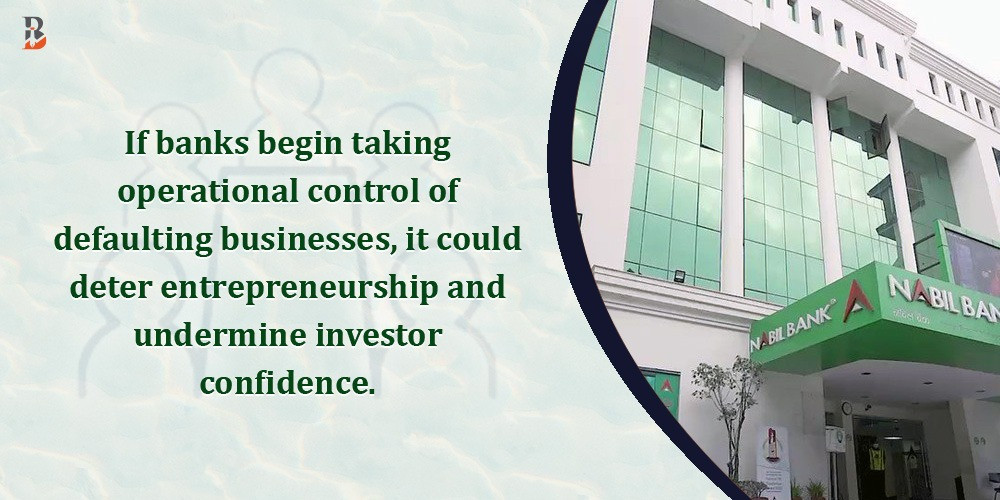
Kathmandu- Nabil Bank, Nepal’s largest commercial lender, has embarked on a controversial approach to recovering bad loans, raising alarm among regulators and industry leaders. The bank intends to take control of struggling businesses unable to meet their debt obligations and operate them through hired consultants. The strategy, unprecedented in Nepal’s banking sector, has drawn parallels to the practices of traditional moneylenders who seized assets when borrowers defaulted.
While Nepal Rastra Bank (NRB), the country’s central bank, prohibits financial institutions from directly running businesses, Nabil has identified a regulatory gray area. By appointing external consultants, the bank argues it can legally manage distressed firms without violating banking laws. Regulators, however, are not convinced.
NRB Governor Maha Prasad Adhikari has expressed concerns over the move, emphasizing that banks should focus on supporting businesses rather than assuming control. 'Financial institutions are meant to facilitate economic growth, not take over enterprises,' Adhikari stated.
NRB spokesperson Ramu Paudel also confirmed that no existing regulations explicitly permit banks to operate businesses through proxies. “We are monitoring the situation closely,” he said.
However, Nabil Bank’s CEO, Gyanendra Prasad Dhungana, has defended the initiative as a necessary measure to recover non-performing loans (NPLs). 'Nepal Rastra Bank does not know everything,' Dhungana remarked. 'Sometimes, we must take the lead in educating the regulator. The economy is under stress, and loan recovery is critical.'
The bank has faced challenges in recovering capital from business loans inherited through mergers and acquisitions. In some cases, agricultural ventures financed by Nabil have been abandoned, leaving assets—such as livestock—without operational oversight. 'Selling a few cows will not recover our loans,' Dhungana said. 'We need to run these businesses effectively to ensure repayment.'
The initiative has prompted concerns that other financial institutions may adopt similar tactics. 'If Nabil succeeds, we will have no choice but to follow,' said the CEO of another major bank. 'Simply liquidating assets is often insufficient to recover outstanding loans. We are under pressure to operate these firms through third parties.'
Nabil’s move could set a dangerous precedent, fundamentally altering Nepal’s financial landscape. If banks begin taking operational control of defaulting businesses, it could deter entrepreneurship and undermine investor confidence. Analysts warn that sectors with high debt exposure, such as hydropower and construction, could be particularly vulnerable.
The hydropower sector, in particular, has seen billions in bank financing, often supplemented by public share offerings. Cost overruns and extended repayment periods have exacerbated financial strain. If energy producers default, banks could find themselves trapped in an endless cycle of running businesses through consultants rather than focusing on their core lending functions.
Beyond hydropower, this model could extend to industries such as cement manufacturing, construction, and agriculture. The risk: a banking sector that drifts from financial intermediation into quasi-private equity operations, with lenders prioritizing profit maximization over economic stability.
Nabil Bank itself is under mounting financial pressure. Non-performing loans have climbed to 4.93 percent, with provisioning requirements surging to nearly Rs 21 billion. Meanwhile, Nepal’s economic growth has stagnated for three years, and although recovery signs are emerging, credit expansion remains a challenge. NRB has already blocked Nabil’s proposal for a rights issue, citing a 10-year lock-in period, limiting the bank’s options for raising fresh capital.
Further complicating matters, Nabil’s directors Nirvana Chaudhary and Malay Mukherjee also hold board positions at Sri Lanka’s Union Bank of Colombo, drawing scrutiny from regulators. NRB has launched an on-site investigation, adding another layer of oversight to the bank’s controversial operations.