
Nepal is set to graduate from Least Developed Country (LDC) status to that of a developing country in November 2026.
In discussing Nepal’s smooth transition strategy, I would like to briefly highlight a few key points: what the LDC graduation process require, how countries have performed post-graduation, Nepal’s current standing with respect to the graduation criteria, and how global economic trends may influence our trajectory.
I will also highlight upon the strategy Nepal has developed and how it could be strengthened through more targeted, strategic actions.
To begin, it is important to understand what LDC status represents. LDCs are characterized by low gross national income (GNI) per capita, high vulnerability to economic and environmental shocks, and weak human assets.
At one point, there were 52 countries classified as LDCs. So far, only seven have successfully graduated.
Over the span of three decades, just seven countries have exited LDC status. It reflects the sluggish and difficult progress within the LDC group. While some have made commendable strides, the overall pace of advancement has been limited.
The experience of countries that have graduated offers valuable lessons. Some have achieved robust economic growth, while others have encountered stagnation or modest progress. Fortunately, none have regressed to LDC status. However, their performance has not always met expectations.
Several factors have contributed to these mixed outcomes—ranging from exposure to natural disasters, the loss of special trade benefits, and a decline in concessional aid.
These vulnerabilities underline the importance of a well-planned and well-supported transition process.
This is where the role of development partners becomes crucial. Smooth transition support is essential to ensure that Nepal’s graduation is not only symbolic but also sustainable.
We are grateful to the United Nations Resident Coordinator (UNRC) and our colleagues at UNESCO, who have expressed their strong commitment to supporting Nepal through this critical phase. Their continued support will be vital as we navigate both the challenges of graduation and the post-graduation development landscape.
That said, the success of Nepal’s graduation and post-graduation development depends largely on ourselves—on how well we adapt to new challenges, how prepared we are, and how effectively we take advantage of the opportunities that come with a changing economic and development environment.
Let me briefly highlight some of the challenges Nepal faces, many of which are common to other LDCs.
Nepal is highly vulnerable to global economic shocks, which we have experienced several times in the past. Some LDCs are affected by conflict, while others are dealing with or at risk of natural disasters, especially those linked to climate change.
In some countries, ongoing stress leaves little room for development. In others, weak democratic systems and governance deficits hinder progress. Development is not just about economics—it also depends on sound politics and strong governance.
Some countries, despite having abundant natural resources, have failed to translate them into prosperity—a phenomenon often referred to as the 'resource curse.' So LDCs face different forms of hardship, and overcoming these challenges is essential.
Graduation from LDC status reflects progress in socio-economic indicators, but not all countries that have graduated have shown strong or sustained development afterward.
Graduation alone is not enough to ensure further progress. It offers a foundation—a platform to build on. But if we continue with a 'business as usual' approach, that opportunity may be wasted.
We must ensure that Nepal doesn’t miss this chance.
Nepal was first classified as an LDC in 1971. Our graduation is scheduled for November 2026, after having been postponed more than once—mainly because we had only met two out of the three required criteria.
Unless Nepal continues to meet the income threshold, we will remain vulnerable. However, now that Nepal has crossed the GNI per capita benchmark and consistently remained above it, it is time we accelerate our preparations for graduation and begin readying ourselves for the post-graduation development scenario.
We are grateful to the United Nations for guiding Nepal and other LDCs through this process during the 2021–2026 preparatory period, and for providing a transition window to help us get ready for graduation. However, it’s worth asking: how well have we actually utilized this period?
The UN has recommended that the smooth transition strategy be developed through the participation of all key stakeholders—including bilateral and multilateral partners, regional organizations, the private sector, and other development actors.
Nepal has, in fact, completed a transition strategy report, finalized last year. But now is the time to review.
This workshop should help shed light on those questions and provide clear guidance for the government and policymakers about what still needs to be done—and what needs to be fast-tracked.Having said that, let me now briefly touch on the current global economic context, which, unfortunately, remains quite challenging.
The global economic outlook is not very encouraging. Growth is projected to decelerate. Data shows that compared to 2024, global growth will likely decline by 0.5 percentage points—from 2.8% to 2.3%.
In addition to slowing growth, escalating trade tensions are setting the stage for what may become the weakest decade of global economic growth since the 1960s, according to researchers. Many low-income countries are already experiencing economic stagnation. This is the global context in which Nepal must navigate its graduation from LDC status.
Amid these uncertainties and shifting policies, heightened trade tensions and policy-induced uncertainties are likely to further disrupt global trade, investment, and financial flows, with particularly adverse effects on LDCs.
The ongoing tariff wars could prove devastating for LDC economies. Years of economic progress risk being undermined, and their integration into global value chains may be stalled. For a country like Nepal, these developments could disrupt supply chains and further slow economic growth.
In this evolving scenario marked by protectionism and external shocks, Nepal must strengthen its resilience and prepare for potential global setbacks.
Let me also turn briefly to the Sustainable Development Goals (SDGs) and the role of LDCs, especially in the post-graduation phase. As we all know, the SDGs were adopted in 2015, and include specific provisions for LDCs—including in Goal 1 (No Poverty), Goal 2 (Zero Hunger), Goal 8 (Decent Work and Economic Growth), Goal 9 (Industry, Innovation and Infrastructure), Goal 10 (Reduced Inequalities), and Goal 17 (Partnerships for the Goals), among others.
These goals called for special and differential treatment for LDCs, particularly in areas like capacity building, trade facilitation, investment promotion, and labor market access—all intended to create decent work and inclusive growth.
This workshop should also examine how far Nepal has progressed in leveraging those provisions, and whether we have been able to benefit from the commitments made during the 2015 UN Summit.
Unfortunately, reports indicate that overall SDG progress among LDCs remains modest, which mirrors the global trend. Multiple factors—such as the COVID-19 pandemic, climate-induced disasters, and geopolitical shocks—have slowed progress worldwide.
Focusing on Goal 1 (No Poverty): In 2015, around 38 percent of the LDC population lived in extreme poverty. As of the latest data, that figure has only dropped to approximately 34 percent.
Similarly, LDCs represent approximately 13 percent of the world’s population, yet they only account for two percent of global GDP and around one percent of global trade—which is even lower than Nepal’s own trade share in 2015. This shows a troubling gap between promises made under the SDGs and the actual developmental outcomes, particularly for countries like Nepal.
That said, Nepal’s graduation from LDC status is on track, and we’ve made measurable progress. We’ve now met the income criterion, which is a positive step forward.
In reviewing the numbers, Nepal’s GNI per capita averaged around $1,400 over the last three years (adjusted for inflation via GDP deflator).
Based on this and the latest updates, we’ve reached the income threshold required for graduation, which is encouraging.
Over the past decade, Nepal has averaged about 4.5 percent annual growth, excluding years severely impacted by events like the 2015 earthquake and the COVID-19 pandemic. While growth has not been rapid, it has been steady—and is expected to continue in the range of 5% annually in the near term.
Now, turning to the other two criteria for LDC graduation:
Human Asset Index (HAI):This has been a relatively secure area for Nepal. We’ve invested significantly in education, healthcare, and broader human capital development, which is improving the quality of life and strengthening the social and economic participation of our people.
Economic and Environmental Vulnerability Index (EVI):Nepal has met the required threshold here as well. However, given our past exposure to external economic shocks, domestic disasters, and cross-border economic disruptions, we cannot afford to be complacent.
Nepal also faces downside risks in its Enabling Business Environment (EBI) index. This workshop should help us examine how to consolidate our gains in this area and prevent future backsliding, particularly around this third criterion.
As we prepare for graduation, it is important to remember: the advantages will not come automatically. There have been arguments—and even rumors—suggesting that perhaps Nepal should seek another deferral. I do not believe this is the right path.
There should be no more delays. We must fully commit to the preparatory phase and ensure our graduation is strategic and sustainable.
So what are the real benefits of graduation?
While preferential trade access may be phased out, we gain in credibility, national branding, and global perception. The 'graduate' tag signals progress. It can help attract investment, improve our creditworthiness, and allow us to negotiate from a position of greater strength in the global development arena.
Does graduation necessarily contribute to our economic growth or development? That remains a critical question. What does image-building mean in practical terms for economic development? These are issues that need deeper discussion.
Certainly, an improved national and international image—along with enhanced creditworthiness—sends a strong signal that Nepal has made real progress: we have improved our human capital, reduced vulnerability to external shocks, and taken measurable steps toward sustainable development.
This matters because such perceptions can help mobilize international resources, boost citizen confidence, and attract capital. But for these benefits to materialize, the private sector must take the lead, particularly in facilitating capital inflows.
One immediate effect of graduation could be a reduction in the country risk premium. Lenders may view Nepal as less risky, thereby lowering interest rates and borrowing costs. That in turn can help attract more foreign direct investment (FDI) and other forms of private capital inflows.
Graduation may also indicate to international investors that Nepal offers improved governance, greater policy stability, and a more favourable investment climate—even if the reality has not fully caught up with the perception.
This shift in perception can also support a stronger sovereign credit rating and improve the environment for corporate bond issuance, as earlier mentioned by other speakers.
In terms of trade, the impact can go either way. If we are unprepared, we may lose some existing preferential opportunities. But if we are proactive, we can open new trade avenues. The outcome will depend on how well we understand the evolving global trade landscape and respond strategically.
Losing LDC-specific trade preferences demands that Nepal shift away from a captive trade system and build a competitive trade regime through new institutions, diversified trade relations, and a more dynamic private sector. If we do this, we can potentially access wider global markets and attract greater investment.
These trade opportunities can be further explored through initiatives such as GSP+, Aid for Trade, climate finance mechanisms, and technical assistance from development partners—all of which remain accessible post-graduation with the right diplomatic and policy groundwork.
Graduation also carries a symbolic value. It hinted that Nepal is ready to move towards a more self-reliant economy, with greater policy autonomy and less reliance on grants and aid. It is also a global validation of Nepal's socio-economic progress.
However, I must stress: none of this will happen automatically. These opportunities will only materialize if we break away from a 'business as usual' approach. Without proactive state leadership and coordinated stakeholder involvement, the potential gains may never be realized.
Now, while I won’t go deep into the impacts on international trade—as other sessions will cover this—let me briefly touch on some key issues.
Graduation will affect many trade-related support measures for LDCs:Preferential market access, Special treatment in services trade, Flexibilities under WTO agreements, and Technical assistance to build trade capacity
Although WTO accession-related concessions will remain unchanged, the loss of unilateral preferences and flexibilities can negatively affect our exports. This includes more stringent rules of origin, particularly regarding single vs. double transformation—which could impact industries like clothing and garments.
Similarly, intellectual property rights obligations could challenge sectors such as pharmaceuticals.
These are areas we need to assess thoroughly in this workshop—and prepare appropriate safeguards and adaptation strategies before the graduation shock hits.
On development cooperation, the picture is mixed.
For most multilateral institutions, LDC status has limited impact, as concessional finance is based on income thresholds and other criteria. So, graduation won’t drastically alter our access to ODA from institutions like the World Bank or ADB.
However, the cost of borrowing may increase slightly as we graduate, especially with some IDA and ADB facilities gradually tightening terms.
In bilateral assistance, some donors may apply higher interest rates, or reduce the concessionality of their lending.
While we may not face a dramatic downturn in aid, the transition will make us more exposed to market dynamics, and less reliant on guaranteed concessional windows.
Support from the UN system may decrease in certain areas, but the focus should now shift to what we can do ourselves. We need to be proactive, not reactive.
Finally, much has been said about the potential adverse impacts of LDC graduation on growth and employment—concerns also addressed by the Smooth Transition Strategy (STS). I won’t pre-empt the discussions ahead, but let me reiterate a point made by Hannah this morning: Nepal’s growth remains vulnerable.
Some of these vulnerabilities are external—geopolitical shocks, trade fluctuations. Others are domestic—climate impacts, institutional inefficiencies, and structural limitations in sectors like agriculture, which still drives one-fourth of our GDP but grows at under 3 percent annually.
Even if we achieve 7 percent growth in services and industry, agriculture's slow pace holds back our overall growth, which struggles to reach even 5 percent consistently.
So the real question is: are we structurally ready—not just politically or symbolically—for graduation?
And are we making the policy and institutional reforms needed to cushion the shocks and seize the opportunities?
If we truly want to drive our growth process, we must transform our agriculture sector. That was a key takeaway from the discussions this morning. However, agricultural transformation is not an easy task.
At present, our agriculture is still largely dependent on external inputs, weather conditions, and outdated technologies. This makes structural transformation increasingly difficult, and we’ve been struggling with this challenge for years. As a result, our export capacity remains weak—limiting our ability to integrate into global markets as competitive producers.
We must now explore how our exports can be enhanced through agricultural modernization. This means making agriculture more specialized, mechanized, and resilient. Alongside this, we must also consider the manufacturing sector, which is likely to be even more affected than other sectors by our graduation from LDC status.
As we lose access to certain LDC-specific provisions—such as rules of origin flexibilities and intellectual property waivers—our manufacturing base will face increased competition and compliance costs. That said, we already have strategies in place for enhancing our manufacturing capabilities. These must now be fast-tracked and implemented with urgency.
Nepal’s Trade Integration Strategy identifies certain manufacturing sub-sectors with high export potential. It is now time to act on that—beyond just planning. The recent national budget mentions encouraging assembly-based industries under a 'Made in Nepal' initiative. For this to succeed, Nepal must implement tariff reforms and modernize its financial service systems to better support agriculture, trade, and industry.
Let me now conclude by highlighting key enabling factors that will help Nepal transition into a post-graduation development scenario:
1. Sound Macroeconomic Policies
First and foremost, Nepal needs credible and consistent macroeconomic policies that ensure stability, promote growth, and create an enabling environment for private sector investment—both domestic and foreign. This includes coordinated action on:Fiscal policy, Monetary policy, Financial sector policy, Trade policy
These must work together to strengthen investor confidence.
2. Enhancing Trade Competitiveness
Nepal cannot—and should not—rely on trade protection forever. Our history has shown that prolonged protection leads to inefficiency. If industries are shielded indefinitely, they will never become competitive, either domestically or globally.
Whether or not we graduate, Nepal must embrace competitiveness. This means investing in: Technology adoption, Productivity gains in labour and capital, Improvements in total factor productivity, Supportive policy frameworks
Without this, we will continue to lag behind.
3. Strengthening Intellectual Property Rights
We must also modernize our Intellectual Property Rights (IPR) regime. The Ministry of Industry should accelerate efforts to enact a new IPR law. Stronger IP laws will enhance investor confidence, protect innovation, and improve Nepal’s alignment with international standards.
4. Improving Sovereign Credit Rating
Nepal must work toward achieving an investment-grade sovereign rating. Right now, we are below the desired level, and this acts as a barrier to attracting large-scale investments. Strengthening macroeconomic fundamentals and ensuring institutional credibility will be essential here.
5. Establishing Foreign Exchange Hedging Mechanisms
To attract foreign investors, Nepal must introduce effective foreign exchange hedging facilities. This will allow investors to protect themselves from currency risk—making Nepal a safer destination for investment.
At the same time, we must also establish reliable domestic credit rating agencies, and improve our systems in: Auditing, Accounting, Bookkeeping, and Legal frameworks
These are crucial for ensuring transparency, investor protection, and a trustworthy business environment.
6. Improving the Ease of Doing Business
Nepal once made significant progress on the Ease of Doing Business Index. Unfortunately, we’ve lost momentum. Reviving and improving this index must become a top policy priority—especially as we graduate and face stiffer global competition.
7. Exiting the FATF Grey List
Finally, and very critically: Nepal must urgently exit the Financial Action Task Force (FATF) grey list. Being under watch for weak compliance with Anti-Money Laundering (AML) and Combating the Financing of Terrorism (CFT) regulations severely damages our financial reputation.
If we fail to address this quickly, many of the benefits we hope to gain post-graduation will be out of reach—from reduced investment to restricted access to global financial systems.
Nepal’s efforts should now be focused on exiting the FATF watch list. We are expected to do so within the next two years. The government has expressed confidence that it can be done within a year. But the real question is how quickly we can achieve this goal, especially when some countries have managed to fulfill all the requirements and exit the list within just six months.
It is therefore imperative that Nepal acts with urgency and commitment. We must prioritize economic diplomacy—an area in which we are currently lagging. Our foreign relations still largely operate through conventional diplomacy. This needs to change.
We must now approach trade negotiations, investment deals, and international collaboration through a strategic economic lens. Economic diplomacy must become a central pillar of our foreign policy.
Our Finance Minister recently emphasized the need for alternative financing mechanisms, particularly through external sources. In this context, economic diplomacy will be critical—not just for traditional aid, but for mobilizing climate finance, accessing emerging global funding windows, and navigating the evolving international financial regime.
Finally, let me reiterate: Nepal must bring the private sector on board—alongside other development actors. The private sector must be adequately prepared to face heightened global competition in trade and manufacturing.
We cannot afford a situation where firms suffer adverse shocks or remain perpetually dependent on the government for concessions, exemptions, grants, or subsidies. These support mechanisms, which exist under our current LDC status, will phase out—if not by 2026, then shortly thereafter, as the transition period ends for our development partners.
Getting the private sector ready will require strong and accountable governance from the state, along with proactive engagement from all stakeholders. Only then can we ensure a sustainable and resilient economic transformation after graduation.
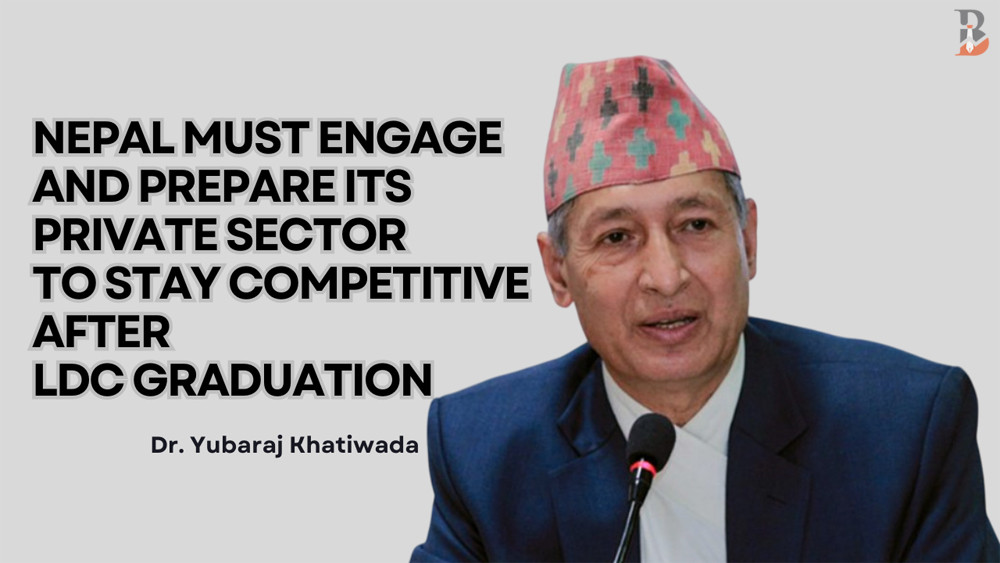
(An edited excerpt of the views expressed by Former Finance Minister Yubaraj Khatiwada at the workshop 'Nepal's LDC Graduation: Smooth Transition Strategy')
© 2026 All right reserved to biznessnews.com | Site By : Sobij
© 2026 All right reserved to biznessnews.com | Site By : Sobij