For years, unresolved issues have not only frustrated citizens but have also eroded trust in the state. The election of March 5 conveyed a clear message: people desire change and reject the old ways of doing things.
The mandate given to the Rastriya Swatantra Party reflects this demand. It is not just routine politics; it is a call to action. With the formation of the government, this work has commenced.
The 100-point action plan for the first hundred days sets the tone, signaling intent and defining priorities. The focus begins with service delivery, emphasizing that the state exists to serve citizens.
However, service reform alone won’t solve the problem. The underlying issues are more complex. Nepal faces structural weaknesses that require direct and comprehensive reform. Efforts are underway to build a shared national agenda based on the election manifesto.
Nepal doesn’t lack diagnosis; reports and commissions have already identified the problems and proposed solutions. The challenge lies in execution. Recommendations from the Public Expenditure Review Commission and the High-Level Economic Reform Advisory Commission must transition from paper to practice.
The government has taken an early stand, asserting that the state is not a tool for extraction.
The repeal of controversial revenue investigation laws demonstrates this shift. The private sector must be treated as a partner, and suspicion and control have hindered growth for too long.
A small group cannot continue to dominate the economy. Nepal needs open and fair competition, which requires removing legal and structural barriers. Some laws from the Rana era still constrain business activity, creating friction instead of fostering growth. The process to repeal 15 such laws has already begun.
This is an initial step, but the reform agenda is broader. Administrative restructuring, simpler laws, and clear policies are essential. A shift in the economic model is underway, and the upcoming budget will set its direction.
Discretionary power remains a significant obstacle, fostering opacity and unpredictability and enabling arbitrary decisions. Investors and entrepreneurs tend to avoid such environments. Clear rules and predictable systems are crucial for building confidence.
Security is another concern. Businesses require safety as much as they need freedom to operate. Recent incidents have highlighted this gap, emphasizing the need for legal and institutional reforms that address both security and freedom.
Infrastructure remains a bottleneck. Without reliable roads, energy, and digital systems, growth stagnates. The private sector has repeatedly raised this issue, and it must be addressed with urgency.
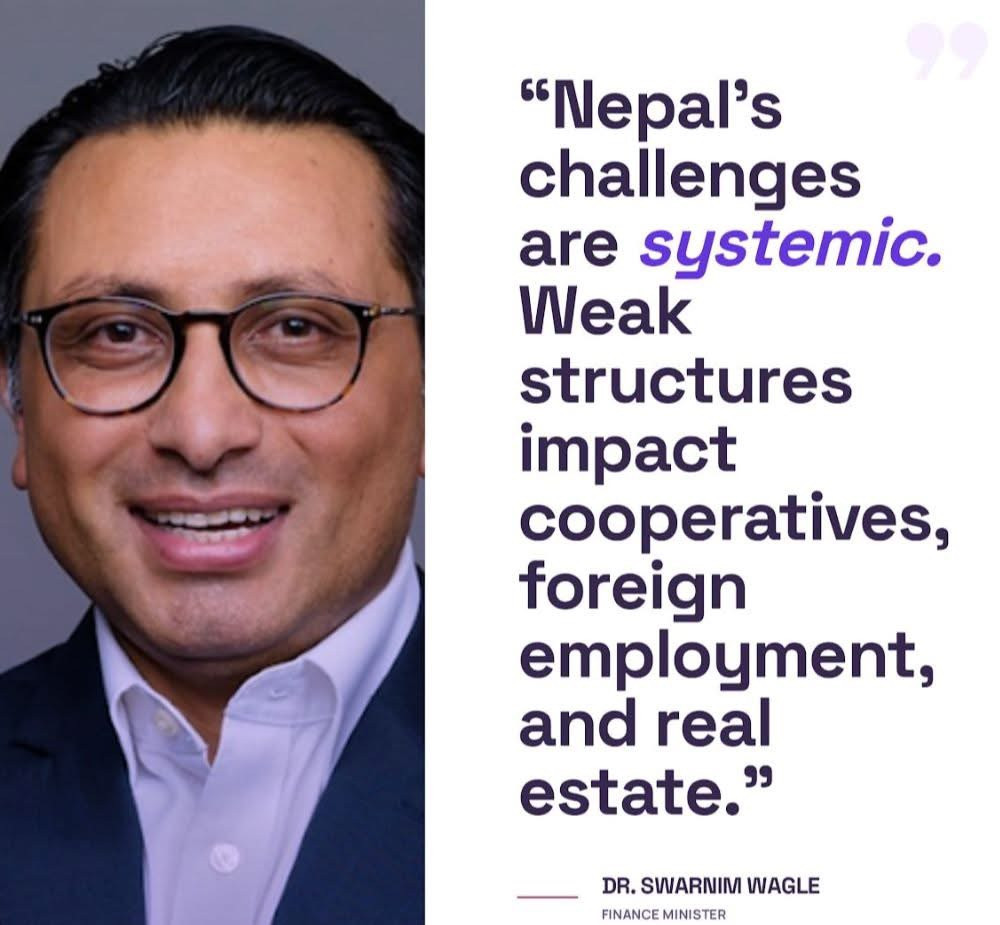
Nepal’s challenges are systemic. Weak structures impact cooperatives, foreign employment, and real estate. Excessive regulation and complex procedures stifle enterprise. Reform must target the system, not just the symptoms.
The 100-day plan has generated momentum, but the harder phase lies ahead. Delivery will determine success. A credible budget, firm execution, and visible outcomes will be most important.
Citizens expect results and have little patience for excuses. This moment demands action.
A transparent and incentive-driven legal framework is essential. Rules must serve the country and not individuals. Regular consultation with stakeholders will guide reform.
Policy direction is clear. It will be more open and transparent. Laws and practices that restrict the economy are now under review. The task ahead is to replace them with systems that enable growth.
(This article is based on a conversation with Finance Minister Dr Wagle and is republished from the biznessnews online magazine
Reset Nepal.)


.png)