
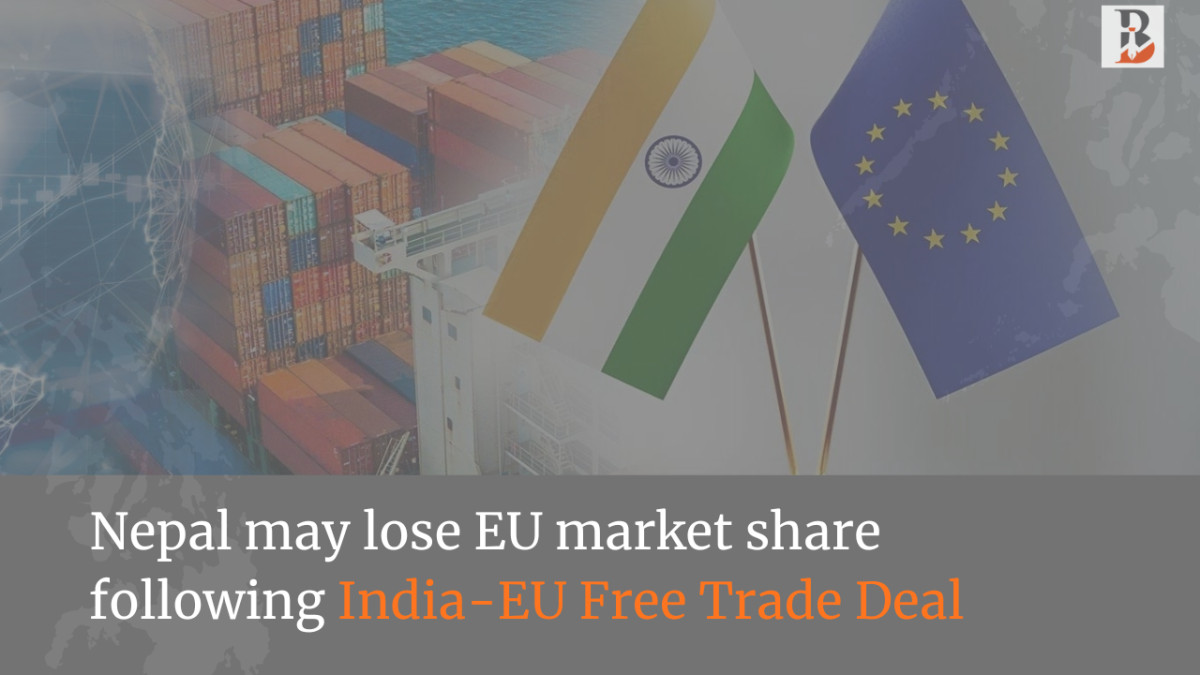
Kathmandu-Experts have warned that the free trade agreement (FTA) concluded between India and the European Union EU in New Delhi last Tuesday could have adverse effects on Nepal’s access to the EU market.
They argue that Nepalese exporters will lose their competitive edge as India will also receive duty free access for most products that Nepal currently exports to the EU at zero tariff rates.
India is Nepal’s largest export destination, followed by the United States, with the EU in third place. Once the FTA between two major economic powers such as India and the EU comes into force, trade experts say direct competition between Nepali and Indian products in the EU market will intensify.
According to the Department of Customs, Nepal exported goods worth around Rs 12.26 billion to the 27 EU member states in fiscal year 2024-25. Nepal’s main exports to the EU include ready made garments, felt products, hand knotted carpets, pashmina, handicrafts, tea, coffee, honey, musical instruments and Nepali handmade paper.
At present, Nepal exports all products except arms to the EU at zero tariff rates under the EU’s Everything But Arms EBA scheme.
This facility, granted under Nepal’s least developed country LDC status, will remain in place until 2029. However, experts say that once India, with its massive production capacity, low labour costs and advanced supply chains, also gains duty free access, Nepal’s preferential advantage will gradually erode.
According to experts, after the India EU FTA, Nepal will face increased competition in the export of ready made garments and textiles, carpets and floor coverings, pashmina and woollen products, leather and leather goods, footwear, bags, handicrafts and felt products, as well as agricultural products such as tea, coffee, spices and honey. They assess that the risk of Nepal losing market share is high in these sectors due to India’s lower production costs, larger scale and more stable supply.
Carpets, garments and pashmina are identified as the most vulnerable sectors after the FTA. Indian carpets will become direct competitors to Nepali carpets.
LDC graduation and cost pressures
Nepal is set to graduate from LDC status in 2026. Although the EU has provided a three year transition period, India will receive tariff concessions on 99 percent of products under the FTA, which is expected to weaken the impact of Nepal’s special market access.
Nepal’s export costs are already high. The lack of direct flights, limited reach of national airlines and expensive air freight make Nepali products costlier in the EU market. In this context, experts say the India EU FTA will place Indian and Nepali products at the same competitive level, increasing pressure on Nepali exporters.
Pashupati Dev Pandey, president of the Nepal Garment Association, said that while the immediate impact may be negative, the agreement could also create strategic opportunities in the long run. He noted that effective use of bilateral agreements with India and regional supply chains could increase demand for Nepali raw materials, fibres and inputs.
According to him, the India-EU FTA carries both risks and opportunities for Nepal’s exports to the EU. However, without productivity gains, product differentiation, structural reforms to reduce costs and active economic diplomacy, Nepal will struggle to retain its position in the EU market.
Key facilities India will receive under agreement
Immediate removal of customs duties on 70.4 percent of tariff lines, covering 90.7 percent of India’s exports. These include textiles and clothing, leather and footwear, tea, coffee, spices, sports goods, toys, jewellery and precious stones.
Gradual implementation of zero tariff rates within three to five years on 20.3 percent of tariff lines, covering 2.9 percent of India’s exports.
Reduced tariffs and preferential access on 6.1 percent of tariff lines, covering around 6 percent of India’s exports. These include certain poultry products, preserved vegetables and bakery products. Special facilities will also be provided for cars, steel and some marine products within specified quotas.
© 2026 All right reserved to biznessnews.com | Site By : Sobij
© 2026 All right reserved to biznessnews.com | Site By : Sobij