Kathmandu – Only two companies have submitted proposals for Nepal Telecom’s billing system contract: Huawei and Whale Cloud. The company is now moving forward with just these two bids.
This means one of them is guaranteed to win the contract. But the way this process is being handled has raised serious concerns. It goes against expert recommendations, legal guidelines, and even court orders — and could put the company’s long-term interests at risk.
Regulators, technical consultants, and the Supreme Court had all warned against letting companies that already supply core systems take over billing as well. If those warnings had been followed, both bids would have been disqualified, and a new tender would already be underway.
Almost all of Nepal Telecom’s critical systems already use Huawei equipment. If Huawei also takes over billing, it would have near-total control of the company — a situation that is alert about revenue protection and data security.
Huawei currently supplies key parts of the core system, including the Mobile Switching Center, Home and Visitor Location Registers, and more in both 2G and 3G networks.
ZTE handles the rest. Now, Huawei and Whale Cloud — which already have a strong grip on the core systems — seem to be teaming up to take over billing too. And Nepal Telecom’s management appears to be backing them.
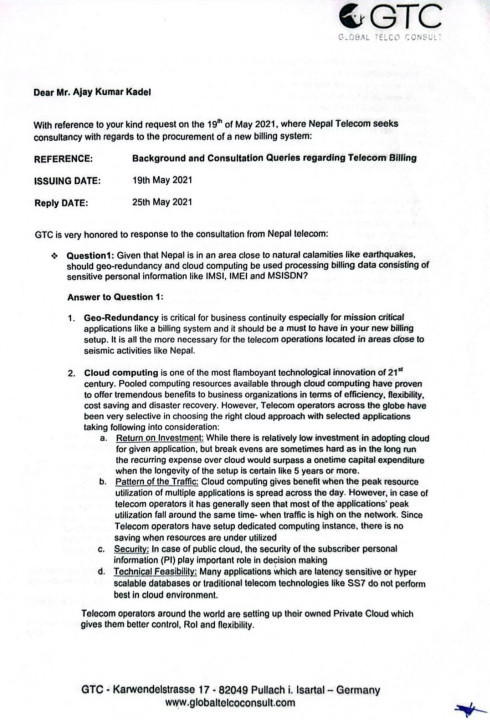
Back in 2021, when the company first considered upgrading its billing system, then-Managing Director Dilli Adhikari reached out to the consulting firm GTC and the telecom regulator NTA for advice.
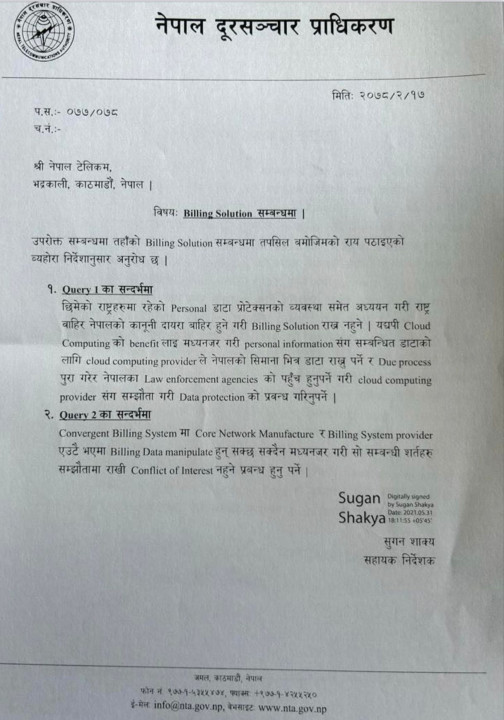
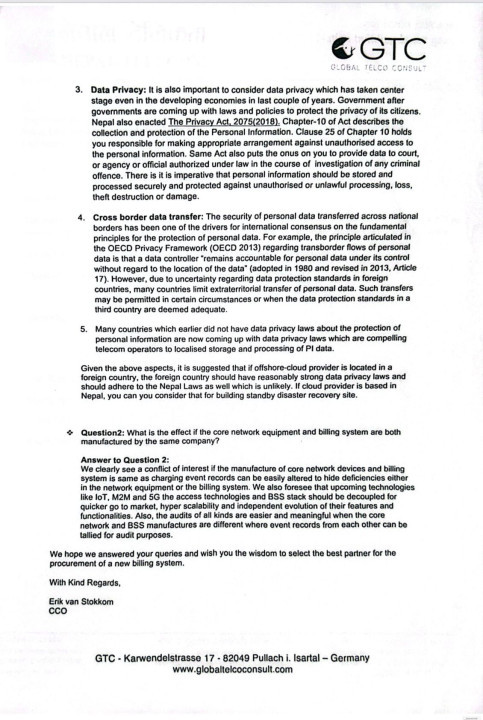
Both gave clear warnings: letting a company already involved in core systems handle billing creates a conflict of interest and opens the door to technical manipulation. It could lead to revenue leaks and put sensitive user data at risk.
The NTA even said the tender should include a clause to avoid such conflicts. Later, the Supreme Court issued a directive saying no single company should control all major systems in a way that could compromise user privacy.
Yet, Telecom’s current management has ignored these warnings and continued working to give Huawei the billing contract.
Huawei, which has been banned in several Western countries over concerns about ties to the Chinese government, already controls major parts of Nepal Telecom’s infrastructure. Getting the billing contract too would give it full dominance.
This is particularly troubling because the technical requirements in the new tender seem designed to favor Huawei. For instance, while the current system uses more powerful hardware (Intel 2.4 GHz and RISC 5 GHz), the new specs lower the bar — accepting 2.4 GHz in both categories. Huawei, under international sanctions, only has access to older, lower-performing hardware — so the new rules appear tailor-made to let it compete.
This setup allows Huawei to win with cheaper, outdated equipment — and at the same time, gain control over even more of the telecom’s sensitive operations.
Whale Cloud also has similar ties and interests, yet instead of canceling and reissuing the tender due to limited competition, Telecom is pressing ahead.
Adding to the controversy, Lokendra Karki, local representative of Whale Cloud’s parent company IDN, is said to be lobbying for the deal. He is the brother of Nepali Congress leader and former Minister of Communications Gyanendra Bahadur Karki.
What’s more, this same company is currently handling billing services for Ncell, Nepal Telecom’s main rival — creating a clear conflict of interest that, according to public procurement experts, should have disqualified them outright.
Officials inside Nepal Telecom warn that letting a company already working with Ncell into their system could lead to major revenue losses. Despite this, the management seems determined to go ahead.
Some insiders believe the tender process has been deliberately complicated — either to protect the current contractor, AsiaInfo, or to help one of the controversial bidders win.
Sources also claim Telecom’s leadership is helping cover up Huawei’s past failures on the 4G project, and tweaking tender rules to block other qualified competitors — all to make sure Huawei gets in.
There are also reports that the Chinese Embassy in Kathmandu has been actively involved from the beginning.