
Kathmandu- Nepal and India have finally agreed to complete the long-stalled boundary work within the next three years.
This decision was made during the seventh meeting of the India-Nepal Boundary Working Group (BWG), held in New Delhi on Tuesday.
Within the next three years, the goal is to reconstruct and repair these pillars, clear the no-man’s land, update the GPS network, and collect data on farming and property ownership by citizens of both countries on each other’s territory.
According to Nepal’s Department of Survey, a total of 8,554 boundary pillars have been erected along the Nepal–India border. Of these, 1,325 are missing, and 1,956 are either fully or partially damaged.
In 2015, the initial goal was to complete bilateral boundary work within three years.
Later, in 2017, the deadline was extended until 2022. However, the work could not move forward, citing the pandemic, disputes, lack of financial resources, and weather-related challenges. After 2019, the working group could not hold a meeting for six years.
The meeting also decided to prepare a detailed list to resolve cross-border landholding issues. This involves Nepali citizens farming on Indian land and Indian citizens cultivating Nepali land. To address these matters at a higher level, survey teams will be mobilized to gather property details.
For boundary surveys, both countries have been using the ‘Nepal–India Boundary Global Navigation Satellite System’ as agreed in 2007. This system will now be updated. Based on 182 GPS-based map sheets, work such as reconstruction and maintenance of boundary pillars and other tasks are being carried out.
To advance the work under the group, two technical structures—the Survey Officials Committee and the Joint Field Survey Teams—are active. All three bodies will be involved in tasks such as constructing and repairing boundary pillars, clearing the no-man’s land, GPS mapping, and collecting details of cross-holding properties.
The two-day meeting that kicked off on July 29 also agreed to review the progress of work done subsequent to the last (6th) BWG meeting held in August 2019, as well as the progress of works of the 11th Survey Officials’ Committee (SOC) Meeting held in September 2019.
The BWG is a joint body constituted by the Governments of Nepal and India in 2014 to carry out works in the fields of construction, restoration and repair of boundary pillars and other technical tasks.
During the COVID-19 pandemic, Nepal’s Armed Police Force (APF) and India’s Sashastra Seema Bal (SSB) managed small technical tasks like pillar maintenance and field surveys. In the next meeting, a new timetable will be set based on reports from the APF and SSB.
The biggest challenge in boundary work between the two countries has come from changes in river flows. With hundreds of rivers shifting course, thousands of hectares of land have changed shape, and property details are being collected based on these changes, according to the Department of Survey.
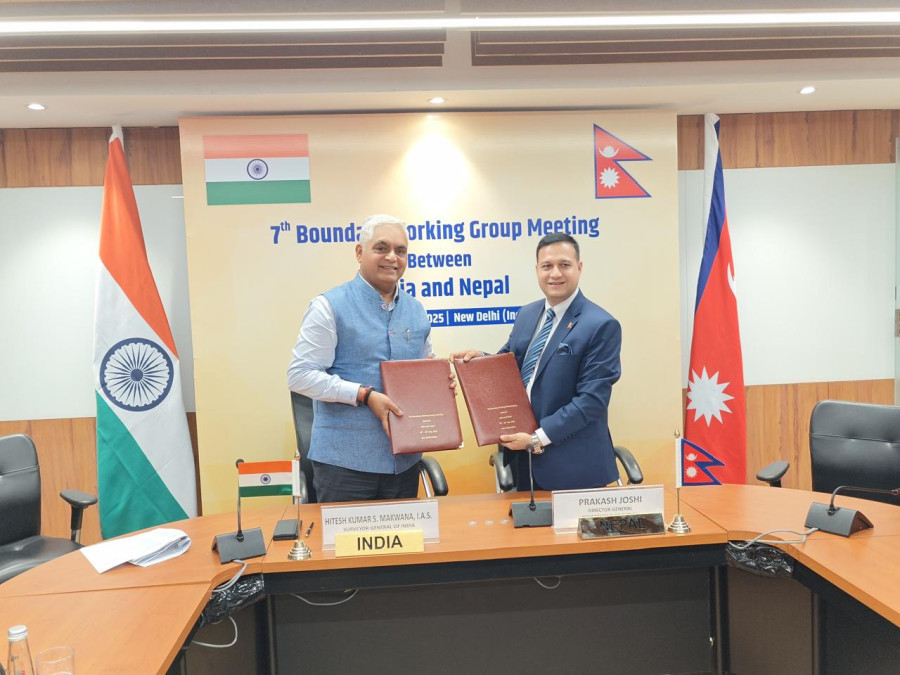
The Indian delegation at the meeting was led by Hitesh Kumar S. Makwana, Surveyor General of India, Survey of India, while the Nepali team was led by Prakash Joshi.
The meeting concluded with the signing of agreed minutes. Both sides agreed to hold the next meeting of the Survey Officials’ Committee (SOC) in Nepal in August 2025 and the next meeting of the BWG in Nepal at a mutually convenient date.
The Nepal–India border stretches for 1,880 kilometers and touches 27 districts of Nepal.
© 2026 All right reserved to biznessnews.com | Site By : Sobij
© 2026 All right reserved to biznessnews.com | Site By : Sobij