
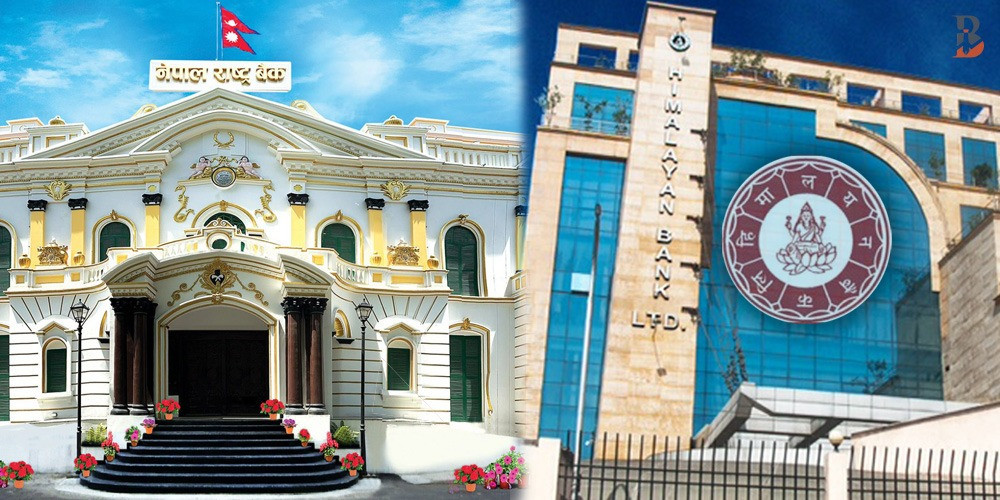
Kathmandu – Himalayan Bank has been submitting incorrect Basel reports for the past two years by concealing its actual accumulated losses, prompting the Nepal Rastra Bank (NRB) to conduct an on-site supervision.
The Bank Supervision Department of the NRB has instructed the on-site supervision team to review the Basel reports submitted by the bank.
Himalayan Bank has been submitting manipulated Basel reports to the central bank in violation of regulatory guidelines, aiming to reduce pressure on its capital by hiding its actual accumulated losses.
After the manipulation was reported by Biznessnews, the NRB’s supervision team decided to investigate the matter further.
NRB spokesperson and Executive Director of the Bank Supervision Department, Ramu Paudel, confirmed that the supervision team has already been instructed to examine the bank’s Basel reports.
'Himalayan Bank is currently under on-site supervision by the NRB. The team at the bank has been directed to review the Basel reports submitted over the past two years. The team will conduct a thorough investigation as required,' said Paudel.
Problems have persisted at the bank since its merger with the former Civil Bank. Its non-performing loans (NPLs) have been steadily increasing. The bank has also failed to sell its non-banking assets.
Due to the rising NPLs, the bank has had to allocate more funds to regulatory reserves, resulting in a distributable loss of up to Rs 7.44 billion.
As the quality of such assets continues to deteriorate, losses from NPLs are also increasing. With no improvement in NPL management, the bank’s net profit was limited to Rs 500 million by the third quarter of the current fiscal year.
The growing distributable loss has significantly eroded the bank’s capital base. Despite a notable decline in capital, the bank has submitted inaccurate figures in its Basel reports by not reflecting the actual accumulated losses.
It appears that the bank manipulated its retained earnings and losses to avoid regulatory action and a capital charge, as it is unable to meet the minimum core capital ratio.
Although the bank reported a profit of Rs 500 million in the third quarter of the current fiscal year, adjustments for all regulatory reserves and accumulated losses up to the previous quarter show a total distributable loss of Rs 7.36 billion.
This loss has been reflected as part of shareholders' equity, classified under retained losses.
However, in the Basel report, the profit and loss account is shown as a negative Rs 572.2 million, and only Rs 5.92 billion is included as accumulated losses—thereby maintaining the core capital adequacy ratio at 8 percent.
If the Basel report were prepared in accordance with NRB directives and accounted for the Rs 7.36 billion in retained losses, the bank’s core capital would be limited to Rs 23.63 billion.
However, the bank has reported it as Rs 24.50 billion by misstating retained losses.
Based on the actual accumulated losses, dividing the core capital of Rs 23.63 billion by the total risk-weighted assets would result in a capital adequacy ratio of 7.71 percent.
The bank also submitted incorrect Basel data in the audited report of the previous fiscal year.
Despite having an accumulated loss of Rs 7.44 billion at year-end, the Basel report listed only Rs 3.24 billion in retained losses.
Additionally, the profit and loss account showed a negative Rs 2.67 billion, while the core capital adequacy ratio was shown as 8.51 percent.
However, after adjusting for the actual retained losses, the capital adequacy ratio is only 7.98 percent.
When capital is calculated based on actual accumulated losses, the core capital stands at Rs 23.47 billion, falling short of the minimum requirement of Rs 25 billion.
Dividing this by the total risk-weighted assets lowers the ratio below the 8 percent threshold. After adjusting for the Rs 7.44 billion in retained losses, the capital adequacy ratio becomes 11.10 percent.
Last year, the bank reported a capital adequacy ratio of 11.54 percent by misreporting retained losses. The same error was repeated in the first and second quarters of the current fiscal year, as well as in all four quarters of the previous year.
Despite repeatedly submitting false Basel reports, the NRB has yet to take any regulatory action against the bank.
© 2026 All right reserved to biznessnews.com | Site By : Sobij
© 2026 All right reserved to biznessnews.com | Site By : Sobij