
'A people that loves freedom must be ready to love the laws and institutions that guarantee it—not the rulers who pretend to deliver it.'
— Maurizio Viroli
Nepal stands at a critical juncture in its democratic trajectory. Nearly two decades after dismantling its centuries-old monarchy, the republic now faces a resurgence of royalist sentiment, visible in street protests, populist rhetoric, and the rising appeal of the Rashtriya Prajatantra Party among disaffected youth. What was once considered a settled question, the rejection of monarchy through the 2006 People’s Movement and the promulgation of the 2015 Constitution has returned to political discourse under the guise of national stability and cultural revival.
Yet the allure of monarchy must be treated for what it is, a dangerous misunderstanding of both history and political theory. A return to royal rule would not resolve the problems plaguing Nepal’s democracy, it would entrench them. It would replace the failures of representative governance with a form of unaccountable paternalism. Nepal does not need the revival of symbolic sovereignty; it needs a revival of constitutional commitment. What we require today is not dynastic nostalgia, but constitutional patriotism, a loyalty not to rulers, but to principles; not to inherited titles, but to collectively defined norms.'
The theoretical foundations of constitutional patriotism , or Verfassungspatriotismu were laid in the ruins of fascism. . In post-fascist Germany, philosopher Jürgen Habermas argued that democratic belonging must rest not on ethnicity or culture, but on allegiance to constitutional values: human rights, the rule of law, and democratic deliberation. This was especially vital in plural societies where no single identity can bind the nation. Nepal is precisely such a society. With over 125 ethnic groups, more than 100 spoken languages, and a tapestry of faiths, our diversity is not incidental, it is foundational
Historically, however, the monarchy has suppressed this pluralism. From King Mahendra’s 1960 coup to King Gyanendra’s 2005 takeover, the royal institution has concentrated power while marginalizing dissent. The Panchayat system institutionalized caste hierarchy, Hindu majoritarianism, and monarchical supremacy. Political parties were banned, and fundamental freedoms were curtailed. Janajatis, Madhesis, Muslims, and Dalits were not included in this framework, they were silenced by it. A return to monarchy would not unify this nation, it would erase hard-won rights, flatten differences, and turn Nepal backward.
The 2006 People’s Movement was a rejection of precisely this structure. It imagined a different Nepal, one that is federal, secular, inclusive and democratic. That imagination was codified in the 2015 Constitution. These are hard-won principles extracted from decades of struggle, protest, and negotiation. It guarantees equality (Article 18), secularism (Article 4), proportional inclusion (Article 42), and decentralization through federalism, especially in response to the demands of the Madhesi and Janajati and other historically excluded groups. These provisions were not incidental, they were deliberate efforts to build a state that reflects, rather than represses, Nepal’s plural character.
Moreover, Nepal’s federal turn, following the Madhesi movement and Janajati mobilizations, was a direct rejection of Kathmandu-centric centralization. As Thomas Benedikter notes, federalism was the constitutional expression of a demand for local representation, cultural autonomy, and distributive justice.To dismantle this constitutional framework now, merely out of discontent or political expediency, is to repudiate the foundational struggles and deliberative choices that gave legitimacy to the Republic’s very existence.
Much of the current monarchist sentiment hinges on the idea that royal rule brought peace and stability. This is an illusion. What monarchy preserved was not harmony, but control. Under the Panchayat regime, political parties were banned, the press censored, and education instrumentalized to perpetuate state ideology. Religious minorities were marginalized. Regional aspirations were delegitimized. The kings ruled, but without consent, accountability, or legal constraint.
Modern constitutionalism exists precisely to correct such imbalances. It divides power, limits authority, and creates structures for public accountability. The role of the judiciary in upholding this framework is crucial. Jeremy Waldron argues that separation of power is not simply a bureaucratic arrangement but a moral commitment to restraints. Courts must act not as antagonist to the other branches, but as equals committed to constitutional fidelity. In an unequal society like Nepal, this necessitates a particularly rigorous approach to the enforcement of socio-economic rights such as housing, education, healthcare, not as charity but as constitutional entitlement. A robust system of checks and balances demands that the judiciary scrutinize executive action, curb legislative overreach, and ensure procedural fidelity in governance. The courts must also remain open to public interest litigation and accessible to marginalized communities, who often lack political voice but bear the brunt of state failure.
Monarchies, by contrast, operate outside such restraint. They draw legitimacy not from consent, but from lineage; not from law, but from myth. Even more dangerously, monarchy in Nepal functioned through an upper-caste, patriarchal framework that actively excluded Madhesis, Janajatis, Dalits, and women from state power. The reintroduction of monarchy would dismantle the constitutional architecture of accountability, and discard decades of constitutional redress and the promise of inclusive democracy.
In Nepal’s context, where institutional memory of royal authoritarianism still lingers, the role of the judiciary becomes even more vital. It is not enough to merely declare rights; those rights must be enforceable, especially against corruption, nepotism, and procedural opacity. Transparency in appointments, accountability in public expenditure, and due process in criminal investigations, these are not technical matters but constitutional imperatives. When courts intervene to check these abuses, they are not overstepping but are restoring balance. Without such interventions, corruption becomes structural, and impunity becomes the norm and faith in democratic institutions begins to fade.
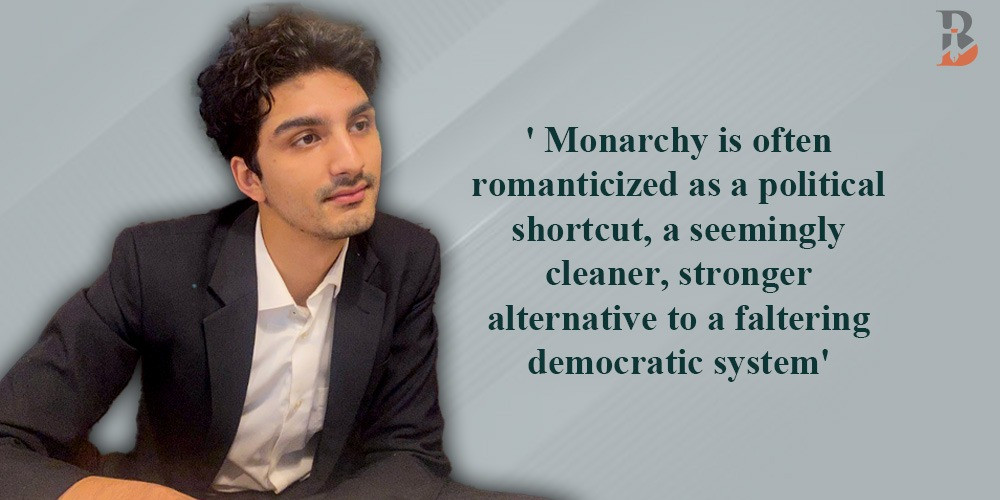
Young Nepalis today confront a deep crisis of political trust. Corruption goes unpunished, political parties circulate the same faces, and electoral choices feel more ritualistic than substantive. They see a republic in form, but not in function. Against this disillusionment, the monarchy is often romanticized as a political shortcut, a seemingly cleaner, stronger alternative to a faltering democratic system. The Panchayat system proved this. It criminalized dissent, crushed student unions, surveilled citizens and silenced media. It prioritized compliance over meaningful engagement. Monarchy may seem like a symbol of unity, but it demands deference and not deliberation. The republic, imperfect as it is, is the only system where power remains answerable to people.
Historically, states that have transitioned away from monarchy rarely return. In countries like South Africa and Germany, new constitutions became vehicles of healing and oversight, not relics of past rule. Even ceremonial monarchies, like in the UK or Japan, exist only because their crowns are entirely symbolic. Nepal’s monarchy never made that transition. Its interventions were political, not ceremonial; legal, not symbolic.
What Nepal requires instead is the deepening of constitutional patriotism. This concept offers a normative framework that transcends ethnic and dynastic politics by focusing on legal commitment, democratic participation, and civic belonging. In post-authoritarian contexts, constitutional patriotism can serve as a counterweight to nostalgia and disillusionment. In South Africa, as Heinz Klug observes, the Constitution served as both a framework for governance and a symbol of national reconciliation.[6] In India, Madhav Khosla notes how the Constitution was used to educate citizens in democratic thinking, transforming subjects into self-governing citizens. Nepal must do the same, not by mythologizing kings but by democratizing citizenship.
Practically, this means building institutions that protect the Constitution from political abuse. Bruce Ackerman’s work on checks and balances in modern administrative states argues for a dynamic role for courts in checking both executive and legislative overreach.[8] The judiciary must not simply interpret the law; it must preserve its moral core. Surya Deva has emphasized the importance of courts in enforcing socio-economic rights in unequal societies. Nepal’s judiciary must do more to ensure that rights are not merely symbolic but materially realized, especially for the poor, the rural, and the marginalized.
Importantly, constitutional patriotism demands civic engagement. Citizens must participate in constitutional life, not only through voting, but through public reasoning, protest, critique, demanding party reforms, litigating for inclusion, pushing for educational and judicial independence. It also means a renewed investments in civic education. The Constitution must be taught not merely as a document, but as a living covenant between people and power. The media must uphold deliberation, not misinformation. The education system must cultivate democratic values, not myths of royal divinity. The public must learn to see authority as answerable, not as sacred. Only when the population internalizes the norms of constitutional democracy can the republic be considered secure
Some may argue that this is too idealistic, that Nepal’s political class is too compromised, the Constitution too ambiguous, the institutions too weak. But idealism, when informed by history and anchored in law, is not naïveté, it is necessary. Every democracy, from the United States to Indonesia, has gone through periods of decay. The ones that survive are those that reform from within, not those that regress into rule from above.
This is ultimately a philosophical choice as much as a political one. Do we believe that people are capable of governing themselves? If so, we must defend the institutions that allow for that governance, even when they falter. If not, we will forever look for saviors, first in strongmen, then in monarchs, then in myths. The monarchy cannot save Nepal from its democratic crisis, because it is structurally incapable of democratic accountability. It is a return not to order, but to ordaining power from birth. It is an insult to the drafters of the Constitution, the visionaries of the Madhes movement, the feminists, federalists, and Janajati organizers who reimagined Nepal beyond the royal gaze. It is a political project aimed at reversing progress under the guise of cultural revival. If we understand patriotism not as deference to symbols, but as loyalty to principles, then the task before Nepal is clear.
(Pandey is an aspiring lawyer currently studying at NALSAR University of Law, Hyderabad)
© 2026 All right reserved to biznessnews.com | Site By : Sobij
© 2026 All right reserved to biznessnews.com | Site By : Sobij