
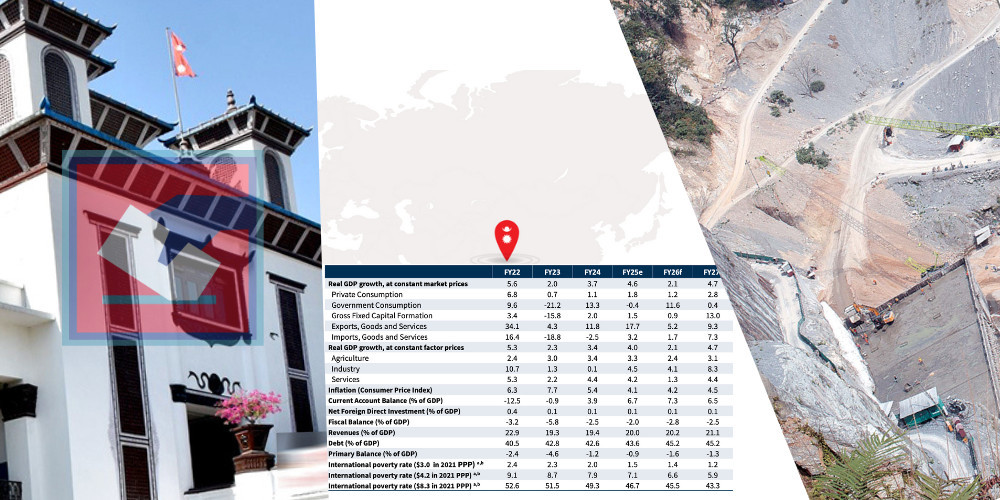
Kathmandu-Nepal’s economic growth is expected to slow due to the impact of the September 2025 unrest and the resulting political uncertainty, according to the World Bank.
Releasing its Nepal Development Update on November 13, the Bank said the outlook remains uncertain. It added that a smooth political transition and steady economic management will be crucial to rebuild investor confidence. Continued instability could weaken sentiment further.
The Bank projects growth to fall to 2.1 percent this fiscal year. Last year, Nepal grew by 4.6 percent. The estimate could range between 1.5 and 2.6 percent.
David Sislen, World Bank Division Director for Maldives, Nepal and Sri Lanka, while releasing an outlook said the protests will cut tourist arrivals and weaken productivity across the tourism ecosystem.
Sislen highlighted three risks. Infrastructure and property losses of more than two hundred billion rupees will weigh on growth. A political transition will reduce peak season tourism. Losses in the insurance sector will reduce profits and slow activity. He said these factors will drag growth this year.
Government rejects bleak assessment
The government does not agree with the World Bank’s projection. After the Bank’s regional update, the Finance Ministry conducted its own review. It concluded that the situation is not as weak as the World Bank suggests.
Finance Minister Rameshwor Khanal has repeated this view in public. At a World Bank event, he said the government’s immediate policy measures and reforms have supported stability. He argued that real time data shows improving trends.
He informed an increase in tourist arrivals after the unrest. 'Imports are up 19 percent, customs revenue 13 percent, VAT 12 percent, and excise duty 10 percent. He questioned how growth could decline with these indicators.'
At the same event, Sislen acknowledged seeing recent encouraging signs. He cited growth in private sector lending and continued expansion in tourism. He said that if this continues, a stronger recovery could follow.
Political transition remains the main risk
The World Bank expects most unrest related impacts to remain limited to this fiscal year. It forecasts growth above 4 percent in the next fiscal year.
Abdoul Mijiyawa, Senior Country Economist for Nepal, said recovery is likely if conditions improve next year.
This outlook depends on completing the political transition. The Bank expects improvement only if elections are held on March 5 or soon after. Institutional reforms and consistent policy support will be essential.
Minister Khanal said the government is pushing ahead with economic measures while preparing for elections. He highlighted the Integrated Business Recovery Plan, which includes grants, tax breaks and operational support. He said resources have been directed toward reconstruction and election preparations, and a reconstruction fund has been created for damaged public and private assets.
The report stresses the need to improve public investment management to support long term growth. Sislen said Nepal must increase public investment to raise growth and create jobs.
He cited priorities such as faster project execution, better budgeting, clearer land acquisition and tree felling processes, stronger financial management and reforms to procurement laws.
The World Bank warned that delays in the election will prolong political uncertainty and slow the recovery.
© 2026 All right reserved to biznessnews.com | Site By : Sobij
© 2026 All right reserved to biznessnews.com | Site By : Sobij