
Kathmandu – In anticipation of a potential tax hike in the upcoming budget announced by the government on Jestha 15 (May 29), a significant number of electric vehicles (EVs) were imported into Nepal.
However, Finance Minister Bishnu Prasad Paudel surprised everyone by not increasing taxes on EVs nor changing their classification.
Despite this, most EV brands had already assumed that the tax would increase and imported a substantial stock of vehicles to last a few months.
As a result, there was a notable surge in the import of EVs and electric commercial vehicles during the month leading up to the budget compared to previous months.
Nearly all EV brands, except a few, continued importing vehicles into Nepal, with most coming from Chinese manufacturers.
Among Indian brands, Suzuki still does not offer any EVs, while Mahindra’s XUV400 EV failed to gain traction among customers. In response, Mahindra imported three new EV models – BE6 and XUV.e9 – this month for testing purposes, which are expected to be available for sale in a few months.
From May 1 to May 28 , a total of 4,696 passenger and internal combustion engine (ICE) vehicles were imported.
In May alone, 1,717 electric commercial vans were imported, bringing the total number of imported vehicles—including passenger EVs and electric vans—to over 6,400 units.
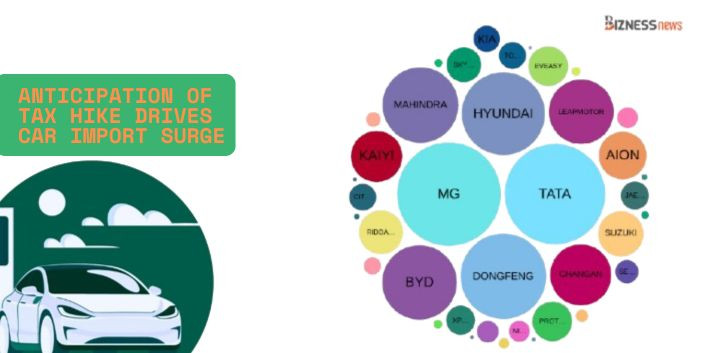
Among the brands, MG recorded the highest number of EV imports in May, with 676 units, primarily consisting of the MG S5, along with 18 Windsors and a few Comet EVs.
Tata Motors followed with 635 EVs, all electric, including models such as the Tigor Express T, Tiago EV, Punch EV, Nexon K3 EV, and Curvv EV.
Dongfeng’s NAMI Box saw 461 units imported, while Hyundai brought in 434 vehicles, mostly Creta EVs, in addition to a few CKD (completely knocked down) versions of Creta and Venue, as well as some Grand i10 and Tucson models.
Mahindra imported 361 vehicles, of which only 3 were EVs. BYD brought in 350 electric vehicles, although detailed figures for the BYD Atto 3 were not available. Leapmotor imported 265 EVs, specifically the C11 and T03 models.
Changan's Deepal brand accounted for 237 imports, mainly the S07. KE followed with 167 EVs, including the X3 Pro, E-Qute 2, and E-Qute 4. GAC’s Aion V was imported in 144 units, while Suzuki imported 131 ICE vehicles. Radar imported 132 electric double-cab pickups, and JMEV’s EVG model, often used as taxis, saw 100 units brought in. Proton’s EMAS Seven, with a 160 kW motor, also recorded 100 imports.
Additional EV brands imported in May included Skywell (77 units), Xpeng (54), and Omoda/Jaecoo (50) with the Omoda S5 and Jaecoo J6. Other notable imports were Citroën and Toyota (46 units each), Kia (44), Seres (34), Dayun from China (30), Nissan (28), Zeekr (27), and BMW (19).
Voltz brought in 14 units, IM Motors 10, Ora 7, Ford and Škoda 5 each, Isuzu and Volkswagen 4 each, and Maxus and Porsche 2 each.
Finally, Audi, Mitsubishi, Subaru, and Wuling each imported 1 vehicle, according to customs data for the month preceding the budget announcement.
© 2026 All right reserved to biznessnews.com | Site By : Sobij
© 2026 All right reserved to biznessnews.com | Site By : Sobij