

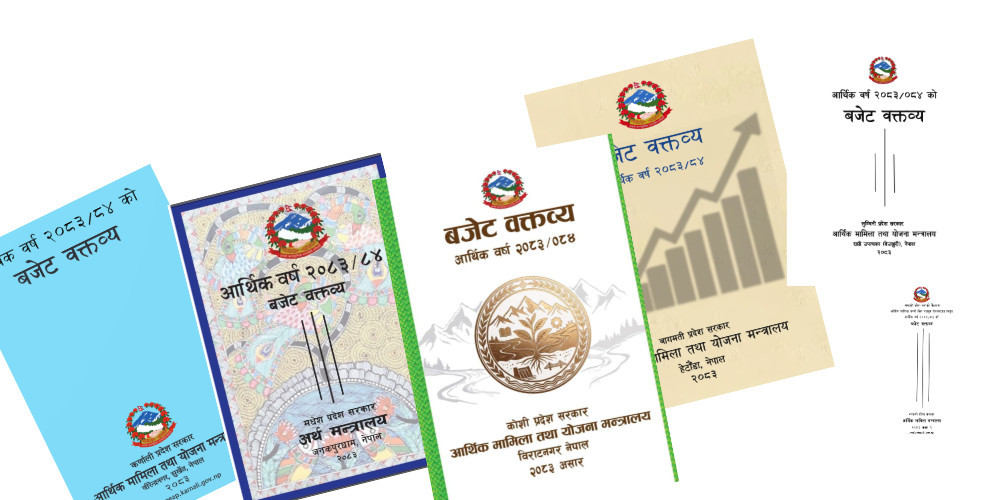
Kathmandu-The seven provincial governments have already unveiled their budgets for the upcoming fiscal year on June 15, as required by the Constitution. Alongside expenditure and revenue projections, they also announced their revenue policies.
Most provinces have focused on harmonising tax rates with other provinces rather than adopting competitive policies to attract investment. Several provincial governments stated that they had adjusted tax rates to align with those of other provinces and pledged to pursue greater uniformity in the future.
Bagmati Province used different wording, stating that it would adopt best practices from other provinces.
Most provinces also identified forest products as a major source of revenue. Provinces that announced reductions in land registration fees to attract businesses have also pledged relief on business registration and renewal fees.
What are the revenue policies of each province?
Bagmati Province
Bagmati Province, home to the federal capital and the country's largest economy, has pledged to identify new revenue sources. It aims to promote existing businesses and increase revenue through economic expansion, introducing various incentives and schemes.
The province has also pledged not to enact laws or administrative measures that result in double taxation or duplicate fees. In particular, businesses that fall under the jurisdiction of local governments will not be charged additional provincial fees.
Bagmati has announced a waiver of penalties for businesses that renew their registrations after paying the required renewal fees. It has also introduced a 50 percent discount on land registration fees for industries and businesses, excluding liquor and tobacco industries.
Gandaki Province
Gandaki Province has announced plans to establish its own Revenue Office to improve revenue collection and administration. The office will coordinate revenue policies and collection efforts with federal and local governments.
The province has also announced that entertainment and environmental management fees can be paid in a lump sum. Businesses that clear all outstanding fees and charges by the end of the current fiscal year will receive waivers on additional penalties and charges during renewal or cancellation procedures.
Karnali Province
Karnali Province has pledged to align land and service fees with those charged in other provinces. It has also announced measures allowing businesses with expired registrations to re-register.
In addition, vehicle owners who pay five years' worth of vehicle tax in a single payment will receive a 20 percent discount.
Lumbini Province
Lumbini Province has also announced plans to harmonise tax rates with those of other provinces. It identified the forestry sector as a major revenue source and announced taxes on the sale of timber and firewood.
The province will provide full renewal fee exemptions for industries other than liquor and tobacco businesses and will impose environmental management fees on crusher industries.
Lumbini has also announced a 50 percent discount on land registration fees for property registered in the name of industries.
Madhesh Province
Madhesh Province has adopted a policy of increasing revenue through higher production in the industrial, agricultural, and service sectors. To support this goal, it has announced financial incentives and support programmes.
The province will make digital payments mandatory and digitise tax and fee collection systems. It has also introduced taxes on timber and firewood sales and announced a fee of Rs 75,000 per chimney for brick kilns.
Koshi Province
Koshi Province has announced plans to develop a tax information system. It will impose taxes on timber and firewood sales, while drinking water service providers and laboratories will also be required to pay provincial fees.
To encourage local governments to regularly deposit revenue collections, the province has announced additional fiscal transfers of up to Rs 50 million.
Koshi has also announced a full waiver of registration fees for individuals and companies from the Tarai region purchasing land or property in hill and mountain areas.
Projects that signed agreements with the provincial investment authority through investment conferences will receive a 75 percent discount on land registration fees.
The province has also announced a full tax exemption for tourism service vehicles and fee waivers on land purchases for agricultural purposes.
© 2026 All right reserved to biznessnews.com | Site By : Sobij
© 2026 All right reserved to biznessnews.com | Site By : Sobij