
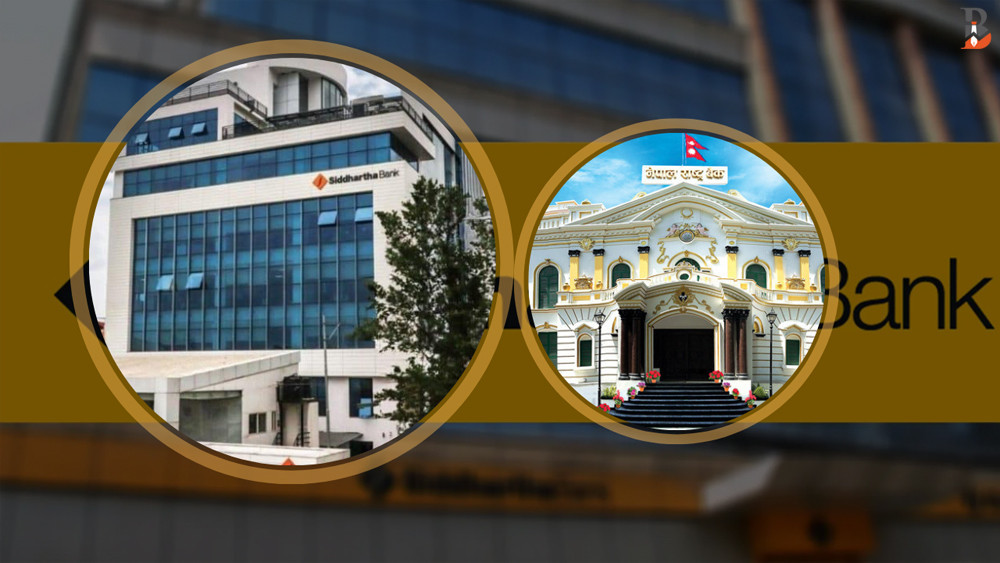
Kathmandu-Siddhartha Bank Limited breached Nepal Rastra Bank rules when it prepared its Basel report to justify a 10.53 percent dividend payout from last year’s profit.
The bank posted a cumulative loss of Rs 221.6 million in the first quarter of the current fiscal year, but it showed a cumulative profit of Rs 111.8 million in the Basel report. This inflated the Tier 1 capital ratio.
The bank used the same approach in the first and second quarters of the previous fiscal year. When a bank lacks adequate Tier 1 capital during cash dividend distribution, it cannot distribute dividends the following year and must focus on recovery.
To avoid this, the bank kept evergreening its Tier 1 capital.
Nepal Rastra Bank’s Supervision Department approved the cash dividend without reviewing the state of the Tier 1 capital ratio. It overlooked the economic impact of Covid 19, the recent GenZ movement, and the risk of future financial stress.
Allowing a cash dividend that drains retained earnings shows a regulatory lapse.
The bank continued preparing inaccurate Basel reports.
Under the Capital Adequacy Framework 2015, banks must deduct all regulatory reserves, including the general reserve, exchange fluctuation fund, staff bonus, and other adjustments, before showing any unaudited net profit as part of Tier 1 capital.
If these reserves are not adjusted, the unaudited net profit cannot count as Tier 1 capital. Siddhartha Bank did not adjust these reserves but still reported the unaudited profit.
The bank’s first quarter financial statement shows a distributable profit of Rs 1.61 billion after offsetting the Rs 221.6 million loss. This appears accurate.
In the Basel report, however, the bank should have shown this as retained earnings.
It did not.
Instead, it reported last year’s distributable profit of Rs 1.83 billion and showed Rs 118.1 million as unaudited profit instead of reporting a cumulative loss of Rs 222.1 million. This violates point number 5 of the Capital Adequacy Framework related to Tier 1 capital.
CEO Sunder Prasad Kandel holds a different view. He has argued that unaudited retained earnings can be included even if this contradicts the framework.
Last year, he said the bank had reported profit without adjusting regulatory reserves such as the general reserve and redemption on debentures.
The bank repeated the practice this year. To avoid pressure on capital due to cash dividends, it presented an inflated Tier 1 capital ratio.
If the bank had reported first quarter retained earnings, its Tier 1 capital would stand at Rs 26.12 billion instead of Rs 26.47 billion. This would bring the Tier 1 capital ratio down to 9.64 percent from 9.67 percent.
The bank reported a capital adequacy ratio of 12.21 percent, but the actual figure for the first quarter is about 12.08 percent.
Dividend distribution will reduce this further. After paying about Rs 780 million in cash dividends, Tier 1 capital will drop to Rs 25.39 billion.
Based on total risk weighted assets of Rs 273.76 billion, the Tier 1 capital ratio falls to 9.27 percent.
A 5 percent bonus share issue prevented a deeper fall. Nepal Rastra Bank also allowed loan loss provisions to count as supplementary capital this fiscal year.
This helped the bank reach 2.54 percent supplementary capital. Siddhartha Bank has Rs 6.95 billion in supplementary capital, including Rs 3.07 billion in general loan loss provisions.
The bank used this regulatory flexibility to distribute cash dividends. This increases pressure on its capital.
After dividend distribution, the capital adequacy ratio is expected to fall to 11.81 percent. This will limit the bank’s lending capacity.
The bank initially reported a distributable profit of Rs 1.86 billion in its unaudited financials. The audited figure is Rs 1.83 billion.
Siddhartha Bank will hold its AGM on Kartik 30. It has announced a 5 percent bonus share and a 5.53 percent cash dividend including tax.
The cash dividend will reduce retained earnings by about Rs 1.41 billion. About Rs 700 million from the bonus shares will be added to paid up capital. Rs 779.1 million in cash dividends will go directly to shareholders. This will directly affect the bank’s Tier 1 capital.
© 2026 All right reserved to biznessnews.com | Site By : Sobij
© 2026 All right reserved to biznessnews.com | Site By : Sobij