Many of you may know that Unilever is a one of the largest British corporations globally. In fact, we have been operating for more than 100 years worldwide, and for nearly a third of that time—over 30 years since 1993—we have been present in Nepal. The journey of the past three decades has been incredibly fulfilling.
To illustrate this, let me provide some examples. We started in Nepal with just one product, but now, we are manufacturing 164 different products in the country. These products meet the highest quality standards and are on par with those available in neighboring markets. We do not compromise on quality. In fact, Unilever Nepal ranks 4th among 32 South Asian Unilever factories in terms of process efficiency and quality.
Our commitment to global standards ensures that we uphold Unilever's operational excellence here in Nepal. This has enabled us to grow sustainably and profitably. As a listed company, our share price is the highest in Nepal, and we pay the highest dividends among all listed companies in the country. Why do I highlight this? To emphasize that if we can achieve this level of success, other corporations—including British, European, and multinational companies—can also thrive in Nepal.
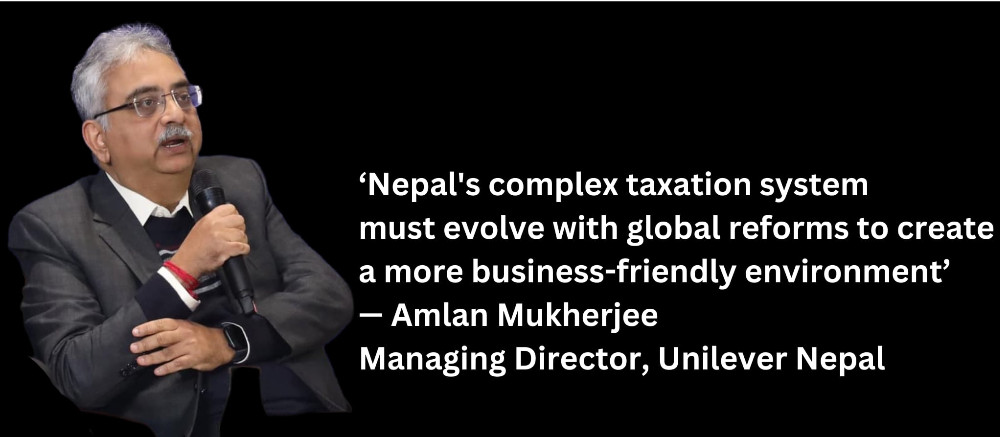
There are, of course, challenges. No country or market is without issues. One of the biggest challenges in Nepal is taxation. The country must keep pace with the progressive tax reforms happening worldwide. Tariffs and taxation policies need to evolve to create a more business-friendly environment.
Another key issue from an multinational companies perspective is royalty payments. When multinational companies operate in a country, they pay royalties to their parent companies in return for technology, brand equity, product quality, and global expertise. This is a standard practice worldwide and must be recognized as an operational expense in Nepal as well, rather than being treated as profit.
Over the last five years, particularly post-COVID, our factory has achieved remarkable efficiency levels, with our workforce performing at global standards. While some may speak of the difficulties of operating in Nepal, I want to highlight the advantages. Our dedicated workforce and supportive authorities have made this success possible. If we can achieve this, so can others—Nepal is a viable and profitable investment destination.
Regarding Unilever’s plans for expanding Research and Development (RND) and manufacturing in Nepal, I want to set the context by explaining our company’s approach. Unilever operates with a "middle-class mentality," meaning every rupee spent is scrutinized for efficiency and effectiveness.
In Nepal, our primary focus is quality control rather than RND. This is because just 300 kilometers away, across the border, extensive RND is already being conducted in India for the same consumer base. Investing in a separate RND facility in Nepal would only add to product costs unnecessarily. Instead, we leverage the advancements made in India and other South Asian markets while maintaining Unilever's stringent quality standards.
To ensure quality, every batch produced in our Nepal factory undergoes rigorous real-time testing. We have a dedicated quality control center where each batch is assessed against global standards before being approved for packaging. If a product fails the quality test, it is removed from the consumer supply chain. This meticulous approach ensures that Nepali consumers receive products of the highest quality.
Technology plays a crucial role in our operations. Our manufacturing facility in Nepal is among the most modern in the country. In the last three years, we have invested nearly 7 million pounds to modernize our plant. Additionally, we employ advanced technology in our sales and distribution processes. We serve 55,000 retail outlets across Nepal, reaching even the most remote hilly regions where government services may not always be present. An impressive 95 percent of these outlets are GPS-tagged, allowing us to track and optimize our supply chain with precision.
We also use artificial intelligence to predict demand rather than just respond to it. Our AI models analyze historical sales data and suggest optimal stock levels to shopkeepers. This predictive approach aligns with cutting-edge global retail technology and has been successfully implemented in Nepal.
Digitalization is another key focus. Today, 60percent of our marketing budget is allocated to digital platforms, with only 40 percent spent on traditional media. This reflects the evolving consumer behavior in Nepal, where 77 percent of consumers have internet access. We continuously evaluate whether even the remaining 40percent spent on traditional media is necessary, as digital consumption continues to rise.
In conclusion, businesses entering Nepal should approach the market with dedication, efficiency, and adaptability, leveraging global best practices while embracing local opportunities for success
(An edited excerpt of the views expressed by Unilever's Managing Director Amlan Mukherjee at the 'Nepal-UK Business Forum 2025)


.png)