Kathmandu – A new study on the 2024 glacial lake outburst flood (GLOF) in the Everest region finds that a complex chain of geological and geomorphological factors amplified the destruction in Thame, a high-altitude village in Solukhumbu, Nepal. The flood occurred on August 16, 2024.
The report, Thame Valley Glacial Lake Outburst Flood – Causes, Impacts, and Future Risks, was prepared by risk experts at the International Centre for Integrated Mountain Development (ICIMOD): Sudan Bikash Maharjan, Tenzing Chogyal Sherpa, and Arun Bhakta Shrestha.
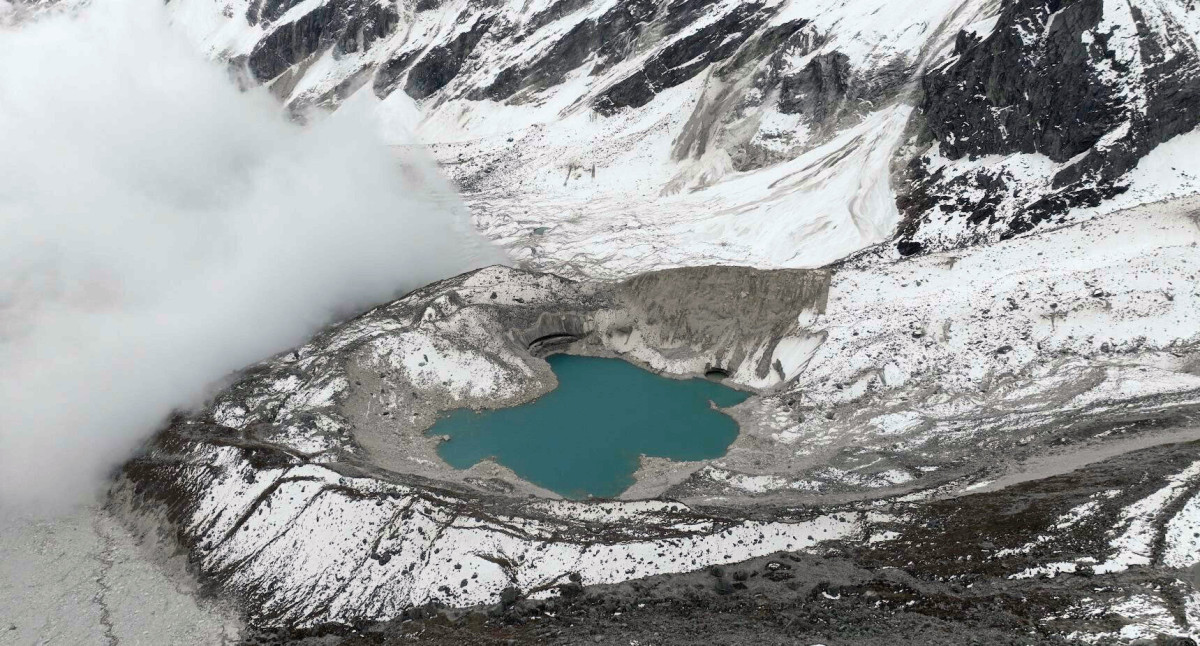
According to the study, a rock avalanche triggered a powerful displacement wave when it struck a glacial lake at 4,900 metres, causing the lake to breach and release 156,000 cubic metres of water. The outflow then dropped 120 metres and hit a second lake, whose moraine dam also breached, releasing an additional 303,000 cubic metres of water. The two events combined to form a hyper-concentrated slurry flow that carried debris and large boulders up to 80 km downstream.
A natural narrowing of the river channel and the sudden release of a temporarily ponded floodwater further intensified the flood’s erosive power. The flood caused severe destruction in Thame, sweeping away homes, a school, a health post, and a bridge, and damaging a hydropower plant. No casualties were reported, largely because the event occurred during daylight and the flooding unfolded in phases.
Nepal has recorded more than 90 GLOFs since the 1920s. The Everest region alone has experienced five major events in less than 50 years, including the 1985 Dig Tsho GLOF that destroyed a nearby hydropower plant.
GLOFs are among the most destructive mountain hazards, capable of releasing millions of cubic metres of water and debris within hours. The accelerating impacts of climate change are increasing these risks. The Hindu Kush Himalaya (HKH) region, warming at an average rate of 0.28°C per decade, has lost 65% more glacier mass in recent decades compared to earlier periods. There are now over 25,000 glacial lakes across the HKH, spanning the Amu Darya, Indus, Ganges, Brahmaputra, and Irrawaddy basins.
Sudan Bikash Maharjan, Remote Sensing Analyst at ICIMOD, said, “The Hindu Kush Himalayas has more than 25,000 glacial lakes. Thame shows us why we must focus more on understanding and mitigating risks from even smaller lakes. In this case, the landscape’s geological features magnified the impact of a climate-driven event that could have cost lives.”
Tenzing Chogyal Sherpa, Cryosphere Analyst at ICIMOD, added, “As climate extremes intensify, Thame is a stark reminder that mountain communities are already suffering the consequences. This calls for stronger investment in preparedness, better scientific understanding, and more support for vulnerable populations.”
The study recommends urgent local actions in Thame, including protecting tension cracks from water infiltration, reinforcing riverbanks, and developing a long-term flood risk management plan. It also urges wider monitoring of high-altitude glaciated areas across the HKH.
The findings were presented during an event marking International Day for Disaster Risk Reduction, co-hosted by Nepal’s National Disaster Risk Reduction and Management Authority (NDRRMA), Disaster Preparedness Network-Nepal (DPNet-Nepal), and ICIMOD. The research was supported by the Asian Development Bank, BGC Engineering, and the Solukhumbu District Administration, with drone footage from the Sagarmatha Pollution Control Committee.
Arun Bhakta Shrestha, Senior Advisor at ICIMOD, said, “The Thame case shows that glacial hazards are intensifying as the HKH warms nearly three times faster than the global average. The region urgently needs more hydrological monitoring and engineering measures to reduce future risks.”
The study reinforces the growing need to turn cryosphere and disaster science into actionable policy. Initiatives such as the Building Adaptation and Resilience in the Hindu Kush Himalayas (BARHKH) project are helping governments prioritize climate-resilient investments and reduce disaster risks.