
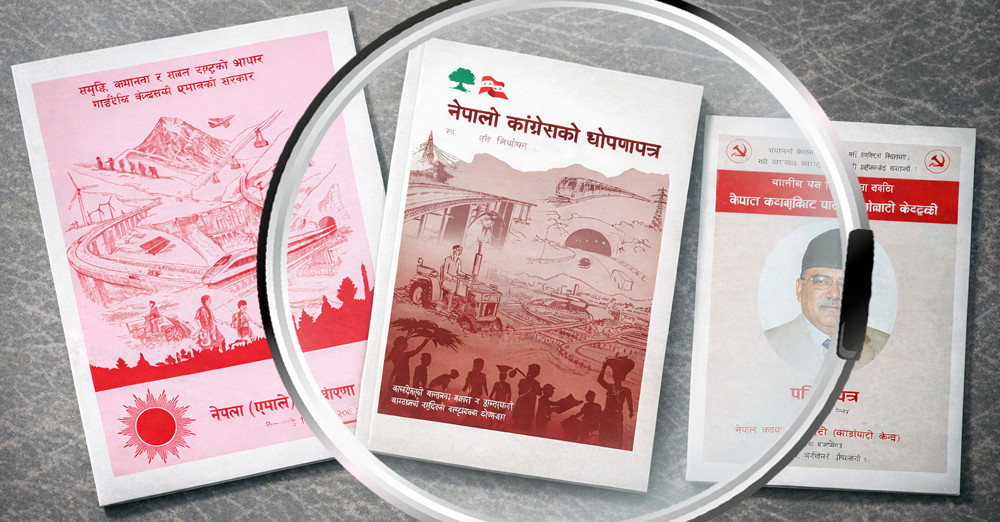
Kathmandu-The election atmosphere has intensified nationwide as political parties accelerate drafting their manifestos for the elections scheduled for March 5.
The evolving political landscape has increased pressure on parties to present manifestos that differ from previous ones. Public confidence has weakened because major promises made in earlier manifestos often remained unfulfilled.
Parties appear to have largely overlooked commitments made during the 2022 elections. Even those that joined the government failed to implement many of the pledges included in their manifestos.
During the last House of Representatives election, four major parties, CPN UML, Nepali Congress, CPN Maoist Centre, and Rastriya Swatantra Party, pledged economic reform, job creation, consumer protection, and expansion of production and exports. However, an assessment of post election governments and party leadership shows that many manifesto commitments remained unimplemented.
Although all four parties presented ambitious commitments on economic reform, production growth, and consumer protection, implementation remained weak. The absence of policy continuity, institutional reform, and trust building with the private sector has made it difficult to achieve manifesto goals. This gap between electoral promises and practical delivery has delayed expected economic improvement.
CPN UML: Ambitious targets, weak delivery
CPN UML pledged to increase Gross Domestic Product to Rs 100 trillion within five years, create employment through industrial development, and raise per capita income to 2,400 US dollars.
Under the slogan ‘No one goes hungry’, the party also pledged to protect consumer rights, control artificial shortages and black marketing, and promote domestic industries and agriculture through import substitution. Despite leading and participating in government, implementation remained limited.
GDP currently stands at around Rs 61 trillion and economic growth has stagnated at 4.6 per cent. Per capita income has not reached the projected level. Middlemen continue to dominate markets, leaving both farmers and consumers dissatisfied.
Efforts to protect selected industries through import substitution have shown limited success. Sectors such as cement, footwear, and pharmaceuticals remain weak. The private sector has not gained expected confidence.
Nepali Congress: Reform pledges, limited results
Nepali Congress pledged to create an investment friendly environment through omnibus economic reforms, generate 1.2 million jobs within ten years, and achieve annual economic growth of 7 per cent. It also pledged market transparency, online market monitoring, control of black marketing, and an 8 per cent cash subsidy to promote exports. Although it did not lead the government, it participated in it.
Significant progress in job creation remains absent. Economic growth remains nearly half the target. Market management continues to face challenges and online monitoring systems remain ineffective.
Exports have increased marginally, but structural reforms required to boost private sector confidence remain incomplete.
CPN Maoist Centre: Extensive programmes, weak implementation
CPN Maoist Centre pledged to establish two small industries in every ward, create an industrial village in each local level, implement the Prime Minister Nepali Production and Consumption Promotion Programme, and achieve self sufficiency in major crops including rice, maize, potatoes, and onions.
It also pledged to increase production through the Agriculture Decade initiative and collective farming. Despite leading the government twice and participating in several administrations, implementation remained limited.
Only four of the proposed 120 industrial villages are operational. Most industrial zones face shortages of electricity, raw materials, and market access. The policy of mandatory procurement of domestic products remains unimplemented. Middlemen continue to dominate supply chains. Agricultural programmes have begun, but expected improvement in production and market systems remains limited.
Rastriya Swatantra Party: Reform agenda, minimal delivery
As an emerging political force, Rastriya Swatantra Party pledged free business registration within 48 hours, a fifteenfold increase in foreign investment, and operation of subsidised outlets to protect consumers and control prices. The objective was to simplify business registration and improve the investment climate.
Government procedures still require weeks. Foreign investment has not increased as projected. Bureaucratic delays and policy uncertainty persist.
Subsidised outlets and price control measures remain limited. Rising inflation and limited availability of pesticide free products continue to concern consumers. Despite participating in government twice, the party has shown limited progress in implementing its commitments.
© 2026 All right reserved to biznessnews.com | Site By : Sobij
© 2026 All right reserved to biznessnews.com | Site By : Sobij