

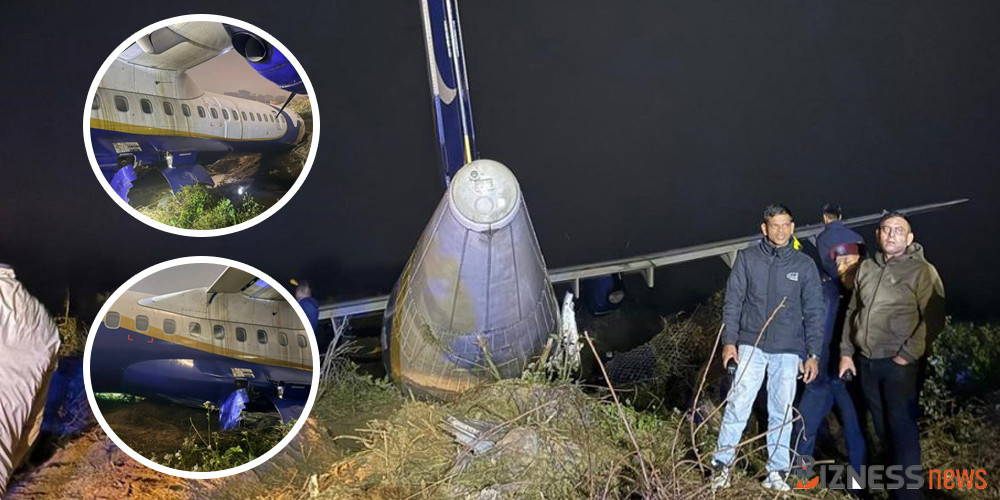
Kathmandu-The incident involving Buddha Air flight 901, call sign 9N-HF, which departed from Kathmandu to Bhadrapur and veered off the runway during landing on Friday night, is not merely a technical error.
It highlights a significant flaw in decision-making at the critical juncture of aviation safety.
Fortunately, all 51 passengers and four crew members were unharmed. However, seven passengers sustained injuries, and the aircraft departed the runway.
This incident is being regarded as a narrowly avoided accident.
Sources at the Civil Aviation Authority of Nepal indicate that the aircraft veered approximately two meters off the runway and landed in a muddy area.
A technical team has already arrived in Bhadrapur to assess the aircraft and facilitate its recovery.
The team comprises CAAN Acting Director General Dev Chandra Lal Karn. Buddha Air has expressed its commitment to cooperating fully with the investigation. However, the primary focus should not be on the aircraft’s condition.
Instead, we must delve into the reasons and circumstances surrounding the decision to land.
According to Bhadrapur airport air traffic control and CAAN sources, the aircraft was not in a suitable condition for landing. It was executing a high approach, which is considered an unstable approach. Air Traffic Controller (ATC) officials had anticipated that the aircraft would proceed with a missed approach.
Landing during an unstable approach is regarded as a high-risk situation under international aviation standards.
Given that ATC was aware of the approach’s unsuitability, why was the landing not halted? Why did the pilot not opt for a missed approach?
These questions warrant a thorough investigation.
A missed approach is not merely an option; it is a mandatory requirement under standard operating procedures for aviation safety. If speed, altitude, and angle fall below safe limits during the final phase of landing, a missed approach becomes obligatory.
During a missed approach, the pilot aborts the landing,ascends again, completes another circuit, and attempts a safe landing. In international practice, a missed approach is not perceived as a failure. It is regarded as a professional decision and a testament to a strong safety culture.
In the Bhadrapur case, the pilot’s attempt to land despite a high approach suggests factors such as landing commitment pressure, schedule pressure, operational pressure, or an error at the moment of decision.
Runway excursion, Coincidence or systemic warning
During a high approach, touchdown occurs farther down the runway than intended. This reduces the available runway length. As a result, braking distance becomes insufficient and the aircraft exits the runway. In aviation terms, this is called an overrun.
Preliminary analysis suggests this is exactly what happened in Bhadrapur.
This raises another serious question. Did the pilot attempt to salvage an unstable approach. If yes, why was such a risky decision taken, and how common is this practice becoming.
Under aviation rules, the final landing decision rests with the pilot. However, ATC’s role is not limited to observation. If risk is evident, ATC has the authority to stop a landing, issue warnings, or instruct a missed approach.
In the Bhadrapur incident, what communication took place until the final moment, why landing clearance remained active, or why it was not cancelled will be central to the investigation.
CAAN has said it will conduct a detailed investigation covering the pilot’s decision making process, ATC pilot communication records, compliance with standard operating procedures, weather and runway conditions, and organizational safety culture.
The investigation will determine whether this was an individual error or a sign of systemic risk in Nepal’s domestic aviation safety.
If a tendency of forcing unstable approaches into landings is quietly being accepted, the Bhadrapur incident could be a serious warning for the future.
© 2026 All right reserved to biznessnews.com | Site By : Sobij
© 2026 All right reserved to biznessnews.com | Site By : Sobij