

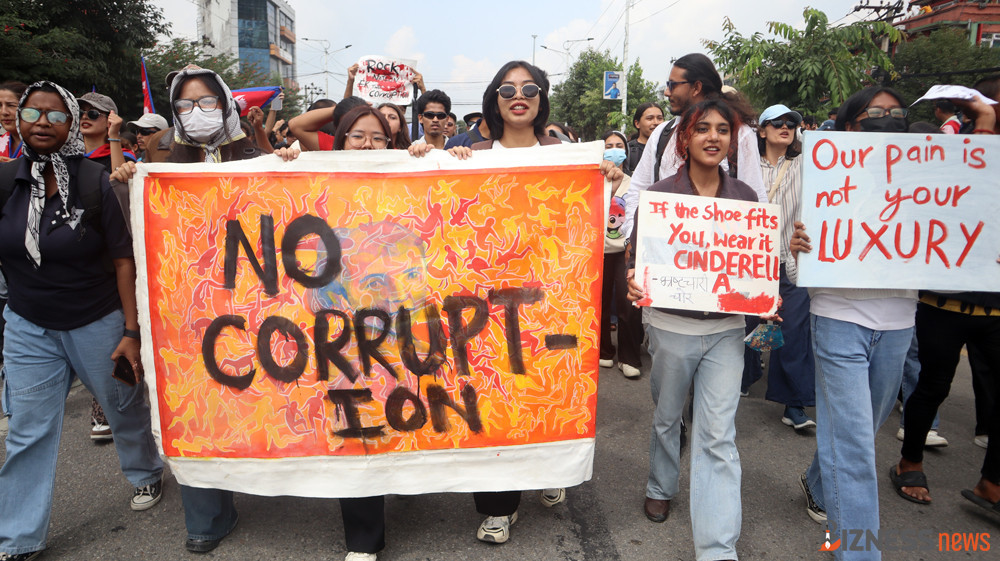
Kathmandu-A study concludes that the Gen Z movement on September 8 and 9 was not just a sudden dissatisfaction but a result of long-standing societal, economic, and governance issues.
The report, titled 'Understanding the Gen Z Movement: Root Causes, Realities and a Roadmap for a Stronger Nepal,' was prepared by the Central Department of Economics at Tribhuvan University and presented by the Ministry of Finance. It identifies rising youth unemployment, declining trust in political leadership, widespread corruption, economic inequality, and perceived restrictions on digital freedom as major drivers.
The study, based on a survey of 420 respondents from all seven provinces, interviews with key informants, group discussions, and secondary sources, emphasizes that the Gen Z movement reflects a broader global socio-political trend.
Youth-led movements have emerged in various countries, including the US, Asia, Africa, and Latin America. The study cites examples from Bangladesh and Indonesia, noting that Gen Z movements are often leaderless, decentralized, and organized through digital platforms. Young people mobilize outside traditional political structures and coordinate through social media.
Young activists use strategies like hashtag campaigns, digital networks, and meme politics to unite women, workers, students, and minority communities.
A World Economic Forum report describes protests in several countries in 2025 against inequality, corruption, and harsh economic policies as a Gen Z rebellion.
The study finds that participants in the movement had high educational backgrounds, with about 98 percent completing secondary school to postgraduate level. This suggests the movement was led by informed and analytically capable young people, not an uneducated crowd.
Participation was highest among those aged 16 to 25, declining with age. Students, unemployed youth, and self-employed young people were the most active participants.
Female participation was slightly higher than male participation. The movement had a multi-ethnic and inclusive character, with significant involvement from Indigenous groups, Khas Arya, and Madhesi communities.
Declining trust in political leadership is identified as a major social driver of the Gen Z movement.
It states that the luxurious lifestyles of political leaders and their families, limited access to state benefits among ordinary citizens, nepotism in appointments, and the exclusion of honest political workers from opportunities have created deep frustration among young people.
The report also highlights that the education system remains disconnected from employment. Many educated youth are unable to find jobs that match their qualifications. Marginalized communities also remain outside the mainstream of development.
Economic factors: unemployment and insecurity
On the economic front, rising unemployment is identified as the most significant factor behind the Gen Z movement.
Limited job opportunities in the country, the compulsion for hundreds of thousands of young people to migrate abroad for employment, low income levels, low wages, and economic instability have created deep frustration among youth.
The study also states that Nepal’s development model has not been focused on job creation. Limited opportunities for entrepreneurship and a weak investment environment in the private sector have led many young people to view their future as insecure within the country.
Governance crisis: dissatisfaction with the administrative system
The study states that governance related problems also played a major role in triggering the movement.
Complicated administrative procedures, delays in service delivery, lack of transparency, nepotism, weak institutional performance, and delays in the justice system have increased frustration with the state among young people.
The report also notes that the absence of a one window service system and bureaucratic hurdles in services such as taxation, land administration, and licensing have further increased public dissatisfaction.
Perceptions on corruption and digital freedom
Most respondents in the survey expressed the view that corruption is widespread in Nepal.
They believe that nepotism, favoritism, and political patronage dominate public services, education, employment, and appointments.
The study notes that young people view corruption not as an individual moral failure but as a systemic problem.
It also highlights that youth consider digital freedom a key pillar of democracy. However, policy ambiguity, surveillance, and censorship have left many young people dissatisfied.
Economic impact of the movement
The study estimates that the Gen Z movement caused physical damages worth about Rs 8.45 billion to government, private, and community structures.
According to the report, this had a negative impact on economic stability and the investment climate in the private sector. Investor confidence weakened, and entrepreneurial optimism declined.
Although the government introduced some policy measures after the movement, the study notes that they were not sufficient. Nepal Rastra Bank allowed loan rescheduling facilities for affected industries and businesses and provided temporary interest subsidies for loans taken to pay salaries.
Recommendations for reform
The study describes the Gen Z movement as a warning for long term reforms.
It recommends making political appointments more transparent, linking education with skills and employment, simplifying and digitizing administrative processes, and freeing anti corruption institutions from political interference.
The report also suggests fully digitizing public services, introducing a one window administrative system, and ensuring youth participation in the policy making process.
Recommendations to increase youth participation
The study recommends forming Youth Policy Councils at federal, provincial, and local levels.
It also suggests making it mandatory to consult young people through digital platforms during the formulation of policies, laws, and budgets.
To promote youth entrepreneurship, the report recommends establishing a separate startup fund that provides concessional loans, risk sharing mechanisms, grants, and technical support.
According to the study’s conclusion, the digitally connected, educated, and aware Gen Z generation expects a democratic system that ensures transparency, opportunity, justice, and accountability. The failure to meet these expectations led to the frustration that ultimately erupted as the Gen Z movement.
© 2026 All right reserved to biznessnews.com | Site By : Sobij
© 2026 All right reserved to biznessnews.com | Site By : Sobij