
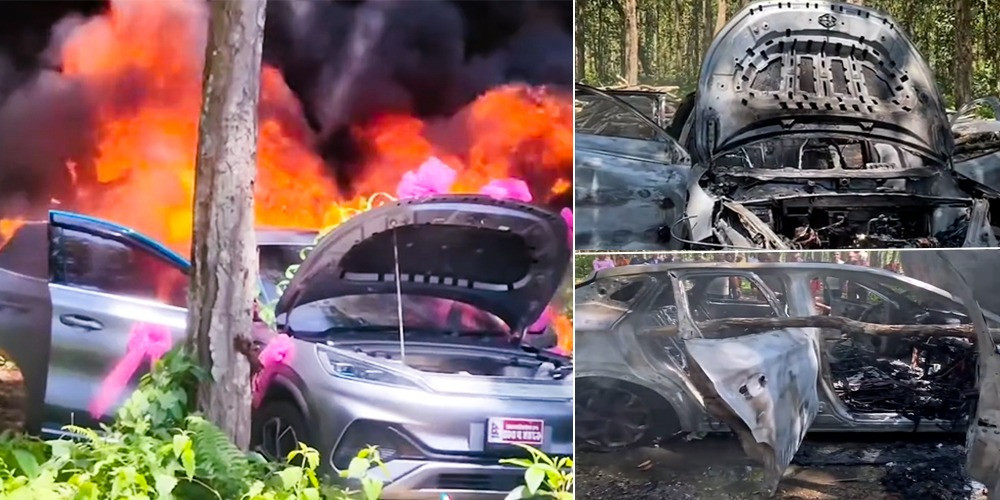
Kathmandu- A BYD Atto 3 electric vehicle has caught fire. Even the electric car of BYD, which claims to have developed one of the safest battery packs, experienced a fire incident. A video of the Atto 3 catching fire while driving in eastern Nepal on Thursday has spread widely on social media.
The fire in the BYD Atto 3 does not appear to have been caused by a short circuit. Since the vehicle caught fire while it was moving, the incident may have been triggered by a problem in the high-voltage battery itself. As the high-voltage battery burned, it appears the vehicle was completely destroyed by the fire.
BYD has long promoted its Blade Battery as one of the safest battery technologies and claimed that it has minimal risk of catching fire.
To reinforce that claim, Cimex Inc Pvt Ltd, the official distributor of BYD vehicles in Nepal, had even demonstrated a 'nail penetration test' a few years ago. However, the same Atto 3 using the battery that was claimed not to catch fire even under a nail penetration test, has now caught fire.
Internal combustion engine (ICE) vehicles with over a century of history still occasionally catch fire. The history of electric vehicles is much shorter.
Even lithium iron phosphate, LFP, and nickel manganese cobalt, NMC, battery powered EVs have only been in widespread use for around two decades. These batteries undergo various levels of testing before being used in vehicles. Despite that, fire risks can still exist in electric vehicles of any brand due to different technical reasons, and such incidents sometimes occur.
However, Cimex had attempted to convince Nepali consumers that the battery used in BYD electric cars would not catch fire by demonstrating the nail penetration test in Nepal. That claim was clearly misleading. It remains unclear why BYD Auto Industry allowed Cimex Inc to carry out such an unscientific demonstration.
Without any certified laboratory or accredited technical team, BYD promoted in Nepal that NMC batteries catch fire more quickly than LFP batteries. Yet BYD’s own batteries also use the same chemical elements commonly found in regular LFP batteries. BYD appeared to be creating the impression that its batteries used some entirely unique chemistry.
BYD’s Blade Battery is fundamentally based on LFP chemistry. The main difference lies in the battery packaging technology. If a fair comparison were to be made, BYD should have compared its Blade packaged LFP battery with other standard LFP batteries using the same chemistry.
Instead, BYD compared its Blade Battery to chemically different NMC batteries and portrayed the latter as inherently dangerous without proper scientific basis. That raised several questions at the time as well. Who verified the test? Was the tested battery actually an NMC battery? Was there even a real Blade Battery involved, or merely a casing? Such serious concerns had already been raised earlier.
Sahil Shrestha, CEO of Cimex Inc Pvt Ltd, had also made misleading claims regarding the replacement of BYD battery cells in Nepal. While trying to downplay cases where repair costs of slightly damaged BYD vehicles reached nearly the value of the vehicle itself, CEO Shrestha had claimed that Blade Battery cells could be replaced in Nepal, even though that was practically impossible.
He argued that BYD batteries are cell based rather than module based, and that only the damaged cells could be replaced. However, although BYD’s Blade Battery is indeed cell based, the company has not authorized cell replacement procedures in any country outside China. BYD has not issued any official cell replacement procedures for markets outside China.
Furthermore, once an IP68 rated battery pack is opened, laser welding is required for resealing, and such facilities neither existed nor currently exist in Nepal. Beyond claims about fire safety, BYD and its representatives also misled consumers by suggesting that battery cell replacement was feasible in Nepal when it was not.
Engineers had concluded that such promotional stunts conducted without independent technical verification or regulatory oversight raised questions about the intent of a company like BYD.
Biznessnews had spoken with six mechanical, electrical, and electronics engineers regarding BYD’s nail penetration demonstration. They described it as a 'so called' nail penetration test and said that in foreign countries, such demonstrations require extensive regulatory approvals and technical protocols. According to them, what BYD conducted in Nepal was merely a publicity stunt.
The way the BYD vehicle caught fire on Thursday, May 8, has now mocked Cimex’s nail penetration claims. This is possibly the first incident in Nepal where a BYD vehicle has been completely destroyed by fire. Regardless of battery type or fuel type, any vehicle can catch fire. Vehicle sellers should not mislead consumers by using demonstrations like nail penetration tests to claim that a vehicle will never catch fire.
The burned BYD Atto 3 carried registration number Bagmati Province 01 030 Cha 4483. The car entered Nepal through the Rasuwagadhi customs checkpoint on May 22, 2024. In the same year, it was first registered under the name of Omega Motocorp Pvt Ltd in October. The Atto 3, bearing Vehicle Identification Number VIN number LGXCE4CB3R2055159, was Boulder Grey in color and was reportedly sold at a price of Rs 5.5 million including taxes.
Omega Motocorp is a dealer of BYD vehicles. The company later sold the same Atto 3 to A Corn Wear, based in Damak, Jhapa, on June 29, 2025.
Why BYD is targeting NMC battery?
© 2026 All right reserved to biznessnews.com | Site By : Sobij
© 2026 All right reserved to biznessnews.com | Site By : Sobij