
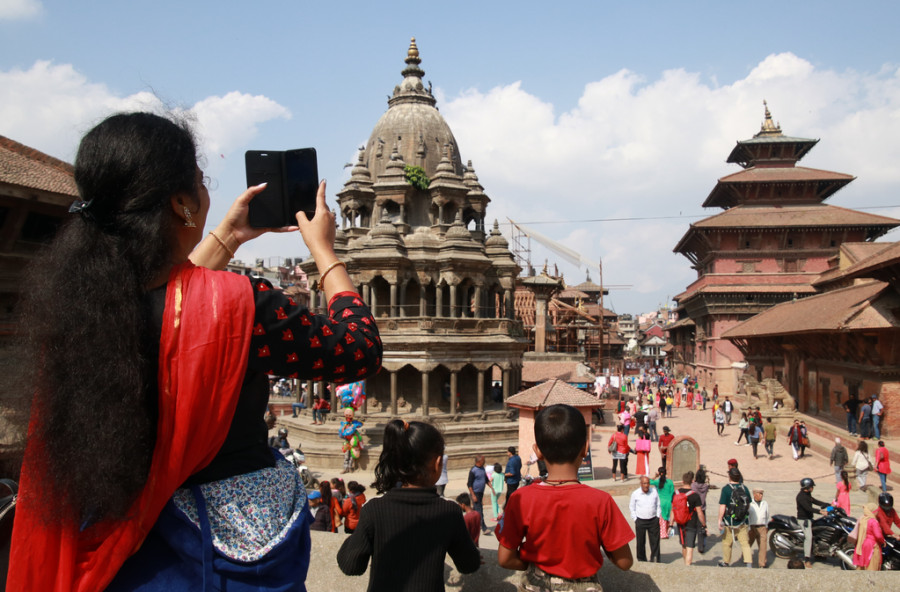
Kathmandu-Payment facilitation measures in Nepal and Indian Prime Minister Narendra Modi's call for Indian citizens to reduce spending in US dollars have contributed to a rise in the number of Indian tourists visiting Nepal.
In recent months, Indian tourists have increasingly travelled beyond Kathmandu to other destinations across the country. Pokhara, one of Nepal's major tourist hubs, has seen a particularly large influx of Indian visitors. Their growing presence has boosted business for hotels and restaurants.
Industry stakeholders say the increase has been driven by recent policy reforms that have made payments more convenient, along with improvements in physical infrastructure. While many Indians previously visited Nepal primarily for religious pilgrimages or family purposes, an increasing number are now travelling for leisure.
Tourism entrepreneurs also believe Nepal has gained greater visibility in India following the youth uprising in Bhadra and the rise of Balendra Shah, popularly known as Balen, which has sparked wider interest in the country.
One of the main reasons behind the increase in Indian tourists is the easing of payment systems. Indian visitors can now spend using their own currency while travelling in Nepal.
Previously, tourists had to carry cash, and restrictions on bringing Indian banknotes above INR 100 limited their spending. However, online payment systems have since been made more accessible.
Indian travellers can now make direct payments from their digital wallets by scanning QR codes at hotels, restaurants and shopping centres across Nepal. This convenience has particularly encouraged younger Indian travellers to visit the country.
Cash transactions are also expected to become easier. Since last Mangsir, the Reserve Bank of India has allowed Indian banknotes of denominations higher than INR 100 to be taken into Nepal.
Although Indian travellers are permitted to carry up to INR 25,000 into Nepal, the provision has yet to be effectively implemented. While India allows travellers to take higher denomination notes into Nepal, it has not introduced a mechanism for bringing them back, leaving many Nepali hotels reluctant to accept notes above INR 100.
Hotel entrepreneur Shashikant Agrawal said that although travellers are allowed to bring up to INR 25,000, Nepali banks have not been accepting those higher denomination notes, making it difficult for hotels to receive them.
He said that while online payment facilities have expanded, cash remains essential in many situations. Since travellers still cannot rely entirely on digital payments, carrying cash continues to be important for confidence and convenience.
Agrawal also said that the current INR 25,000 limit on higher denomination notes is too low and has not even been properly implemented.
However, this is expected to change.
Sanjay Malhotra has agreed with Bishwo Nath Poudel to introduce the necessary policy measures to facilitate the use of higher denomination Indian banknotes in Nepal.
During a meeting in Switzerland, the RBI Governor pledged to introduce policy reforms to further ease both digital and cash transactions between the two countries.
Governor Poudel said the Indian side had committed to raising the limit on higher denomination banknotes that Indian visitors can carry into Nepal and ensuring that Nepali banks can readily accept the cash collected by hotels.
According to Poudel, the RBI Governor has promised to issue a circular soon to remove the existing obstacles.
Once implemented, the new arrangement will make it easier for Indian tourists to use cash while travelling in Nepal, a move that hotel operators believe will further benefit the tourism industry.
© 2026 All right reserved to biznessnews.com | Site By : Sobij
© 2026 All right reserved to biznessnews.com | Site By : Sobij