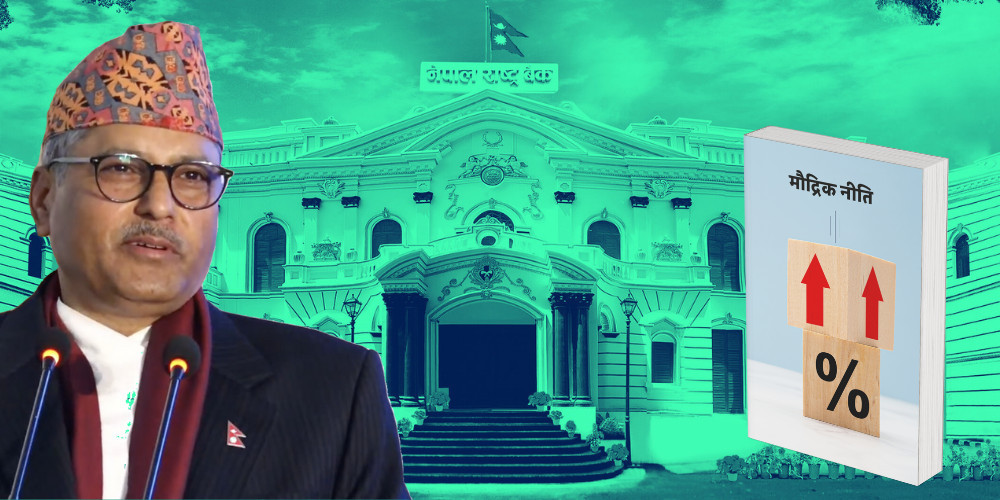
Kathmandu- The Nepal Rastra Bank has hinted at the possibility of not making any changes in its half-yearly review of monetary policy.
NRB Governor Maha Prasad Adhikari remains firm on maintaining existing regulatory policies and monetary policy instruments, with only two months left in his tenure. Given the current economic conditions, the central bank sees no pressing need for policy adjustments.
Recent microeconomic data from NRB indicate that the external sector is in a favorable position. While credit flow has shown only marginal improvement despite declining interest rates, foreign trade remains stagnant. The growth rate of remittances has slowed, but it has not significantly impacted foreign exchange reserves. As a result, central bank officials see little urgency for policy amendments.
In the first half of the fiscal year, Nepal’s current account recorded a surplus of Rs 148 billion, while the balance of payments stood at Rs 249 billion. Foreign exchange reserves reached USD 16.84 billion, sufficient to cover 17.3 months of goods imports and 14.4 months of total imports. Compared to the previous fiscal year’s end, foreign exchange reserves have grown by 10.3 percent.
Inflation and Interest Rate Dynamics Inflation has generally remained within the government’s target of 5.5 percent, except for Mangsir and Poush. The six-month average inflation rate stands at 4.97 percent, lower than the central bank’s policy rate of 5 percent. Given this scenario, adjustments to monetary policy instruments appear unlikely.
NRB has progressively reduced the policy rate over the past year—from 6 percent to 5.5 percent in the previous fiscal year’s mid-term review and further down to 5 percent in the current fiscal year’s monetary policy. This has contributed to a decline in interest rates across the banking sector. By the end of Poush, commercial banks’ average loan interest rate stood at 8.69 percent, down from 11.38 percent a year earlier. Development banks and finance companies also experienced similar declines.
The central bank has maintained the average interest rate on treasury bills at 2.81 percent, consistently absorbing excess liquidity from the banking system through short-term deposit collection instruments. Given the liquidity surplus, changes to the interest rate corridor or policy rate appear unnecessary.
Credit Expansion and Investment Climate NRB had targeted a 12.5 percent credit expansion for the fiscal year, yet only Rs 265 billion in loans (5.2 percent of the target) has been disbursed in the first six months. Despite ample liquidity and lower interest rates, private-sector investments have not gained momentum.
Dr. Gunakar Bhatta, Executive Director of NRB’s Economic Research Department, suggests that instead of expecting monetary policy alone to drive economic changes, the government and private sector should focus on optimizing resource utilization. He warns that the current favorable conditions—sufficient foreign reserves, low interest rates, and abundant liquidity—may not last indefinitely.
While NRB is unlikely to declare additional financial institutions problematic, it remains focused on stabilizing struggling development banks and finance companies through guided mergers. Governor Adhikari prefers facilitating acquisitions by commercial banks rather than declaring institutions problematic, which could trigger panic and deposit withdrawals.
Some board members have expressed dissatisfaction with NRB’s approach, arguing that timely interventions could have prevented financial distress in certain institutions. However, with Adhikari’s tenure nearing its end, he is reluctant to take measures that could signal economic instability or lead to criticism of the central bank and government.
Strategic Direction Rather than making direct policy changes, NRB is steering financial institutions through indirect regulatory guidance. A senior NRB official noted that while monetary policy cannot solve all economic challenges, well-directed interventions can encourage banks to align with broader economic objectives without disruptive policy shifts.
The central bank emphasizes that fiscal policy should play a greater role in stimulating the economy. With low lending rates, the private sector is expected to take the lead in revitalizing economic activities.
NRB is set to release the mid-term review of the monetary policy in the last week of Magh or the first week of Falgun, with minimal adjustments anticipated.