

Kathmandu- Stakeholders believe that implementing the ‘National Urban Policy, 2081,’ introduced by the government nearly two decades later, could open new doors to economic prosperity in Nepal.
The government released the policy last month, aligning with federal law to guide urban development. It delegates rights to the federal, provincial, and local levels, resolving jurisdictional ambiguities.
The policy aims to improve urban infrastructure indicators to 50 percent by 2036, targeting a 15 percent growth rate.
Stakeholders emphasize the need for laws based on the policy’s provisions. They highlight the necessity of an umbrella act to regulate real estate transactions and address the state of urban infrastructure development at all levels of government.
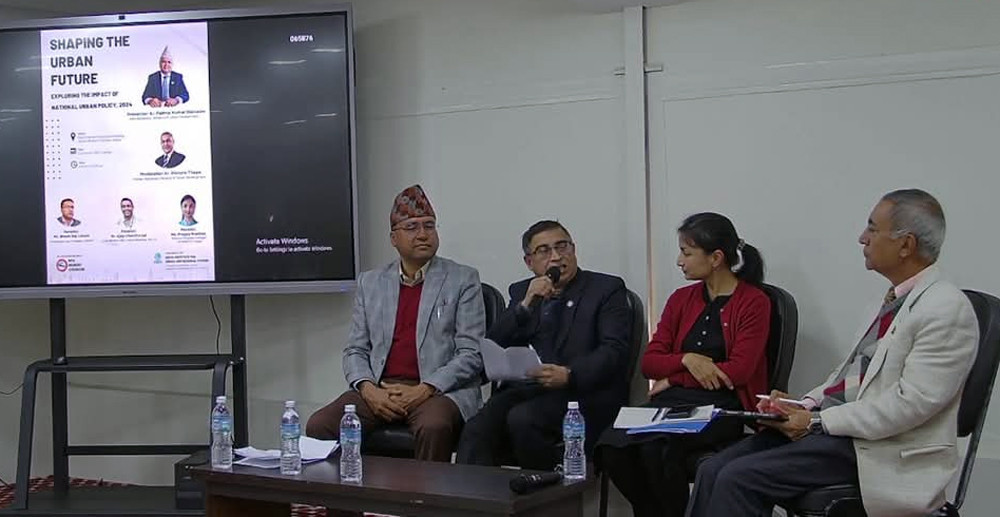
During a program organized by the Nepal Institute for Urban and Regional Studies (NIURS), stakeholders stressed the importance of effective implementation of the new policy.
Padma Kumar Mainali, joint secretary of the Ministry of Urban Development, presented a working paper, stating, 'It took more than a decade to revise the 2064 policy into this current version, which incorporates strategies and objectives aligned with federal principles.'
He noted plans to develop major cities, including provincial capitals, as key economic hubs. He added, “The urban system must be redefined, and smaller cities should be integrated into the network of larger ones.”
Urban development expert and former secretary Kishore Thapa remarked that new policies often prompt protests from the private sector. However, he called for dialogue to resolve issues. Highlighting studies showing an annual investment of Rs 2 trillion is needed in urban infrastructure, he said, 'This is impossible without private sector participation.'
NIURS Chairperson and former Vice Chairperson of the National Planning Commission, Jagadish Chandra Pokharel, emphasized that future infrastructure investments would focus on services. He believes the policy will help streamline urbanization.
Former President of the Nepal Land and Housing Developers Federation, Bheshraj Lohani, noted that while the 2064 policy proposed laws to encourage private-sector participation in land development, they were never enacted. He welcomed the continuity of these provisions in the current policy.
Lohani stressed the need for legislation, saying, 'Laws should introduce licensing systems for city planners and developers. Policies should facilitate the institutionalization of the private sector and promote mergers of small real estate companies into larger, reliable entities.'
With over 18,000 companies currently engaged in real estate transactions, Lohani advocated for consolidating smaller companies into trustworthy, large-scale entities.
He also noted that 98 percent of real estate companies operate informally. While he praised the inclusion of umbrella legislation in the policy, he criticized delays in implementing laws, which have stunted business growth.
The policy includes plans to allocate land pooling to the private sector, lift restrictions, and enable companies to issue IPOs for capital collection.
Lohani pointed out that the government’s announcement to build four cities in the Kathmandu Valley was made eight years ago. He suggested clustering and opening these cities to attract investments, adding that they could be completed within three years.
UN-Habitat’s National Program Manager, Pragya Pradhan, highlighted the policy’s inclusiveness. She emphasized strengthening local governments, saying, 'Development is often perceived solely as physical infrastructure, but it involves other critical aspects that need attention.'
Key Provisions and Features
The policy aims to expand resilient urban infrastructure, improve access to basic services, and ensure periodic maintenance and management of urban assets.
It promotes multi-sectoral planning, alternative financing mechanisms, and resource mobilization for organized urban development. Partnerships with private, cooperative, financial, institutional, foreign, and community sectors are encouraged.
New urban areas will include startup spaces, digital parks, public toilets, and green infrastructure. Plans also involve integrating urban services, managing solid waste scientifically, and developing open spaces.
Digital records of land and infrastructure will be maintained, and public, barren, and leased land will be reorganized for optimal use.
The policy outlines systematic waste management, progressive taxation on underutilized land and structures, and standards for urban services and infrastructure.
Plans include developing mega cities, smart cities, Himalayan cities, food-green cities, and urban economic corridors.
The policy also envisions strengthening transportation and communication links between urban and rural areas, developing urban villa.
© 2026 All right reserved to biznessnews.com | Site By : Sobij
© 2026 All right reserved to biznessnews.com | Site By : Sobij